
Best MongoDB GUI tools in 2026 (Free & paid options)
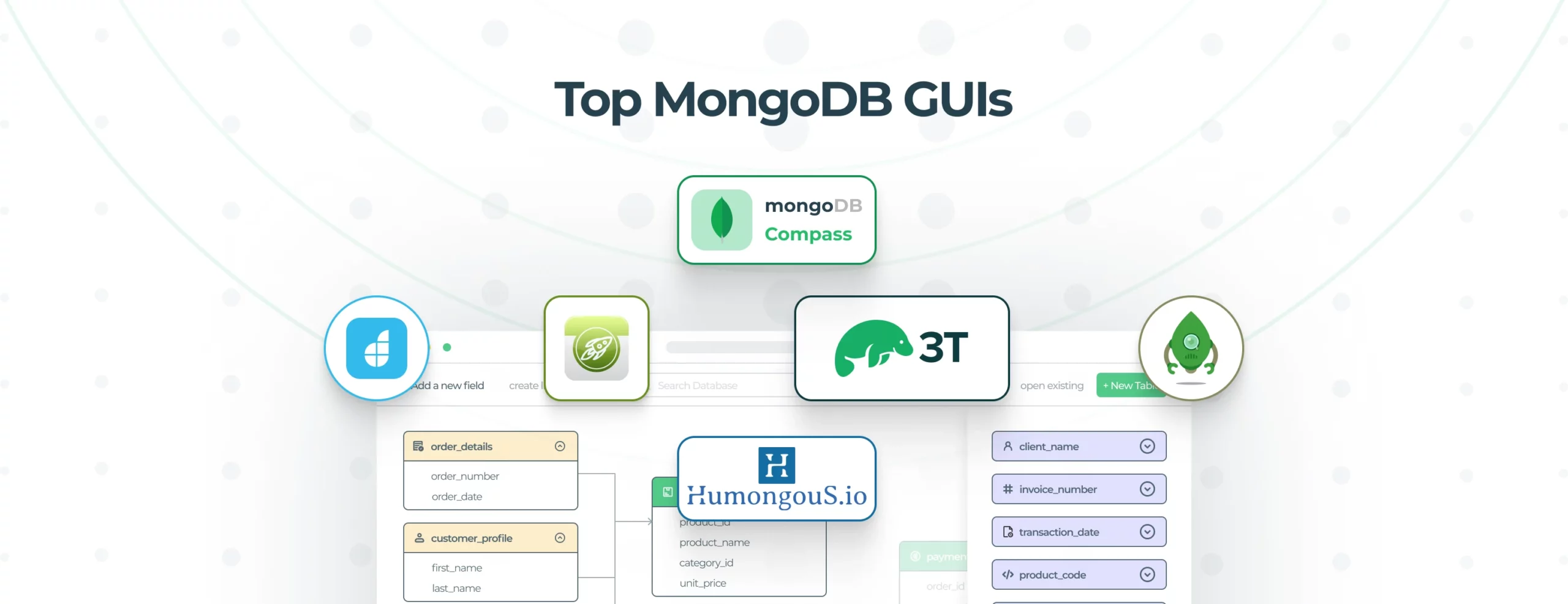
Managing MongoDB purely from the shell still works, but it no longer reflects how teams operate in 2026. Today, MongoDB GUIs fall into these broad categories:
- Database-native GUIs focused on schema exploration, performance analysis, and safe CRUD.
- Developer IDE-style clients that add SQL-like querying, scripting, and deep shell integrations.
- Application-layer GUIs that sit on top of MongoDB to power internal tools, admin panels, and operational workflows used daily by non-database specialists.
- The modern standard is AI-driven interactions
The right choice depends on whether you’re debugging data, writing complex queries, or building reusable interfaces for teams, not just on personal preference.
We’ve moved from ‘Low-Code’ to ‘Vibe Coding’, where you describe the interface or the data insight you need, and the tool generates the query, the logic, and the UI in seconds. This guide highlights the best MongoDB GUIs of 2026, from official diagnostic tools to AI-native app builders.
Keep these criteria in mind as you read on:
CRUD UI: Does the tool let you create, read, update, and delete documents without writing code?
Query flexibility: Can you switch between a visual query builder, raw shell, or SQL-style syntax?
Monitoring and alerts: Does it surface performance metrics and let you set up notifications?
Import/export: Can you quickly move data in or out via the GUI instead of custom scripts?
Platform support: Does it run where you need it: desktop, web, or both?
License and pricing: Is it free for individual use, open source, or paid for enterprise features?
Evaluating MongoDB GUI clients
While you can continue to query your Mongo data exclusively from the command line, GUIs have proved to be a helpful alternative by providing a better user interface and AI-assisted analysis.
MongoDB GUIs give users the ability to interact with the MongoDB database, visualise data, edit queries, and more without having to use the command line.

Build GUI on top of MongoDB in minutes
DronaHQ offers AI-powered frontend building capabilities with a drag and drop interface so you can build GUIs in fastest way possible
Get started for free →1. DronaHQ: Application-layer MongoDB GUI (visual + vibe coding)
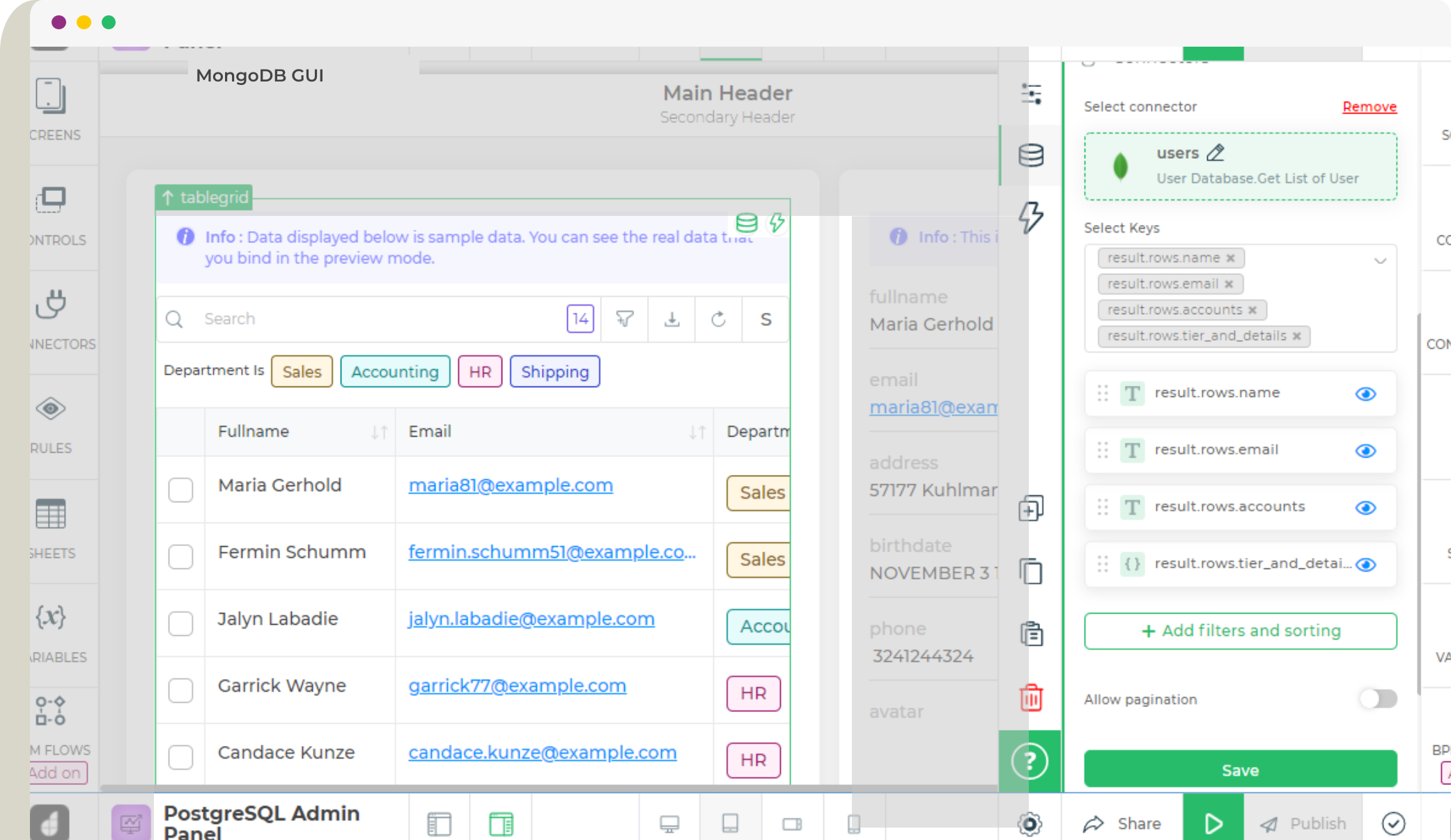
DronaHQ is not a traditional MongoDB client. Instead of helping you inspect MongoDB, it helps you build production-grade GUIs on top of MongoDB: admin panels, dashboards, workflows, internal tools, and AI agents that teams actually use. DronaHQ supports two complementary ways to build these interfaces:
- Visual low-code builder for drag-and-drop UI composition, and
- Vibe Coding platform: an AI-assisted app builder where developers describe intent in natural language and refine logic using real code when needed.
DronaHQ offers a native MongoDB connector that makes connecting to your clusters as easy as a few clicks. Instead of hand-coding data fetches, you type in a prompt to an AI chatbot or drag and drop ready table, form fields, charts, onto a canvas and bind them directly to your MongoDB collections: “Create a MongoDB-backed admin panel with filters, pagination, and role-based access” – and DronaHQ generates the UI, data bindings, and logic.
Unlike no-code tools, Vibe Coding does not hide complexity. You can inspect queries, add JavaScript logic, fine-tune API calls, and evolve the app incrementally. This makes it ideal for engineering teams that want speed without sacrificing control.
The platform is hyper-flexible: you can combine MongoDB data with REST or GraphQL APIs, SQL databases, or third-party services. Need conversational query interfaces? Connect to LLMs and embed chat-style search boxes alongside your dashboards, exactly what modern ops and support teams need.
Key features
- Visual designer with reusable components for tables, charts, forms, and date/time pickers
- Built-in MongoDB connector for Atlas and self-hosted clusters
- AI-powered query assistant that translates text prompts into MongoDB queries
- Drag-and-drop binding of data sources, including REST, GraphQL, SQL, and LLM endpoints
- Role-based access control at collection and field levels
- Workflow automation to trigger alerts, emails, or external API calls on data events
- Responsive layouts optimized for desktop and mobile
Pros
- Slash frontend development time by up to 70% with AI + visual drag-and-drop
- AI assistance accelerates complex query writing and schema exploration
- Hyper-flexible integration across multiple data sources and LLMs
- Fine-grained permissions keep data secure and compliant
- Cloud host (DronaHQ) or self-host
Cons
- Not intended to replace database-native tools for deep performance debugging or one-off shell experimentation
- Learning curve for teams new to visual development and vibe coding
Ideal for
Engineering and ops teams that need to deliver MongoDB-driven dashboards, admin panels, and data-powered workflows quickly while integrating other data sources and AI interfaces without maintaining separate UI codebases.
2. MongoDB Compass (free, official GUI)
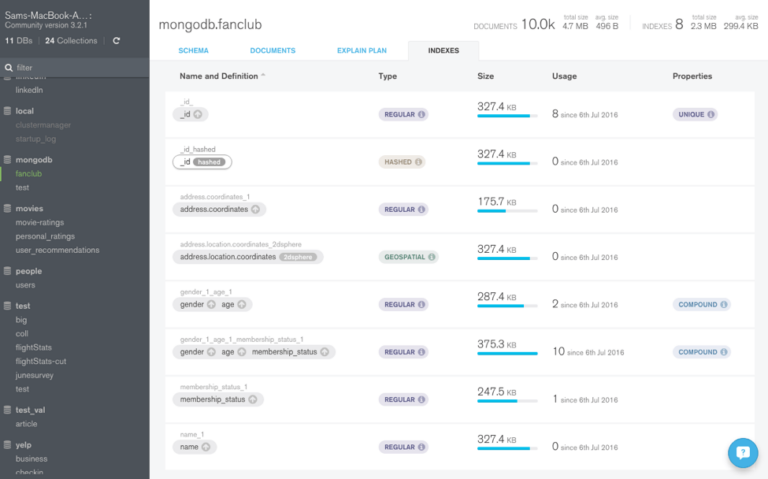
MongoDB Compass is the official GUI from the makers of MongoDB. It targets both developers and operations teams who need a reliable, visual way to explore data and monitor performance without the shell.
Compass connects to any MongoDB cluster or Atlas deployment. Once you point it at your database it introspects schemas and displays rich document structures. You can filter documents with a simple query builder or switch to raw JSON. It highlights slow queries and displays server status metrics like memory usage, CPU load, and index usage.
Compass excels at exploration and diagnostics, but it is not designed for building shared operational interfaces or workflows.
Key features
- Visual schema explorer with type inference and nested document drill down
- An interactive explain plan that highlights slow queries and suggests index improvements
- Built-in validation editor for authoring and testing JSON schema rules
- Real-time performance charts showing CPU, memory, connections and index usage
- Connection manager with support for SSH tunnels, x509, Kerberos and LDAP authentication
Pros
- Officially maintained and regularly updated alongside the MongoDB server
- Deep integration with Atlas, including performance advisor and charts canvas
- Fully free to use for all core features, with no hidden tiers
- Cross-platform desktop app for Windows, macOS and Linux
Cons
- Lacks advanced ad hoc data export and import compared to specialized tools
- Not extensible via plugins for third-party integrations
- Limited to MongoDB-specific operations (no SQL or multi-database support)
Ideal for
Teams that host on MongoDB Atlas or self-managed clusters and want a zero-cost, officially supported gui for schema exploration, performance tuning and basic CRUD operations.
3. Robo 3T (formerly Robomongo)
Robo 3T is one of the most popular GUI for MongoDB users.
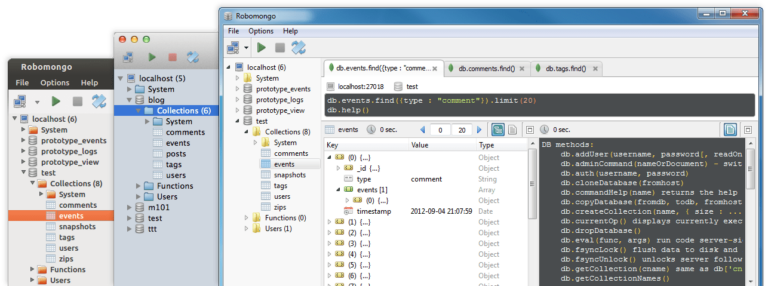
It is a lightweight, open-source tool that has cross-platform support. Robo 3T embeds the Mongo shell within its interface to provide both shell and GUI-based interaction. It is developed by the team behind Studio 3T, the IDE for MongoDB 3T Software.
Robo 3T MongoDB GUI Best Features:
- The embedded shell provides increased functionality as it works directly with MongoDB
- Asynchronous, non-blocking UI
- Useful runtime autocomplete feature that works through an internal virtual machine.
- Operations are executed asynchronously so users get a faster UI that does not block them from working by freezing up
- A large community of users, plenty of tutorials, guides, and forums to get support
Robo 3T is no longer under active feature development and primarily supports older MongoDB versions. It remains useful for lightweight local exploration but is increasingly being replaced by Compass or Studio 3T in modern setups.
4. Studio 3T (formerly MongoChef)
Studio 3T is a power-packed cross-platform IDE (integrated development environment) specially designed for MongoDB users. Owned by the 3T Software Labs, this MongoDB GUI tool lets you directly write SQL queries (similar to NoSQL Booster). It is a rather professional version of Robo 3T (also owned by 3T software labs).
Studio 3T is best suited for database specialists rather than teams building operational tooling for broader audiences.
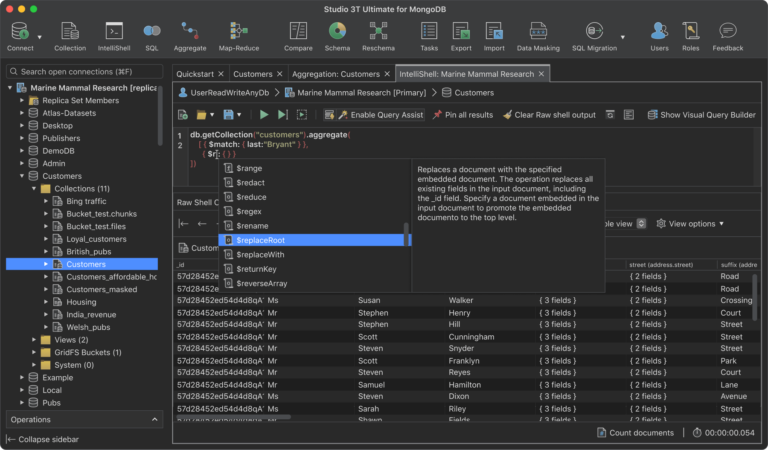
The high volume of query methods (including less “technical” ones) makes Studio 3T usable for anyone, no matter their familiarity with document-based databases, query languages, or command lines.
Studio 3T also sports IntelliShell, a built-in Mongo shell with autocomplete features that supports Javascript standard library functions, collection and field names, operators, and methods.
Studio 3T MongoDB GUI Best Features:
- Three ways to view data: Tree, Table, and JSON. The tree view displays data into expandable hierarchies, suitable for large and deeply nested documents
- Export queries in Node.js, Python, Java, C#, PHP and Ruby, and Mongo shell language using the Code generation tool
- Data importer works with SQL and Oracle
- Autocomplete queries with IntelliShell
- Drag and drop fields to visually build queries
- Use SQL, with INNER and OUTER joins, to query MongoDB
- Secure connections for single MongoDB instances and replica sets
Get hands-on experience on how to build a GUI for your MongoDB database.
Book a tutorial
5. NoSQLBooster
NoSQLBooster is a shell-centric MongoDB GUI with a built-in script debugger, SQL query, server monitoring, and true IntelliSense.
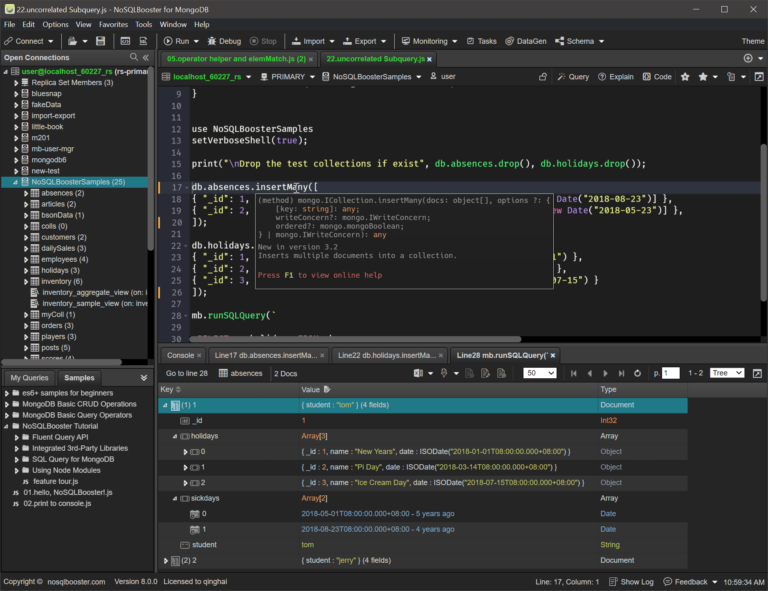
Similar to Studio 3T’s IntelliShell, NoSQL Booster’s IntelliSense language service appears as a tooltip while you type to suggest completions, methods, properties, variables, keywords, collection names, field names, and operators.
NoSQLBooster appeals most to developers who live in the shell and want IDE-level assistance rather than visual abstractions.
NoSQLBooster MongoDB GUI Best Features:
- SQL query builder lets you query your collections using SQL query language
- Import Node.js modules like lodash, bluebird, ShellJS, or moment.js within the shell using the Shell extensions
- A Log Parser allows you to filter and analyze your MongoDB logs
- Supports Mongoose-like fluent query builder API
- Rich performance monitoring and analysis tools
- Query code generator that allows users to translate MongoDB queries to various target languages: MongoDB Shell, JavaScript (Node.js), Java, C#, Python, PHP, Ruby, and Golang.
6. HumongouS.io
HumongouS.io is a powerful online MongoDB GUI. It sits between a database GUI and a hosted admin interface, offering quick dashboards but limited extensibility for complex workflows.
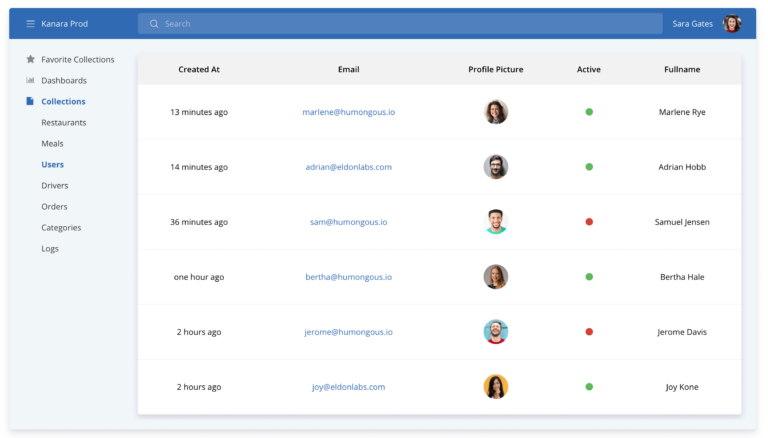
HumongouS.io MongoDB GUI Best Features:
- Smart filters to display collections as chips that enable quicker access
- Comes with a Charts and Dashboard creation tool to track critical metrics
- A widget system to customize how data is displayed. Widgets pull data from reference collections (clickable URLs, formatted numbers, image previews…)
- You can access your data through this GUI anywhere, even on mobile devices
- Smart Search feature lets you search your database with just keywords
- Display specialized data using layout widgets, an alternative to the default table view
7. NoSQL Manager
NoSQL Manager is a MongoDB GUI tool that merges the power of shell with an intuitive user interface. NoSQL Manager supports all the MongoDB and MongoDB Enterprise features, making it easy to navigate, view, and update documents. You can use this GUI to effectively manage collections, users, roles, and functions. It also saves time for database developers and administrators.
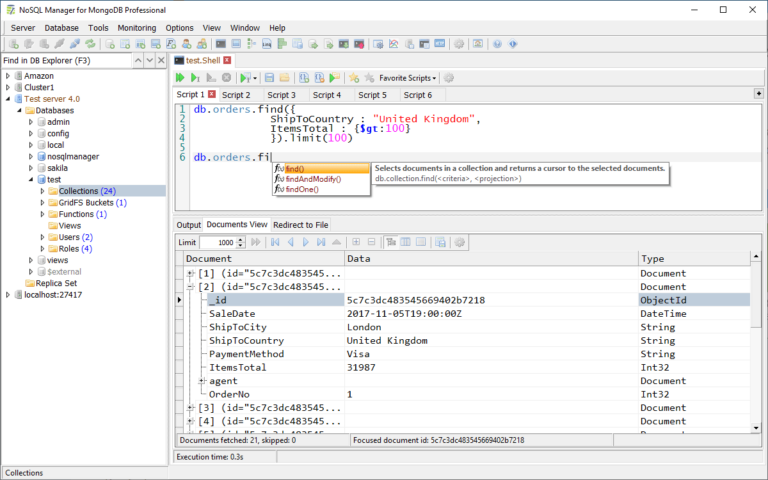
NoSQL Manager MongoDB GUI Best Features:
- It is a fully-featured GUI with autocomplete and syntax highlighting support
- Easy-to-use document viewer. Tree, table, and JSON view modes in the editor
- Support replica sets, shared clustered connections, and standalone hosts
- NoSQL manager offers SSH tunneling
- File Manager Tool to work with GridFS
- Import tables from MySQL and SQL Server databases
- Multiple Mongo host database connections
- Export documents to CSV, XML, XLSX, and JSON file formats’
Ideal for: While NoSQL Manager is feature-rich and supports a wide range of MongoDB configurations, it is more commonly seen in legacy or on-prem setups. In cloud-native environments, especially teams standardised on MongoDB Atlas, newer tools like Compass or IDE-style clients are more frequently adopted.
8. TablePlus
TablePlus is a modern, lightweight, and fast GUI client that works with multiple databases, including MongoDB. It is known for its speed and simplicity. TablePlus provides an intuitive interface and the essential tools for database management and querying, making it a popular choice for developers. It is highly customizable and works on multiple operating systems, including Windows, macOS, and Linux.
TablePlus MongoDB GUI Best Features:
- Cross-Platform Compatibility: Offers native applications for Linux, Windows, and macOS.
- Integrated Query Editor: Includes syntax highlighting and auto-completion for efficient query writing.
- Fast and Lightweight: Provides smooth and rapid data management.
- Multiple Database Support: Adaptable and compatible with various databases.
- Secure Connections: Features encryption and multi-factor authentication.
- Fast Data Import/Export: Supports multiple formats for quick and easy data import and export.
- Active Community and Regular Updates: Ensures continuous improvement through regular updates and an engaged community.
Note: MongoDB support is more limited compared to SQL databases and is best for basic browsing rather than advanced Mongo-specific operations.
9. Navicate for MongoDB
Navicat for MongoDB, a powerful database management tool, is designed for professionals working with MongoDB. Its user-friendly interface and advanced features make it ideal for managing large datasets and complex workflows.
Top Features of Navicat for MongoDB GUI:
- Visual Query Builder: Create and modify queries without needing in-depth knowledge of MongoDB syntax.
- Data Modeling Tools: Design database schemas visually and create ER diagrams.
- Robust Import/Export: Supports various formats for easy database integration.
- Cloud and Mobile Ready: Perfect for modern, collaborative teams requiring remote access.
- Secure Communications: Enables SSL and SSH tunneling for safe data transfer.
- Task Automation: Schedule tasks to reduce time spent on repetitive processes.
Extensive Support: Compatible with Sharded Clusters, Replica Sets, and MongoDB Atlas.
Heavier, enterprise-oriented, and often overkill unless you already use Navicat across multiple databases.
Best MongoDB GUI for your project
There is no single “best” MongoDB GUI, only the best fit for your workflow. If your goal is schema exploration and diagnostics, MongoDB Compass remains the safest default. If you need advanced querying, SQL-style access, or migrations, Studio 3T or NoSQLBooster are strong choices.
But if your challenge is building shared, secure, MongoDB-powered interfaces: admin panels, operational dashboards, approval flows, or AI-assisted internal tools, then database clients fall short.
In those cases, platforms like DronaHQ let engineering teams move beyond inspection and into application-layer tooling, without maintaining a separate frontend codebase.
Related Articles