
The enterprise guide to agentic AI
Over the past year, something has shifted in how companies talk about AI. This shift is realized in workshops, customer conversations, and even casual chats with teams building internal tools, there is a new level of curiosity. People are no longer asking whether AI can help with specific tasks. They are asking how AI can act on their behalf and carry work forward without constant supervision.
You’ve probably already interacted with some form of AI agent without even realizing it , think of e-commerce AI agents that place your orders details , provide shipping updates, or suggest products you might like. Or maybe you’ve chatted with a customer support bot that helps with FAQs, processes refunds, or tracks your order.
The global trend also reflects this shift.
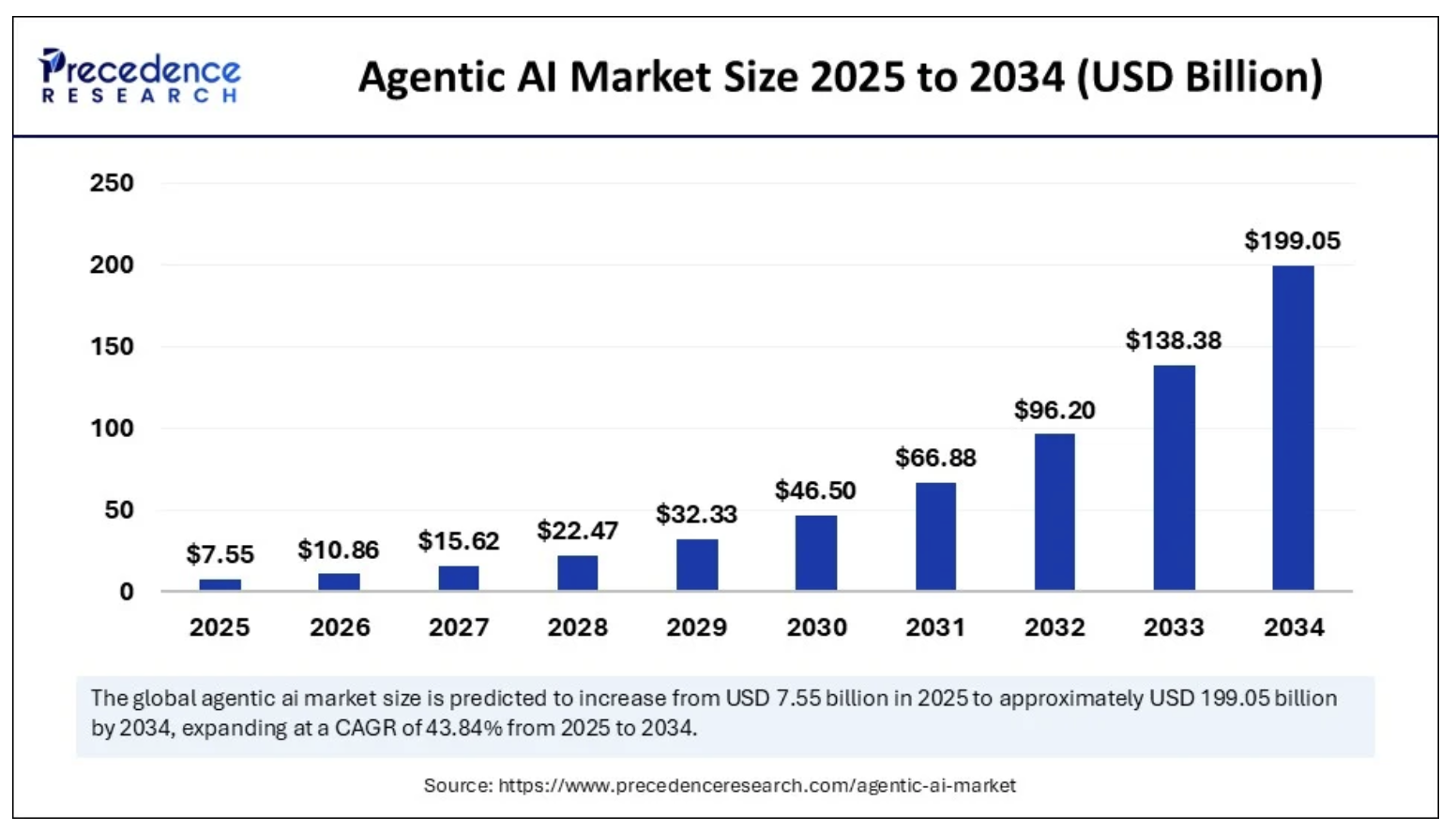
- Market projections show that the global Agentic AI market is expected to soar from $7.5 billion in 2025 to nearly $199 billion by 2034, growing at an incredible 44% CAGR.
- Reports show that about 62% of organizations are already experimenting with AI agents, and 23% have scaled them across the enterprise so far.
- Companies using Agentic AI are reporting faster execution in areas like operations, support, procurement, and knowledge tasks by 30–50%.
- Leading sectors like technology, media, telecom, and healthcare are showing the most activity.
All of this points to a simple reality. Enterprises are looking at AI not only as a writing or summarising assistant. They want AI that can participate in work.
So what is agentic AI
Agentic AI refers to systems that can work toward a goal, make decisions, and take action with minimal oversight. These systems observe what is happening, reason about the situation, take the next step, and learn from the outcome. The loop is continuous. Perceive, reason, act, learn.
This looks different from traditional generative AI. Most of the tools we use today reply when we ask. You give them a prompt, they give you a response. They’re reactive, they wait for you to ask, then predict the most likely and relevant answer, fantastic for writing, editing, summarizing data, and even designing, but it does have its limits.
Agentic AI, on the other hand, goes a step further. These agents are proactive problem-solvers. It can reason through multiple steps, dynamically handle complex or unstructured tasks, and explores different paths when something changes, and uses tools or systems to complete the task. It can combine language models, retrieval, policies, and business logic to get work done in a structured environment. Explore more about AI agents: a jargon-free guide on our blog.
A simple example from operations explains this well.
An agent monitoring an enterprise resource planning system notices a risk of stockout for a critical item. It checks approved vendors, prepares a substitute purchase order that fits the procurement policy, sends it to a manager for review, and updates the customer system with the revised timeline once confirmed.
This is not a chat response. It is work.
What makes AI truly agentic
AI Agents operate in a continuous loop of perceive → reason → act → learn. Before building, it’s key to define what makes AI truly agentic, systems that act with purpose, adapt, and learn.
Goal matters: Real agents pursue clear objectives, like “increase ROI by 25%” without needing constant direction. Vague ones lead to weak automation.
Adaptability matters: When data changes or systems fail, they find new paths forward.
Autonomy matters: They take initiative, executing tasks like querying data, running simulations, or executing tasks in software systems and making decisions on their own.
Learning matters: Over time, they learn from outcomes and refine their approach.
Where enterprise finds value
Companies are not adopting agentic ai because it sounds futuristic. They are exploring it because day to day operations have many repetitive, multi step processes. These processes involve data checks, handovers, decisions based on rules, and frequent back and forth across systems.
Agents fit naturally into these environments. They can monitor signals, take action when thresholds are crossed, follow policy, request approval when needed, and keep the organisation informed. The promise is not perfection. The promise is steadiness, speed, and fewer delays. But running an ai pilot is simple. Running the same system in production is a different.
Biggest issues show up not because of model performance, but because of system fragility and governance gaps.
Common failure modes include:
- Agents acting outside intended scope due to unclear boundaries.
- Hallucinations leading to incorrect actions or miscommunication.
- Data access violations or poor identity controls.
- Lack of rollback or incident response plans when something goes wrong.
In short, it’s not the intelligence that breaks, it’s the plumbing.
Understanding the spectrum of automation, agentic systems, and AI agents
Not every workflow needs a fully autonomous agent. It helps to know where your use case fits.
| Type | What It Does | Example | Limitation |
| Automation | Follows fixed rules and scripts. | RPA bots processing invoices. | No adaptability or reasoning. |
| Agentic Systems | Can reason through steps, plan actions, and adapt dynamically. | A support agent that triages and escalates tickets based on context. | Needs oversight, testing, and policy alignment. |
| AI Agents | Blend reasoning, memory, and tool use to achieve goals autonomously. | A procurement agent that identifies needs, compares vendors, and initiates orders. | Requires deep governance and guardrails to prevent misuse. |
Guardrails and governance
Enterprises can’t just deploy an AI agent and “hope for the best.” They need safety, clarity, and control before they can trust an ai agent. Good systems address these areas: These include:
- Policy enforcement: defining what agents can and cannot do.
- Human-in-the-loop checkpoints: for sensitive or high-impact decisions.
- Observability: logging, monitoring, and traceability of actions.
- Identity and access control: strict authentication and authorization for data and tools.
- Incident response and rollback: so you can safely recover from errors.
Governance is not an add on. It is the foundation that lets AI participate in real processes.
Architecture that scales and stays safe
A robust agentic system is more than a model connected to a tool. It works as an ecosystem of components:
- identity and access control
- a policy store that defines rules
- a tool registry with approved functions
- a memory store for context and history
- a router that decides which step to take
- a planner that breaks tasks into actions
- an action executor connected to enterprise systems
- observability and logging
- audit and reporting
- human checkpoints wherever required
When these parts work together, the system becomes predictable, safe, and ready for scale.
Designing for failure and resilience
Even the strongest of agents may face unexpected issues. Strong systems accept this reality and prepare for it. Some of the common modes of failure and their mitigation:
| Failure Mode | Risk | Mitigation |
| Hallucination | False or misleading outputs. | Grounding, retrieval augmentation, human validation. |
| Unsafe Actions | Unintended or harmful commands. | Action whitelisting, sandbox execution, approval workflows. |
| Overload / Abuse | Excessive or repeated actions. | Rate limiting, quota management. |
| System Errors | Crashes, bad responses, loops. | Rollback mechanisms, incident playbooks. |
| Policy Violations | Compliance or data breaches. | Continuous monitoring, audit trails, escalation alerts. |
When these controls are thoughtfully integrated, enterprises can move from “experimental demos” to production-grade AI systems, safely, responsibly, and at scale.
How enterprises can approach investment in agentic AI
The best progress happens when companies start small and structured.
Pick a clear operational problem, define the boundaries, choose the right autonomy level, set guardrails, and test in detail. Then scale only when the system is stable.
This approach builds trust, delivers faster value, and avoids the pitfalls of deploying an agent without oversight.
Want to see how agents fit into real business operations? Schedule a demo call with our team.
Looking to dive deeper into RAG agents? Check out our detailed guide: “Are you using RAG agents yet? Read this before you decide”
Related Articles