
Voice AI agent use cases | Best practical applications
Teams are increasingly curious about AI voice agents, but most get stuck at the same point. They understand the concept, yet struggle to see where it delivers real value without becoming complex or risky. This guide exists to close that gap.
What is an AI voice agent?
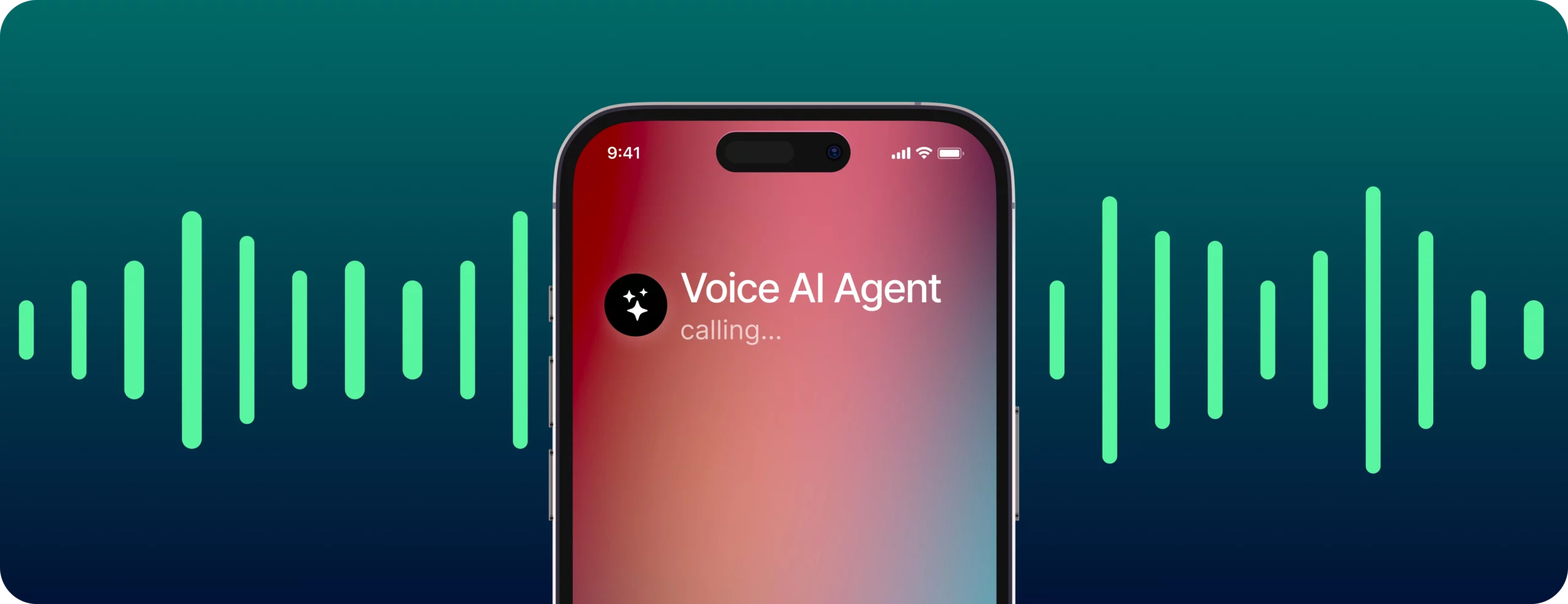
An AI voice agent is software that conducts real-time spoken conversations, understands user intent, and completes actions by connecting to business systems such as CRMs, scheduling tools, or payment platforms.
It can ask follow-up questions, remember earlier parts of the conversation, and perform tasks such as booking appointments, updating records, or triggering workflows.
Unlike traditional IVR systems that rely on fixed menus or scripts, AI voice agents handle open-ended conversations and complete real tasks without human intervention. As accuracy and reliability have improved, many teams now use AI voice agents in live production workflows rather than limited pilots.
How voice AI agents differ from traditional IVR, voice assistants, voice chatbots.
| Traditional IVR | Voice assistants | Voice chatbots | Voice AI agents | |
|---|---|---|---|---|
| Example | “Press 1 for billing” | “What’s the weather today?” | “Your ticket has been logged” | “I see your payment failed. Do you want to retry now?” |
| Interaction style | Menu driven | Command based | Scripted | Conversational |
| Understands free speech | No | Partial | Limited | Yes |
| Can complete tasks | No | Limited | Limited | Yes |
| Connected to business systems | No | No | Sometimes | Yes |
| Handles context | No | Low | Low | High |
| Best suited for | Call routing | Personal queries | FAQs | End to end workflows |
Where AI voice agents work best
AI voice agents work best when conversations are predictable, outcomes are structured, and actions can be completed automatically. The table below summarizes where most teams see value first.
| Use case category | Typical goal | Value generated |
|---|---|---|
| Customer support triage | Handle first contact and routing | Lower call load and faster resolution |
| Appointment management | Confirm, reschedule, cancel | Fewer no shows and manual calls |
| Payment reminders | Notify and guide next steps | Faster recovery cycles |
| Lead qualification | Ask qualifying questions | Faster response and cleaner pipelines |
| Service feedback | Collect post interaction input | Better data with low effort |
| Internal IT or HR helpdesk | Resolve common requests | Reduced ticket backlog |
How this guide evaluates voice agent use cases
To keep this practical, every use case below is evaluated using the same framework.
- Conversation predictability. How repeatable the conversation flow is.
- Actionability. Whether the agent can complete a real task.
- Volume. Whether enough calls exist to justify automation.
- Risk. What happens if the agent gets it wrong.
- Time to value. How quickly a team can see results.
1. Customer support and call triage voice agents
This is often the first place teams deploy an AI voice agent.
The agent answers inbound calls, understands the reason for contact, and either resolves the issue or routes it with context. Typical examples include order status checks, account queries, basic troubleshooting, and service outages.
Predictability is usually high because a large share of inbound calls fall into known categories. Actionability is strong when the agent can read from and write to ticketing or CRM systems. Risk is manageable when escalation rules are clear.
This use case reduces call volume handled by humans and improves handoffs when escalation is required. It is a good starting point for teams already tracking call reasons.
2. Appointment scheduling voice AI agent
Appointment related calls are highly structured and easy to automate.
An AI voice agent can confirm appointments, handle cancellations, suggest new slots, and update scheduling systems in real time. This is common in healthcare, field services, education, and personal services.
Conversations follow a narrow path. Actions are well defined. Volume is steady. The value comes from reducing no shows and freeing staff from repetitive outbound calls.
Voice works particularly well here because many customers respond faster to calls than messages or emails.
3. Payment reminders and early collections
Payment-related calls are another strong fit when designed carefully.
A voice AI agent can notify customers about upcoming or failed payments, explain the context, and guide them through next steps. These steps might include retrying a payment or selecting a different date.
The business value shows up in faster recovery cycles and fewer manual follow-ups. Risk exists around tone and compliance, so this use case benefits from strict scripts, opt outs, and escalation paths.
This category works best for reminders and early stage follow ups rather than complex disputes.
4. Lead qualification and sales follow-ups agents
Sales teams often struggle with response time and consistency.
An AI voice agent can call inbound leads, ask qualifying questions, and route them to the right representative or book a meeting. The agent can log responses directly into the CRM.
Predictability is moderate but improves with well defined qualification criteria. The value comes from faster first contact and better use of human sales time.
This use case is most effective for high volume inbound leads rather than complex enterprise sales.
5. Service feedback and surveys agents
Voice based feedback collection often outperforms text surveys.
After a delivery, appointment, or support interaction, a voice agent can call customers and ask structured questions. It can adapt based on responses and log feedback automatically.
The conversation scope is narrow, which reduces risk. The value lies in higher response rates and richer feedback without manual effort.
Teams that already collect NPS or CSAT through email often use voice as a complementary channel.
6. Internal IT and HR helpdesks
AI voice agents are increasingly used inside organizations.
Employees can call to reset passwords, check leave balances, understand policies, or log issues. The agent connects to internal systems and knowledge bases to resolve common requests.
This use case reduces ticket backlog and improves response time. Risk is low when access is scoped correctly and sensitive actions require verification.
Internal adoption is often easier because expectations are clearer and feedback loops are shorter.
7. Logistics and operations coordination
Operations teams rely heavily on phone calls.
Voice agents can coordinate with drivers, vendors, or partners to confirm delivery slots, capture status updates, or report delays. These updates can be logged directly into operations systems.
This use case is valuable in environments where apps or dashboards are not consistently used. Conversations are predictable and outcomes are structured.
It works best when the agent is limited to status capture and confirmation rather than negotiation.
Common misconceptions and mistakes
Many teams assume voice ai agents are a replacement for human agents. In practice, they work best as the first layer of interaction.
Another mistake is starting with broad, open ended conversations. Voice agents perform better when the scope is narrow and outcomes are clear.
Some teams also underestimate the importance of system integration. Without the ability to take action, the agent becomes a talking interface with limited value.
How to choose the right use case for your business
- Start by mapping your call volume by reason. Look for categories that repeat daily and have clear outcomes.
- Next, ask whether the agent can complete an action rather than just respond. If the answer is no, the value will be limited.
- Consider risk and user tolerance. Start with low stakes conversations before moving to sensitive ones.
- Finally, estimate time to value. Use cases like appointment management or support triage often show results within weeks.
For implementation guidance, many teams start with internal pilots before expanding externally.
DronaHQ Voice AI agent builder is designed precisely for these practical rollouts. Teams can connect voice agents to existing APIs, CRMs, ticketing tools, or internal workflows without rebuilding systems from scratch. This makes it easier to pilot one use case, measure results, and expand gradually.
If you want to experience how this works in practice, you can connect with our team and get a short preview call handled by an AI voice agent built on DronaHQ.
Related Articles