
AI Agents for Ops teams: 7 Practical use cases
Operations teams manage growing system complexity, tighter service-level expectations, and workflows that span multiple tools. Orders, incidents, approvals, inventory movements, and vendor interactions often require coordination across ERP, ITSM, CRM, monitoring, and internal platforms. As scale increases, manual triage and cross-tool updates consume a significant share of operational bandwidth.
AI agents for ops teams introduce a goal-driven layer into this environment. These agents monitor signals across systems, interpret context, and execute bounded actions through APIs and workflows. Teams exploring production-ready deployments often evaluate structured platforms such as AI agents by DronaHQ to ensure governance, auditability, and integration depth.
What are AI agents for ops teams?
AI agents for operations are software agents that combine large language models, policies, and system integrations to pursue defined operational goals. They continuously observe data and events, reason about context, and act within guardrails.
Typical capabilities include:
- Monitoring queues, alerts, and transactions across operational systems
- Classifying issues using context and historical patterns
- Executing updates through APIs and workflow engines
- Escalating cases with structured summaries and recommendations
Teams that want to build AI agents for operations typically begin with clearly scoped workflows and defined action boundaries.
Why AI agents are gaining traction in operations
Operational environments are increasingly event-driven and distributed. A single issue may involve multiple systems, teams, and decision points. While rule-based automation addresses predictable patterns, many workflows involve variability in format, timing, and resolution paths.
AI agents for business operations extend automation into these variable zones by combining reasoning with structured tool access. For a broader landscape of real deployments, review these curated AI agent use cases.
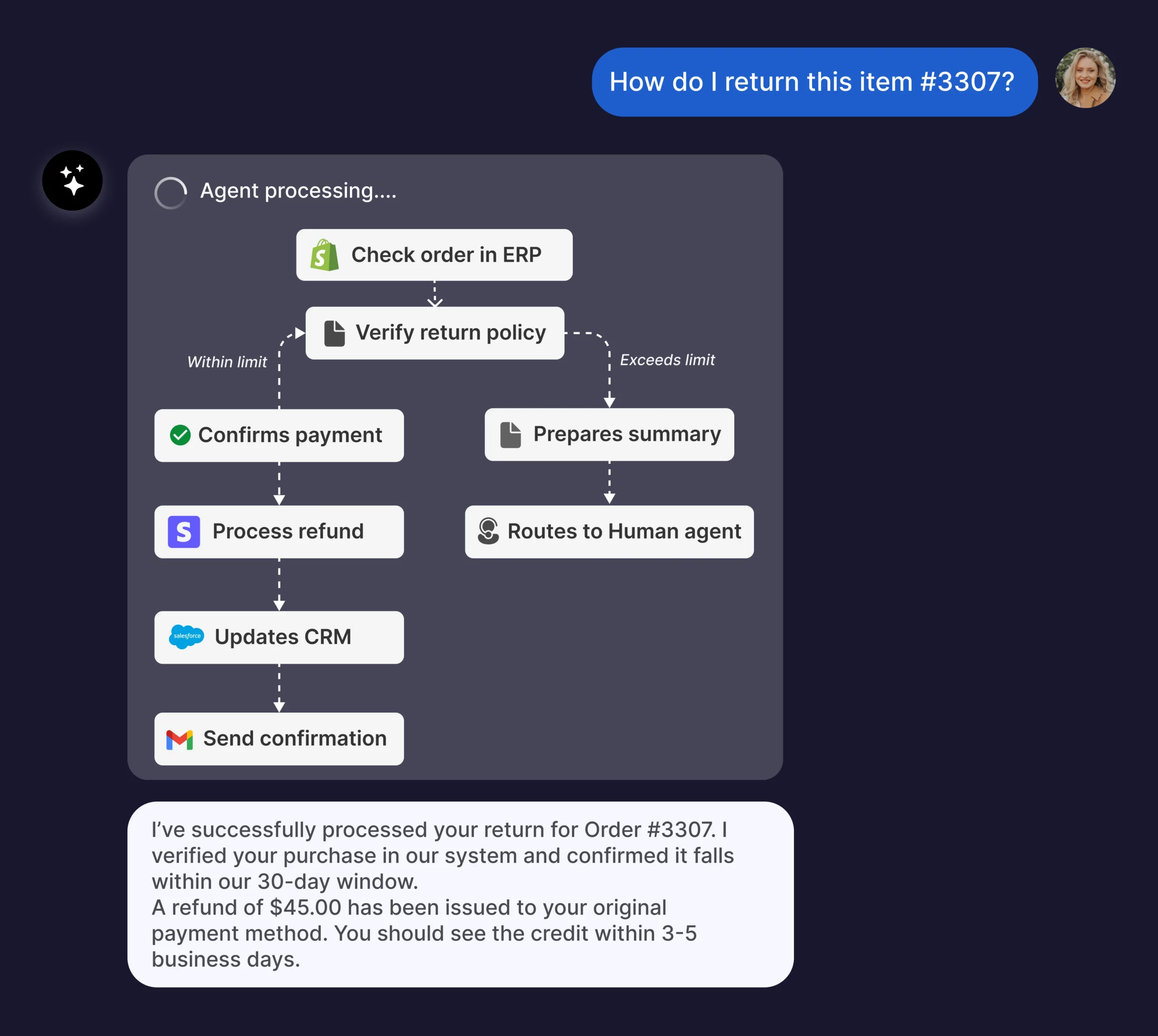
7 practical AI agent use cases for ops teams
1. Exception triage and queue management
An exception triage agent monitors operational queues for aging items, SLA risks, or abnormal states. It classifies cases, resolves low-risk issues, and escalates complex ones with enriched context. This reduces manual scanning and improves response time.
Example: An order ops team processes 4,000 orders daily in an ERP. Around 6% go on hold due to tax ID or credit limits. The agent checks CRM and billing, fills missing tax IDs when available, releases eligible orders, and routes credit-limit cases to the right approver with a structured summary.
Tools integrated with
ERP, CRM, billing system, approval workflow, Slack or Teams.
2. Supply chain and inventory monitoring
AI agents for supply chain operations track shipment status, inventory thresholds, and supplier performance. They detect anomalies, suggest replenishment actions, and trigger corrective workflows through integrated systems.
Example: A planner manages five warehouses in a WMS. A SKU dips below safety stock while an inbound shipment is delayed. The agent forecasts stockout risk using sales velocity, drafts a replenishment request in procurement, and alerts the planner with recommended quantities and expected timelines.
Tools integrated with
WMS, shipment tracking API, procurement system, supplier portal, collaboration tool.
3. IT operations and incident co-pilot
An IT ops agent correlates alerts, summarizes logs, highlights recent changes, and assists with structured timelines and remediation suggestions during incidents.
Example: Checkout failures spike. The agent pulls logs from observability tools, checks recent deployments from CI/CD, links related ITSM tickets, and generates a structured timeline. It suggests a rollback playbook and prepares a change request for approval.
Tools integrated with
Observability platform, CI/CD pipeline, ITSM tool, knowledge base, Slack.
For orchestration patterns behind these flows, explore modern AI agent frameworks.
4. Maintenance and reliability management
A reliability agent monitors telemetry and historical failures to recommend preventive maintenance, create work orders, and coordinate scheduling before downtime occurs.
Example: A plant tracks motor vibration through IoT sensors. The agent detects an anomaly pattern matching past bearing failures, creates a maintenance ticket in the asset system, reserves spare parts in ERP, and proposes a service window aligned with the production calendar.
Tools integrated with
IoT telemetry platform, asset management system, ERP, scheduling tool.
5. Access and approval workflows
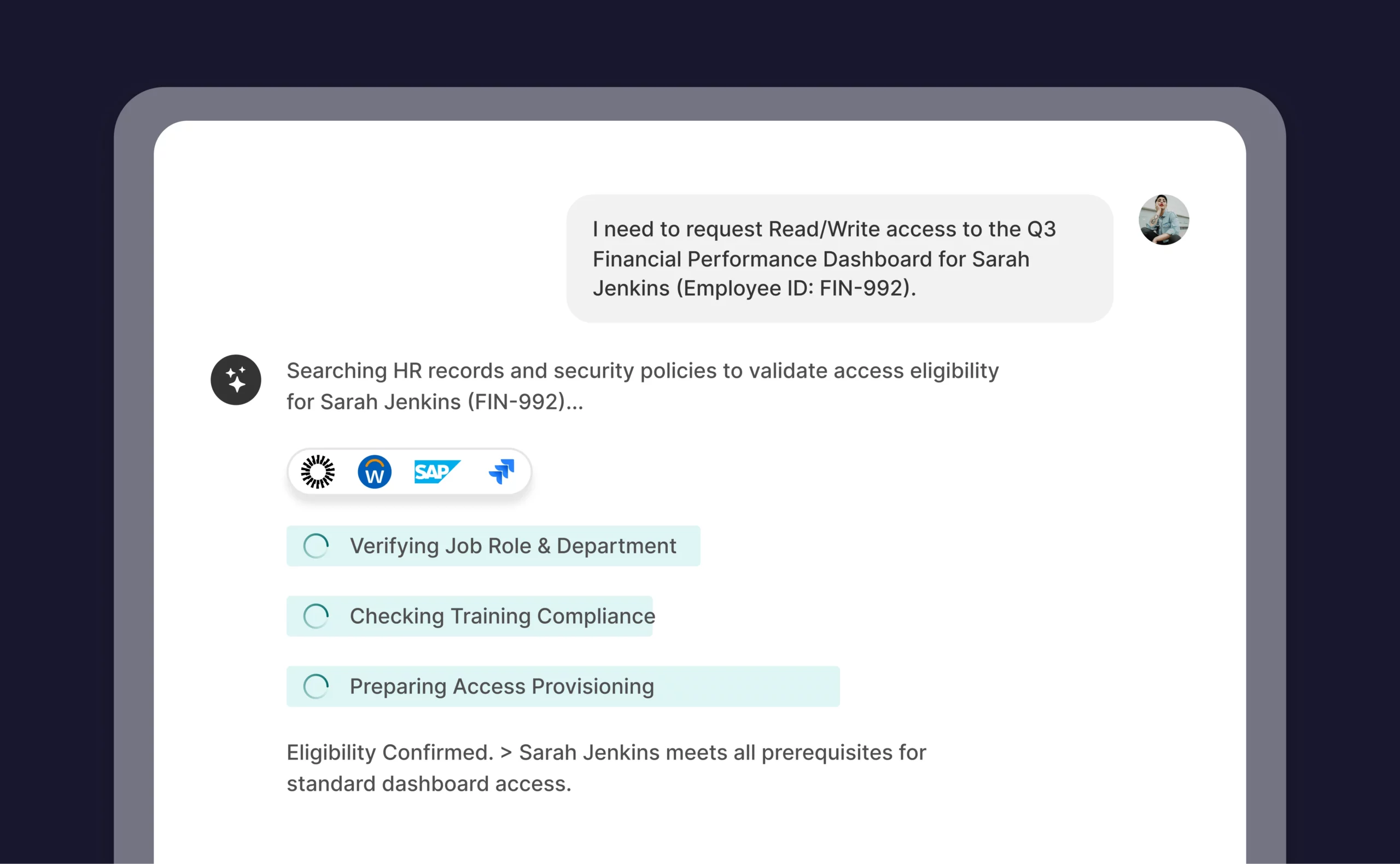
An access agent reads incoming requests, validates eligibility against policy, applies low-risk approvals, and routes exceptions with structured context for review.
Example: A finance analyst requests dashboard access. The agent checks HR role data, verifies training completion, validates IAM policy scope, grants standard access automatically, and logs the action. For elevated permissions, it generates a summary and routes the request to the manager.
Tools integrated with
IAM platform, HRIS, ticketing system, audit log, internal portal.
6. Shared services and back-office automation
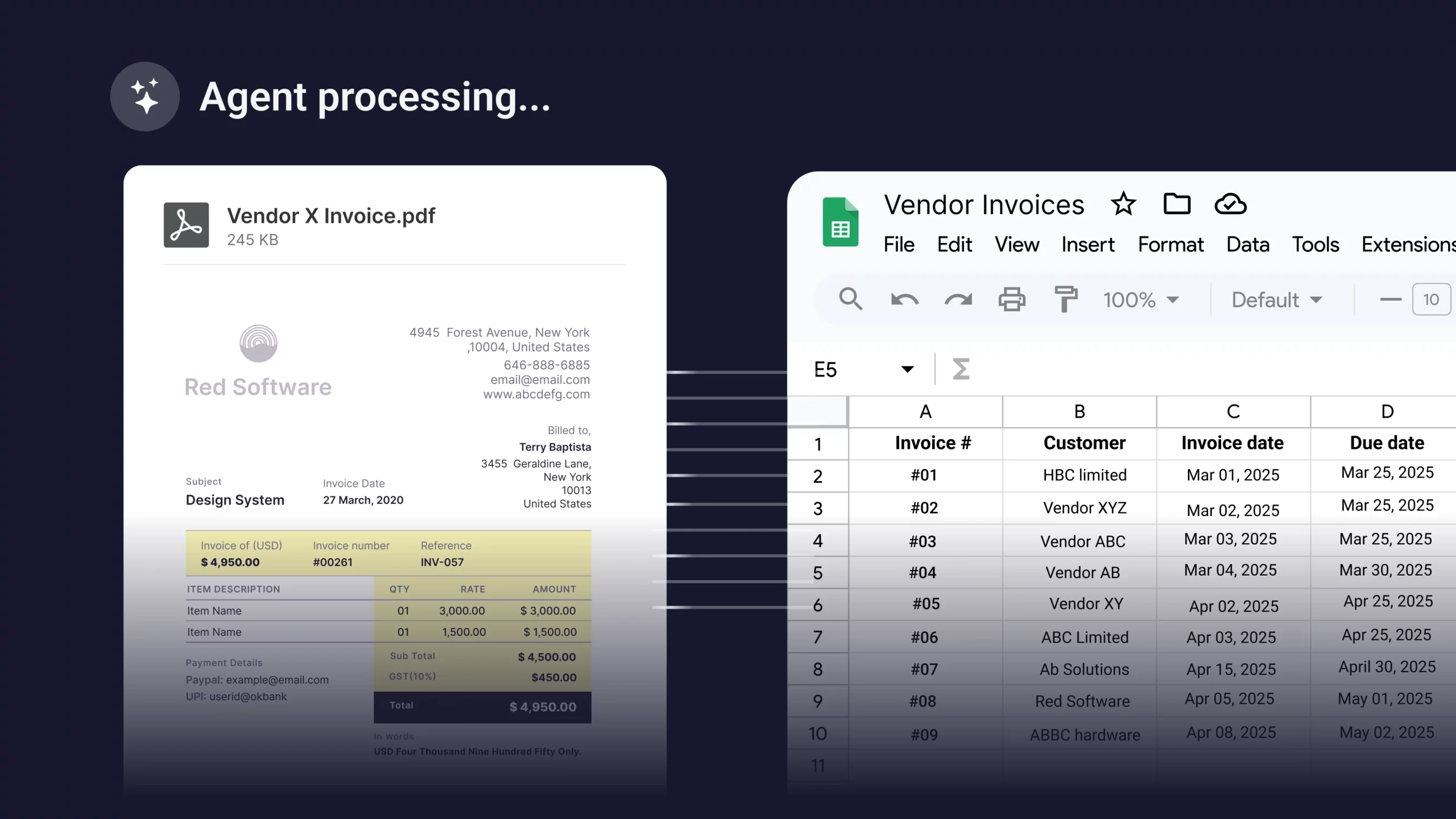
A shared services agent extracts data from emails and documents, validates against systems of record, updates workflows, and escalates incomplete cases for human review.
Example: Vendor invoices arrive as PDFs. The agent extracts line items, matches vendor IDs in ERP, checks duplicates, and creates a draft payable entry with the attachment. If totals mismatch the purchase order, it highlights discrepancies and routes the case to an analyst.
Tools integrated with
Email server, document storage, OCR or extraction service, ERP, accounting workflow system.
Document-aware operational flows often leverage retrieval-based designs such as RAG agents.
7. Cross-system copilots in collaboration tools
A chat-embedded ops agent retrieves real-time system data, executes multi-step workflows, and posts structured updates back into the team’s collaboration channel.
Example: In Slack, a teammate asks to update a ticket and notify a customer. The agent retrieves the CRM record, checks billing status, updates the ITSM ticket, drafts a customer-ready summary, and posts the change log in the thread while tagging the on-call owner.
Tools integrated with
Slack or Teams, CRM, ITSM, billing platform, workflow engine.
How AI agents operate in an ops environment
Operational agents typically follow a structured lifecycle:
Observe
Subscribe to system events, logs, queues, and APIs.
Interpret
Classify events using language models and policy rules.
Decide
Select an appropriate action within defined thresholds.
Act
Execute changes through integrated tools and workflow engines.
Record and refine
Log actions, capture outcomes, and adjust configurations over time.
Deployment decisions often include governance, hosting, and cost considerations. Teams evaluating rollout models can review detailed AI agents pricing and implementation guidance.
How to get started with AI agents for ops teams
A practical rollout usually progresses through defined stages:
- Identify a high-friction workflow with measurable impact.
- Map the systems the agent must observe and update.
- Define action boundaries and escalation rules.
- Measure baseline performance and post-deployment improvements.
- Expand gradually to adjacent workflows.
Teams that prefer structured, guided implementation can participate in a hands-on AI agent building workshop before scaling deployments.
Conclusion
AI agents for ops teams extend operational capacity by combining reasoning with structured execution across systems. When designed with clear policies, integrations, and oversight mechanisms, they reduce repetitive coordination work and improve consistency across complex workflows.
The most effective deployments begin with a focused use case, measurable outcomes, and clearly defined guardrails. As confidence grows, organizations can expand agent coverage across related operational domains. For detailed implementation questions and architectural considerations, consult the comprehensive AI agents FAQ.
Related Articles