
AI agents for hospitality: Personalization at scale, not just speed
TL;DR
- AI agents for hospitality are digital staff that orchestrate guest journeys end to end—understanding context, acting in systems, and learning from every stay.
- AI in hospitality is forecast to reach roughly 1.4B USD by 2029 with a CAGR above 50%, as hotels chase personalization, efficiency, and revenue growth.
- The competitive frontier is moving from one-off chatbots to a virtual GM agent that personalizes experiences and optimizes operations across properties.
Why hospitality is being rebuilt around personalised agents
The soul of hospitality has always been personal: remembering a guest’s name, knowing how they like their room, recommending the one restaurant they will actually love. What has changed is that guests now expect that level of recognition and relevance on every channel, at any hour, at every price point.
Analysts show that AI is now the only realistic way to deliver personalization at scale—analyzing data from past stays, behavior, and real-time context to tailor offers, room setups, and communication in the moment. At the same time, travel and hospitality leaders expect agentic AI to collapse the fragmented “look to book” funnel into a continuous, tailored conversation that goes from dreaming to booking to in‑stay service in a single flow.
The contrarian thesis is simple: the real unit of automation in hospitality is not a chatbot per page—it is a virtual GM agent that knows every guest, every room, and every constraint, and can orchestrate pricing, staffing, and service as if it were your best manager on their best day, every day.
What agentic AI means in hospitality
Agentic AI for hospitality is an architecture where large language models, hotel and travel data, and tool integrations into PMS, CRS, POS, workforce, and pricing systems allow software agents to plan, act, and learn toward specific business goals such as RevPAR, NPS, or time‑to‑resolution.
Simply put:
Agentic AI in hospitality is AI that takes responsibility for outcomes like “get this family rebooked tonight, protect margin, and keep their review five stars,” instead of just answering questions.
In practice, hospitality AI agents:
- Understand guest or staff messages across chat, email, web, and voice, then decide whether to respond, clarify, or escalate.
- Call APIs into PMS, CRS, POS, loyalty, and workforce tools to change reservations, allocate rooms, route tasks, and adjust prices or offers.
- Learn from outcomes—resolved issues, reviews, upsell conversions, churn—to refine prompts, playbooks, and policies over time.
Why hospitality needs agents now
Demand for contextual personalisation
Studies on AI in hospitality personalization highlight that guests increasingly expect hotels to anticipate needs, tailor recommendations, and adapt experiences in real time. This spans everything from room preferences and amenities to activities, dining, and communications style.
Labour and margin pressure
At the same time, operators face structural staffing shortages and rising labour costs, making it hard to deliver high‑touch service the traditional way. AI-driven automation is being positioned as the lever to maintain or improve service while handling more interactions per FTE and reducing waste in areas like housekeeping, F&B, and maintenance.
Market scale
Analysts project that the global AI in hospitality market will reach roughly 1.44 billion USD by 2029, growing at an estimated CAGR of about 57.6%, driven by personalization and operational optimization. Industry reports and vendor data show rapid adoption of AI assistants for booking support, recommendations, and in‑stay service across hotel brands and travel intermediaries.
10 AI agent use cases that actually move the P&L in hospitality
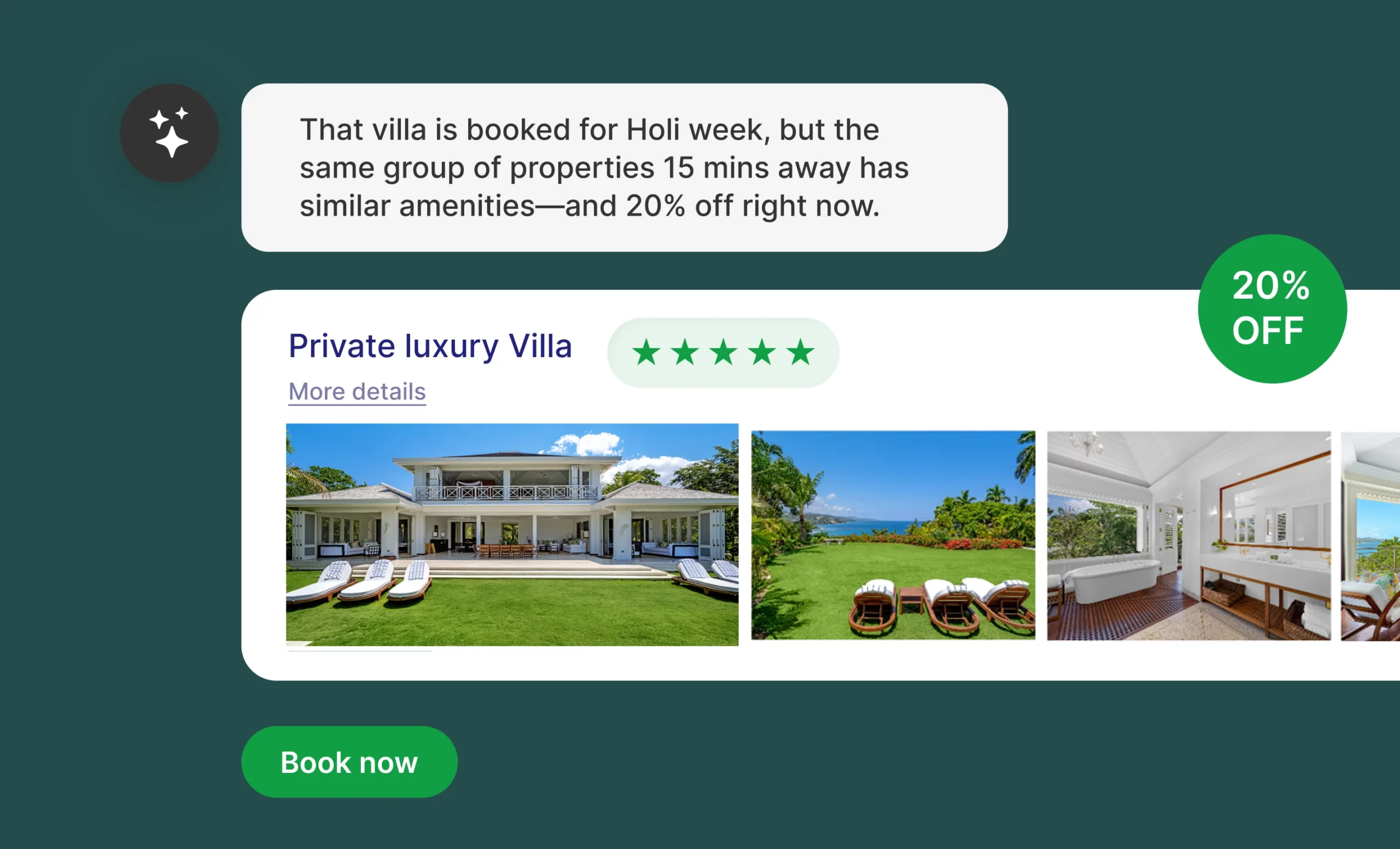
1. Virtual concierge and 24/7 guest messaging
A virtual concierge agent becomes the guest’s single point of contact across web, app, messaging apps, and email.
- Answers amenity, policy, and local questions in seconds, in the guest’s language and tone.
- Orchestrates early check‑in, late checkout, and upgrades by talking to PMS and pricing systems, not just “taking a note.”
Example:
Guest on messaging app: “We land at 7am with two kids—any chance of early check‑in and a quiet room?”
The agent checks occupancy and housekeeping forecasts, finds a suitable room, prices an early check‑in, offers it, takes payment, updates the PMS, and schedules housekeeping to prioritize that room.
Open this agent simulation in a new tab
2. Hyper-personalized journeys and micro-itineraries
Agents design micro‑itineraries tailored to each guest using past stays, stated preferences, loyalty data, and real‑time context like weather and events.
- Propose activities, dining, and services that fit the guest’s profile and constraints (budget, kids, mobility).
- Adjust plans on the fly when flights move, weather changes, or guests give feedback.
Example: the system recognizes a repeat wellness guest and pre‑builds a weekend around spa slots, healthy dining, and quiet rooms, surfacing it as a one‑click suggested itinerary.
3. Automated check-in, room allocation, and smart rooms
Open this agent simulation in a new tab
Agents turn arrivals into frictionless, context‑aware experiences.
- Trigger digital check‑in, ID verification, payment, and key issuance with minimal manual handling.
- Allocate rooms based on preferences, loyalty tier, and feedback from previous stays, not just “next clean room.”
- Configure room settings (temperature, lighting, content) automatically based on guest patterns.
4. Proactive service and issue recovery
Agents watch for signals—sentiment in chats, review drafts, sensor alerts, flight disruptions—and intervene before problems escalate.
- Auto‑offer remedies (quiet rooms, late checkout, credits) when risk of dissatisfaction spikes.
- Alert human staff with context and suggested actions for high‑stakes or complex cases.
Mini-simulation:
Guest writes “room is really noisy near elevator” in app chat; the agent detects negative sentiment, identifies alternatives, proposes a new room and a drink voucher, updates PMS and housekeeping, and confirms the move.
5. Intelligent revenue management and dynamic offers
Revenue agents look across demand, compset rates, historical trends, and guest profiles to shape pricing and offers.
- Adjust rates and restrictions across channels in near real time.
- Construct personalized offers and bundles—room, F&B, spa, activities—based on willingness‑to‑pay and context.
6. Housekeeping and maintenance optimization
Ops agents turn bookings, check‑outs, and sensor signals into optimized workflows.
- Dynamically assign housekeeping tasks using real‑time room status, staffing levels, and arrival times.
- Predict maintenance needs from logs, IoT data, and guest comments, scheduling work proactively.
7. Inventory, F&B, and waste reduction
Agents forecast demand for restaurants, bars, banquets, and amenities using bookings, events, and historical patterns.
- Recommend purchase quantities for perishables to balance availability against waste.
- Suggest menu engineering moves—promotions, placement, pricing—based on item performance and guest mix.
8. Reputation and review management
Reputation agents monitor reviews and social mentions, classify them, and respond at speed without losing personalization.
- Draft on‑brand responses tailored to the specific guest and incident.
- Identify recurring issues and feed them back into operational and training playbooks.
9. Workforce and scheduling co-pilot
Workforce agents align staffing with predicted demand, guest expectations, and service standards.
- Propose shift patterns, cross‑training, and assignments to cover peaks efficiently.
- Run “what‑if” scenarios for schedule or facility changes, projecting impact on service and cost.
10. Cross-property “virtual GM” agent
At portfolio level, a virtual GM agent continuously watches performance and nudges local teams.
- Flags underperforming properties on metrics like conversion, RevPAR, ancillary revenue, and complaint rates.
- Recommends interventions—price moves, targeted campaigns, service fixes—and can implement low‑risk actions autonomously.
The Hospitality Agentic Stack
Brain: reasoning and policy
The Brain is the LLM-based reasoning layer that interprets intents, plans multi‑step flows, and enforces risk and brand policies across use cases. It decides when to clarify, when to act, and when to hand off to humans.
Memory: context and retrieval
The Memory layer combines RAG over SOPs, property details, FAQs, and contracts with structured context from PMS, CRS, loyalty, CDPs, and past conversations. It lets agents remember who a guest is, what matters to them, and what is happening right now at the property or across the group.
Hands: API orchestration and automation
The Hands layer is how agents do work: orchestrating calls into PMS, CRS, POS, ticketing, workforce, pricing, IoT, and marketing systems with explicit latency and reliability constraints. It handles retries, fallbacks, and compensating actions when something fails so the guest still experiences a smooth journey.
Face: channels and experience
The Face layer delivers a consistent agent identity across web, app, messaging, email, IVR, kiosks, and staff consoles. Context moves with the guest across channels, so they do not have to repeat themselves and can feel genuinely known.
Economics and ROI: more than a demo
For agentic AI to be infrastructure rather than a toy, it must move four levers:
- Throughput: more interactions and decisions handled per hour with equal or fewer staff.
- Accuracy: fewer booking errors, mis‑allocations, and revenue leaks across channels.
- Labour: automation of repetitive tasks in service, ops, and back office, easing staffing gaps.
- Ticket size and revenue: better pricing, upsell, and personalization that drive ancillary spend and loyalty.
If it doesn’t move throughput, accuracy, labour, or ticket size, it’s a demo—not infrastructure.
The Hospitality Agentic Maturity Curve
Stage 1 – Digital basics
Hotels have websites, OTA presence, basic email flows, and maybe a simple FAQ chatbot; systems are siloed and decisions are mostly manual.
Stage 2 – Assisted agents
Agents appear on guest channels and in internal helpdesks, integrated into PMS/CRS for a subset of flows, with staff supervising and correcting them.
Stage 3 – Virtual GM / fully agentic operation
A portfolio-level virtual GM agent orchestrates pricing, staffing, and guest journeys across properties with clear P&L impact and well‑governed autonomy. Most of the industry is between Stage 1 and early Stage 2; those who design for Stage 3 now will define guest expectations later.
Why hospitality AI pilots fail
Common failure modes:
- Demo-first, reality-second: beautiful flows with no deep PMS/POS/ticketing integration, so nothing operational actually changes.
- No latency budget: agents that take 8–10 seconds to respond or complete actions, which guests experience as “broken.”
- No owner: nobody in the business is accountable for agent performance, training data, or policy, so models drift and value stalls.
- Over-polite, under-precise: agents empathize but rarely commit to actions, refunds, or concrete resolutions.
Rollout playbook for operators
Step 1: Start narrow and high-volume
Pick one journey with clear economics—WhatsApp pre‑arrival questions, webchat booking support, or simple concierge requests—and wire it end‑to‑end into PMS and CRM.
Step 2: Integrate deeply, not widely
Make sure that one flow handles authentication, context, decisions, and actions with observability and fallbacks; avoid spreading a shallow FAQ layer across channels.
Step 3: Set targets and instrumentation
Define baselines and targets for response time, resolution rate, upsell, and handover; instrument dashboards that compare pre‑ and post‑agent metrics.
Step 4: Assign an “AI GM” on the operator side
Give a specific leader responsibility for agent performance, guardrails, and iteration cadence, just as you would for a new property opening.
Step 5: Scale when behaviour changes
Only expand to new use cases when staff and guests naturally route work through the agent, and when you see sustained movement in the four ROI levers.
Roadmaps for three hospitality archetypes
Independent or boutique property
- Phase 1: deploy a virtual concierge and messaging agent tightly integrated with PMS and basic CRM.
- Phase 2: add housekeeping task automation and review response drafting.
- Phase 3: adopt light revenue and personalization agents to shape offers and repeat‑stay journeys.
Regional chain
- Phase 1: standardize concierge, messaging, and check‑in agents across flagship properties with shared playbooks.
- Phase 2: deploy revenue, workforce, and F&B agents, tuned to local demand patterns.
- Phase 3: roll out a virtual GM layer that monitors the portfolio and orchestrates cross‑property actions.
SaaS / PMS / POS vendor
- Phase 1: embed agentic modules—AI concierge, AI revenue assistant, AI ops co‑pilot—into your core product.
- Phase 2: build a multi‑tenant agent fabric that can operate across many hotels with shared, privacy‑safe learning.
- Phase 3: position your platform as the default orchestration layer for hospitality agents, with open APIs for partners and operators.
Related Articles