
AI agents for customer service in 2026
Customer expectations have shifted. People want instant answers, accurate information, and seamless resolution across chat, email, and voice. Conversational AI for customer service has improved response speed; however, many deployments still stop at scripted replies and static flows.
AI agents for customer service represent the next stage. These AI customer service agents combine language understanding with structured access to your systems.
They do not simply respond to queries. They interpret intent, retrieve context, take action across tools, and escalate to humans when judgment is required. In practical terms, the model looks like this:
Customer → AI agent → system orchestration → human escalation if needed.
A customer surfaces a question. The agent understands the intent, checks relevant systems such as CRM, ERP, or billing, completes permitted actions within policy, logs the interaction, and escalates only when confidence is low or the case falls outside defined boundaries. This is the foundation of AI-powered customer support.
No-code AI agents for customer service, such as those built with DronaHQ Agents, allow CX teams to deploy these capabilities without building orchestration logic from scratch.
Why support teams are hitting a ceiling without AI agents
Support volumes continue to grow while customers expect 24/7 coverage and consistent answers across channels. Contact centres face pressure to reduce cost per contact while maintaining service quality.
Human-only teams struggle to scale predictably. Wait times increase during peaks. Knowledge inconsistencies surface across agents. Training cycles become longer and more expensive.
AI agents for customer support address these constraints by offering structured, always-on handling of repetitive and policy-bound interactions. This is where AI customer support automation moves beyond answering questions and begins coordinating actions.
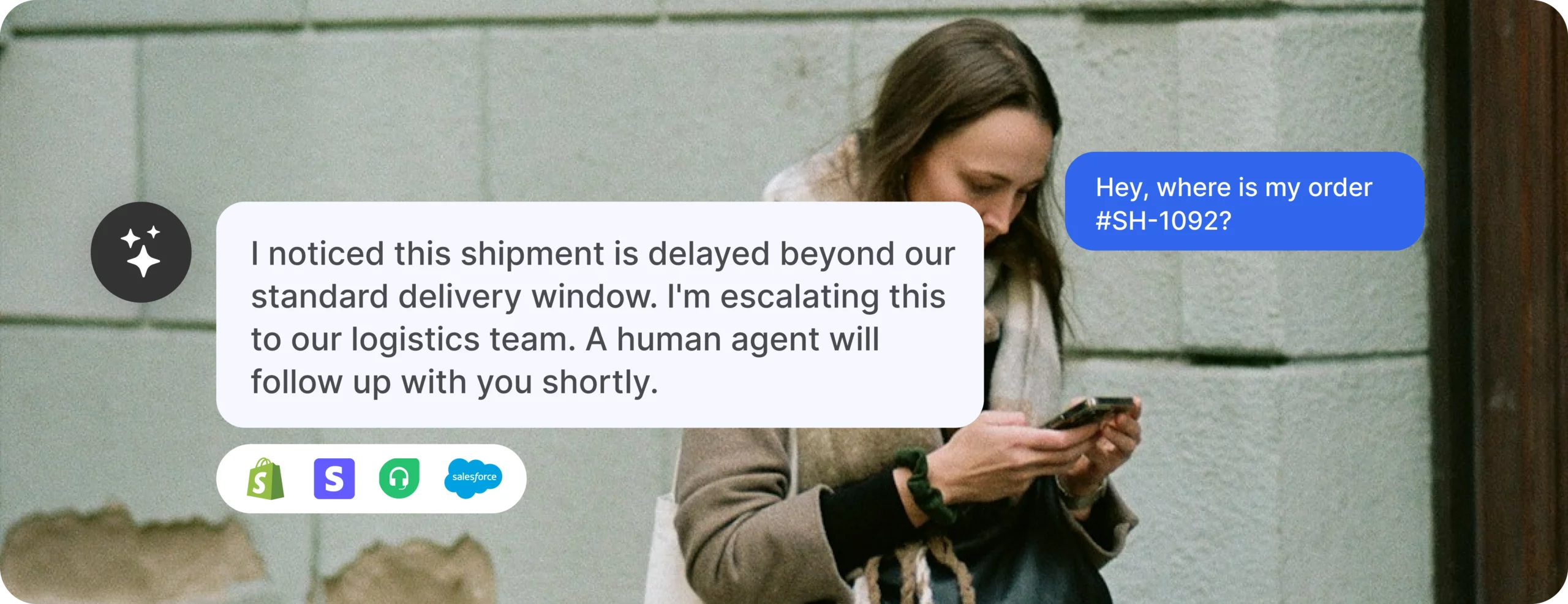
For example: Order tracking
When a customer asks, “Where is my order?” The agent checks the ERP for shipment status, confirms the carrier tracking ID, updates the CRM timeline, logs the interaction in Freshdesk, and sends the tracking link via email. If the shipment shows a delay beyond SLA, it escalates with context to a human agent.
This flow reduces response time while preserving escalation pathways for exceptions.
What is a customer service AI agent?
Conversational AI vs traditional chatbots
A customer service AI agent is an LLM-powered virtual agent that understands intent, retrieves relevant knowledge, and can take structured actions or escalate appropriately. It combines conversational AI for customer service with system integrations and policy enforcement.
Traditional chatbots rely on predefined flows and keyword rules. AI customer service agents interpret language more flexibly and operate within guardrails that allow action across systems.
| Capability | Legacy Chatbot | AI Customer Service Agent |
| Logic | Rule based | LLM + workflow orchestration |
| Autonomy | FAQ replies | Executes actions within policy |
| System access | Limited | Fully integrated within boundaries |
| Resolution scope | Single step | End to end task completion |
AI agents vs chatbots: Key differences that matter for CX
The comparison of AI agents vs chatbots is not about interface, but about capability and impact.
A chatbot may answer “How do I return an item?” with instructions. An AI agent for customer service can verify the order, check return eligibility, generate a return label, update the order system, notify the warehouse, and confirm via email.
Example: Refund processing
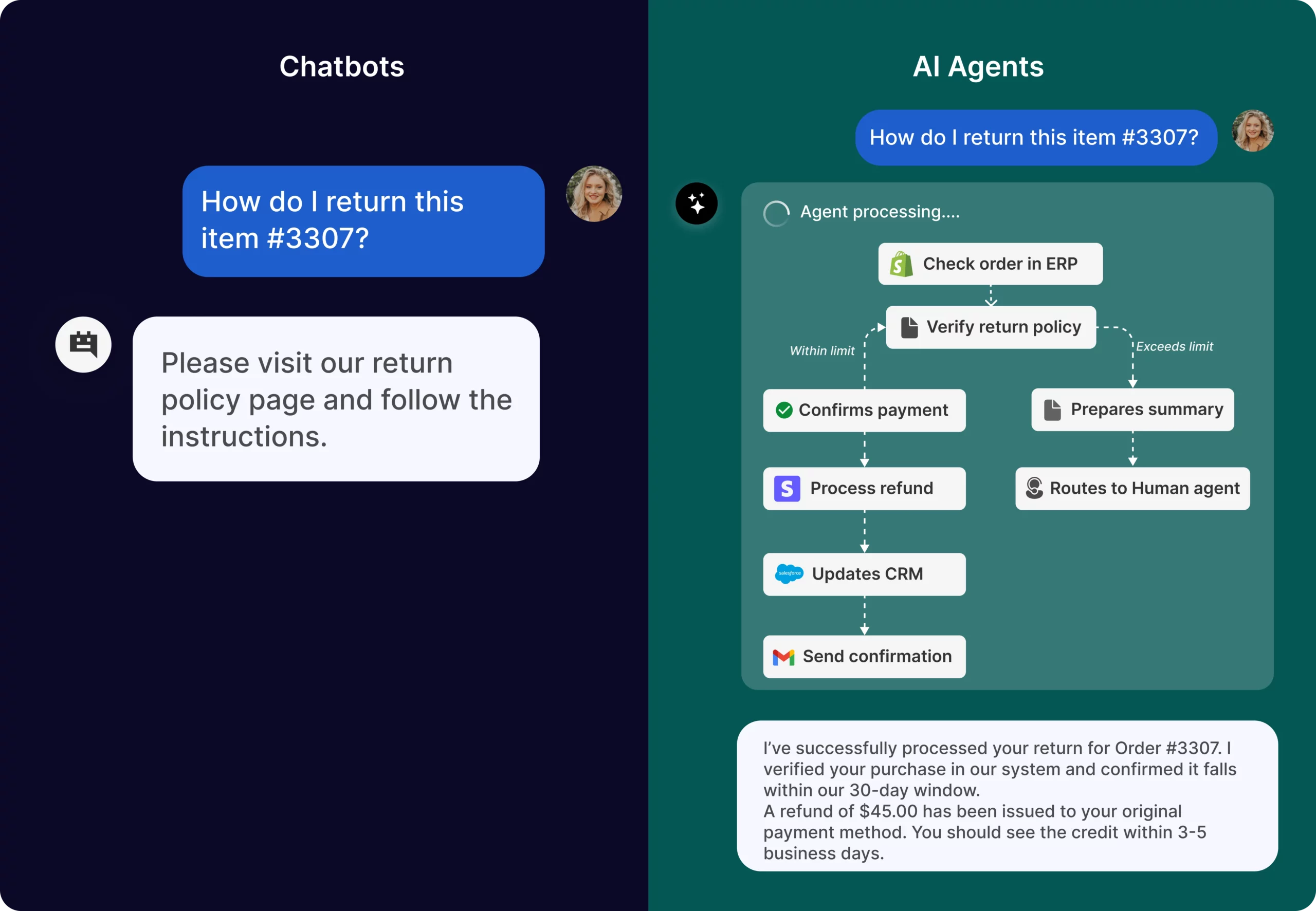
A customer requests a refund. The agent checks the order in ERP, verifies the return window policy, confirms payment method in billing, processes a refund below a defined threshold, updates the CRM, and sends confirmation. If the refund exceeds policy limits, it prepares a summary and routes it to a human.
The difference lies in the agent’s ability to reason within policy and act accordingly.
How a customer-facing AI agent actually works
A customer-facing AI agent begins at the first touchpoint. It receives a query in chat, email, or voice. It identifies intent, retrieves necessary context, and determines what actions are allowed.
If the case fits within predefined rules and confidence thresholds, it proceeds to execute structured actions across systems. If ambiguity or risk is detected, it escalates to a human agent with full context attached.
Example: Subscription upgrade
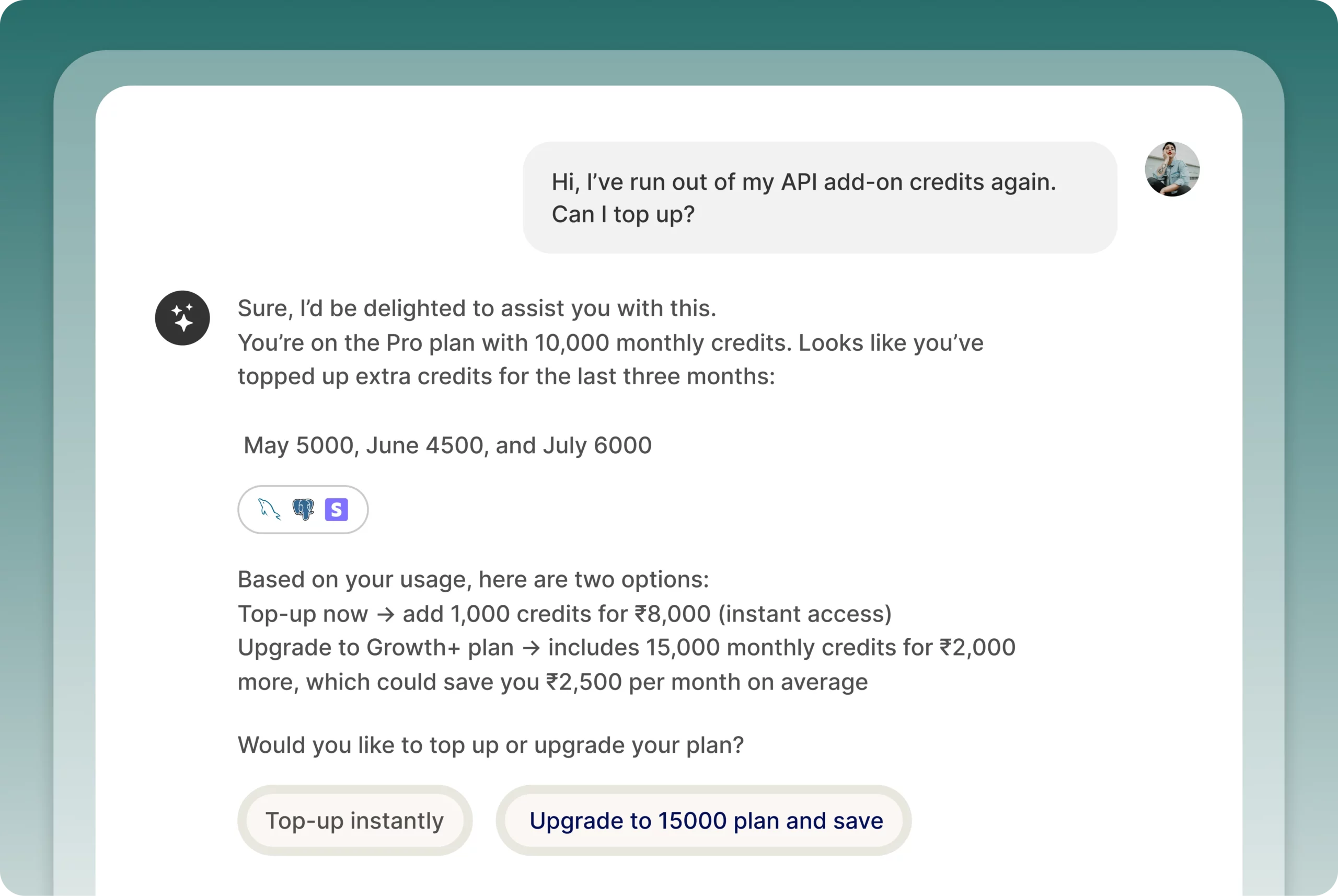
A user asks to upgrade their plan. The agent checks current subscription in CRM, validates pricing rules, updates billing, modifies entitlements in the product database, logs the change in the ticketing tool, and confirms the upgrade. If payment fails, it escalates with transaction details.
This orchestration model ensures continuity rather than isolated responses.
How AI customer service agents work (Conversational AI + agentic AI stack)
Modern AI customer service agents operate through layered intelligence.
- Understanding and routing
The agent interprets user intent, sentiment, and urgency. It routes tickets or initiates workflows based on confidence levels. This layer powers ai customer support automation.
Example: Password reset
A user says they cannot log in. The agent verifies identity through predefined checks, triggers a secure password reset workflow, updates the ticket status, and confirms completion. If identity verification fails, it escalates.
- Retrieving knowledge and grounding
The agent references approved documentation and knowledge bases to generate accurate, grounded responses.
- Acting across tools
Agentic AI for customer service enables secure API calls across CRM, ERP, billing, and ticketing systems.
Example: Shipping address update
A customer requests a delivery address change. The agent checks shipment status in ERP, confirms eligibility for modification, updates the address in the order system, syncs the change to CRM, logs the action in Freshdesk, and confirms to the customer.
15 high-impact AI agents for customer service across industries
Below are 15 well-defined AI agents for customer service. Each example reflects a true AI agent that understands intent, accesses live systems, reasons within policy, and executes actions across tools rather than simply replying with scripted answers.
Ecommerce
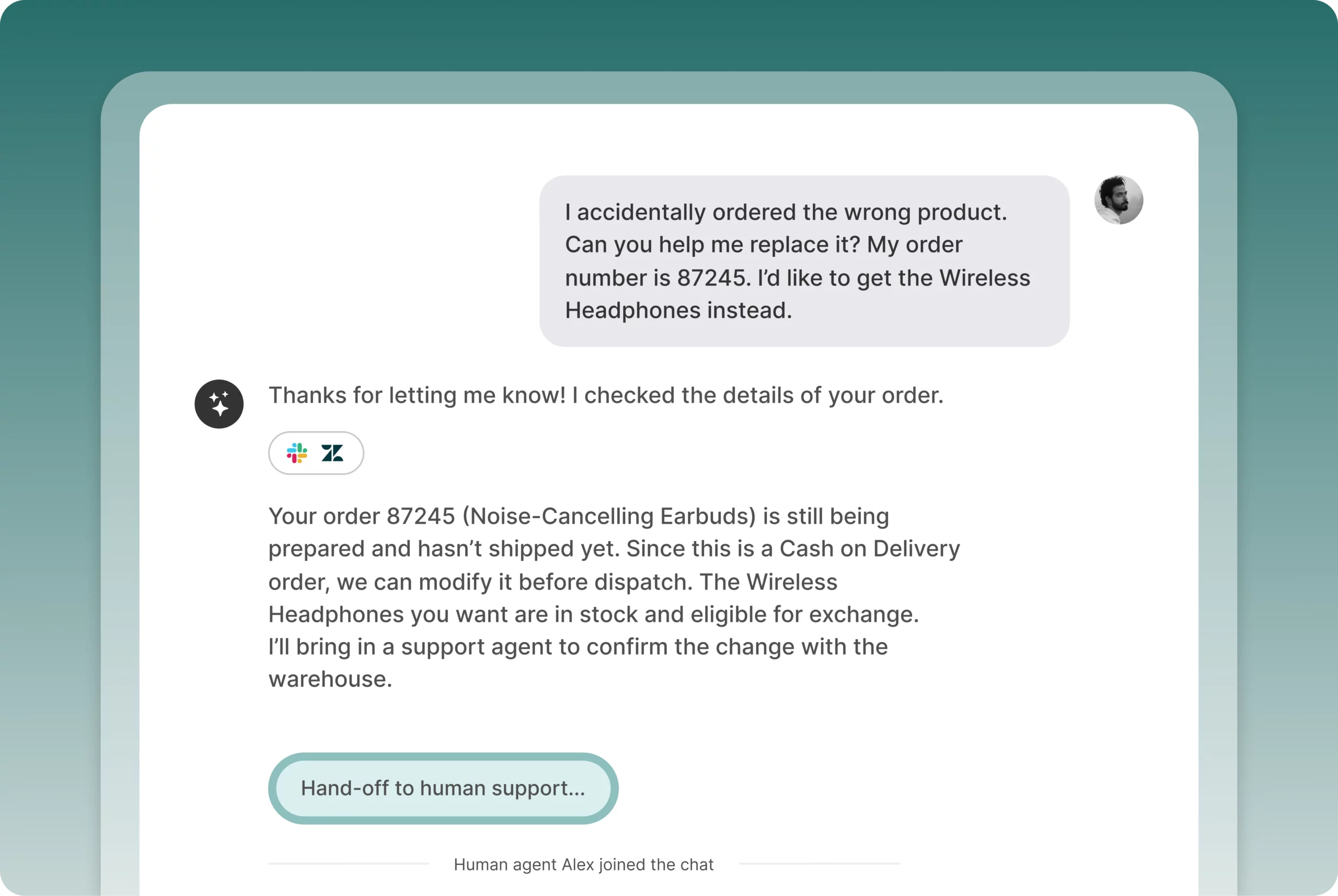
- Order resolution agent
Handles tracking, shipment delays, and carrier updates. Checks ERP, retrieves live tracking, updates CRM timeline, and proactively notifies customers if SLA risk is detected. - Returns and refund agent
Validates eligibility against policy, generates return labels, processes refunds below threshold via payments API, updates ERP and CRM, and escalates exceptions. - Post-purchase modification agent
Updates shipping addresses or delivery windows when eligible, synchronizes ERP and logistics systems, and confirms changes via email.
SaaS
- Subscription lifecycle agent
Manages plan upgrades, downgrades, renewals, and proration. Connects CRM, billing platform, and product entitlement systems before confirming changes. - Account access agent
Handles password resets, MFA issues, and role changes by validating identity and triggering secure workflows in IAM systems. - Usage intelligence agent
Monitors product usage, identifies churn risk signals, and proactively notifies customers about overages or optimization opportunities.
Banking and fintech
- Transaction inquiry agent
Retrieves transaction history, explains charges using grounded policy data, and escalates fraud signals when anomaly thresholds are triggered. - Dispute initiation agent
Collects required details, creates structured dispute records, updates case management systems, and informs customers of next steps. - Card services agent
Handles card activation, temporary blocks, and replacement requests through secure verification and backend updates.
Telecom
- Outage response agent
Correlates location data with network status, informs customers of active outages, creates service tickets when needed, and updates CRM. - Plan migration agent
Recommends eligible plans, updates billing systems, modifies provisioning records, and confirms new entitlements.
Travel and hospitality
- Booking modification agent
Checks fare rules, rebooks flights or rooms within policy, updates reservation systems, and sends updated itineraries. - Cancellation and refund agent
Validates eligibility, processes refunds through payment gateways, updates booking systems, and triggers confirmation workflows.
Insurance and healthcare
- Claims intake agent
Collects structured claim data, validates policy coverage, creates case files in claims systems, and notifies customers of documentation gaps. - Appointment coordination agent
Schedules, reschedules, and confirms appointments by integrating with provider systems and sending reminders across channels.
These agents move beyond scripted conversations. They combine conversational AI with structured orchestration across CRM, ERP, billing, and ticketing systems, forming the backbone of AI customer support automation at scale.
If this orchestration model resonates and you are exploring how to implement it in your own support stack, review how structured AI agents can be deployed inside a governed environment with DronaHQ Agents.
How to cut support costs with automation without wrecking CX
Leaders exploring how to reduce support costs with AI focus on staffing, peak coverage, handle time, and quality assurance.
AI-powered customer support reduces repetitive ticket load and shortens response times. When 25 to 40 percent of routine inquiries are handled by agents within policy, cost per contact declines while human agents focus on nuanced cases.
The key is measured deployment. Human-in-the-loop customer service AI ensures oversight for edge cases and preserves brand quality.
AI support maturity model
Support teams typically evolve through three maturity levels. Each stage carries different risks, data requirements, and next steps.
Level 1: FAQ assistant
Handles basic queries using a knowledge base.
Risk: Hallucinations if grounding is weak.
Data requirement: Clean, updated documentation.
Next step: Add structured intent classification and analytics tracking.
Level 2: Transactional agent (orders, refunds, resets)
Executes single-system actions within policy.
Risk: Policy misconfiguration or incorrect threshold logic.
Data requirement: API access to CRM, ERP, billing with audit logging.
Next step: Introduce multi-step workflows and human approval triggers.
Level 3: Agentic orchestrator (multi-system workflows, proactive communication)
Coordinates actions across CRM, ERP, ticketing, and messaging channels.
Risk: Over-automation without clear escalation rules.
Data requirement: Unified customer context, role-based permissions, monitoring dashboards.
Next step: Add proactive notifications and continuous optimization based on CX metrics.
From pilot to agentic AI contact center
A practical implementation roadmap:
- Audit top intents and select high-volume, low-risk journeys.
- Clean knowledge sources and define response policies.
- Launch a customer service AI agent for FAQ and simple transaction handling.
- Introduce agent assist for human teams.
- Expand into multi-system workflows within defined guardrails.
At each stage, measure containment, resolution time, and customer satisfaction.
Launch your first AI support agent
Customer-facing AI agents deliver the most value when they are deployed in a controlled, measurable pilot. Start with a high-volume journey such as order tracking or refunds, define clear policy thresholds, and connect your CRM, ERP, and helpdesk systems.
You can launch a pilot AI agent in a no-code builder and move from FAQ handling to transactional orchestration in stages. Explore how to get started with a governed, production-ready approach through DronaHQ Agents.
Related Articles