
AI Agents for coffee shops and cafés
Most great cafés share the same ingredients: familiar faces, a predictable rhythm, and the quiet satisfaction of someone getting your order right without asking twice. As cities get denser and menus get more complex, that kind of service is harder to deliver.
Owners I talk to aren’t looking for robots behind the bar. They want a way to make “we know you” service possible even on a chaotic Monday morning. That’s where AI agents for coffee shops and cafés come in.
These systems don’t replace baristas or turn your shop into a vending machine. They act more like invisible teammates: remembering preferences, noticing patterns, and nudging the right action at the right moment, whether that’s suggesting a usual, flagging an allergy risk, or warning that oat milk is about to run low.
In the next sections, we’ll look at how these agents show up in the café – at the table, on the counter, in the drive‑thru lane, and behind the scenes, and what needs to be true technically for them to actually work in a real coffee rush.
What is agentic AI for coffee shops?
In technical terms, agentic AI uses large language models (LLMs), tools, and feedback loops to pursue goals, not just respond to isolated prompts, but in practice, I think of it as “AI that can actually take responsibility for an outcome.”
In a coffee shop, that translates to AI agents that:
- Understand a goal (for example: minimise queue time, increase repeat visits, or boost add‑on attachment rate).
- Use RAG (retrieval‑augmented generation) to ground responses in your real menu, policies, and constraints, instead of hallucinating.
- Orchestrate APIs to POS, inventory, loyalty, and workforce systems and then take multi‑step actions without human micromanagement.
Unlike traditional rule‑based automation or generic chatbots bolted onto a website, agentic AI in cafés is goal‑oriented and system‑aware. It knows the difference between suggesting an out‑of‑stock pastry and using live inventory to push alternatives.
Why cafés need agentic AI now
The basic economics of coffee shops are not getting easier:
- Ingredient costs are volatile, and guests are more price‑sensitive.
- Hiring and training frontline staff is expensive, especially when turnover is high.
- Guests expect “my usual” to follow them from one location or channel to another.
Here is the critical, falsifiable prediction:
To move from reactive service to predictive delight, cafés need systems that plugin the data points they already have on them.
Most cafés still operate in reactive mode: the barista waits for the order, inputs it, and moves to the next customer, with no anticipation or context carried forward. But what if the system could recognise the customer, pull up their past orders, detect time-of-day or seasonal patterns, and suggest before they speak?
This will happen for one simple reason: the cafés that deploy agents to shorten queues, increase visit frequency, and reduce waste will out‑compete those that don’t. The question for operators is no longer if agentic AI shows up in their market, but whether they want to shape it or inherit it.
7 agentic AI use cases across a coffee shop
An agentic café doesn’t start with a single “AI feature”. It starts with a network of small, specialised agents working together across the journey, from QR menus to drive‑thru voice.
1. Guest‑facing tableside agentic menus (QR)
Open this agent simulation in a new tab
When guests scan a QR code, they should see more than a list of items. In an agentic setup, that scan becomes the start of a tailored experience:
- A system that recognises past orders
- Recalls favourite add-ons, and
- Suggests options that match both preference and availability (“Less sweet today?” “Make it extra hot?”).
- Guides checkout, payment, and pickup (“Your order will be ready at Counter 2 in 4 minutes.”).
Every interaction – dietary flags, preferred milk, add‑ons, pace of visit – becomes structured memory. Backed by RAG and live menu data, the agent avoids classic failure modes like recommending items that are not available or misrepresenting allergen information.
What used to be “self-service” becomes self-aware service.
2. The digital barista: discovery, rewards, and offers
A personal concierge for discovery and rewards
Open this agent simulation in a new tab
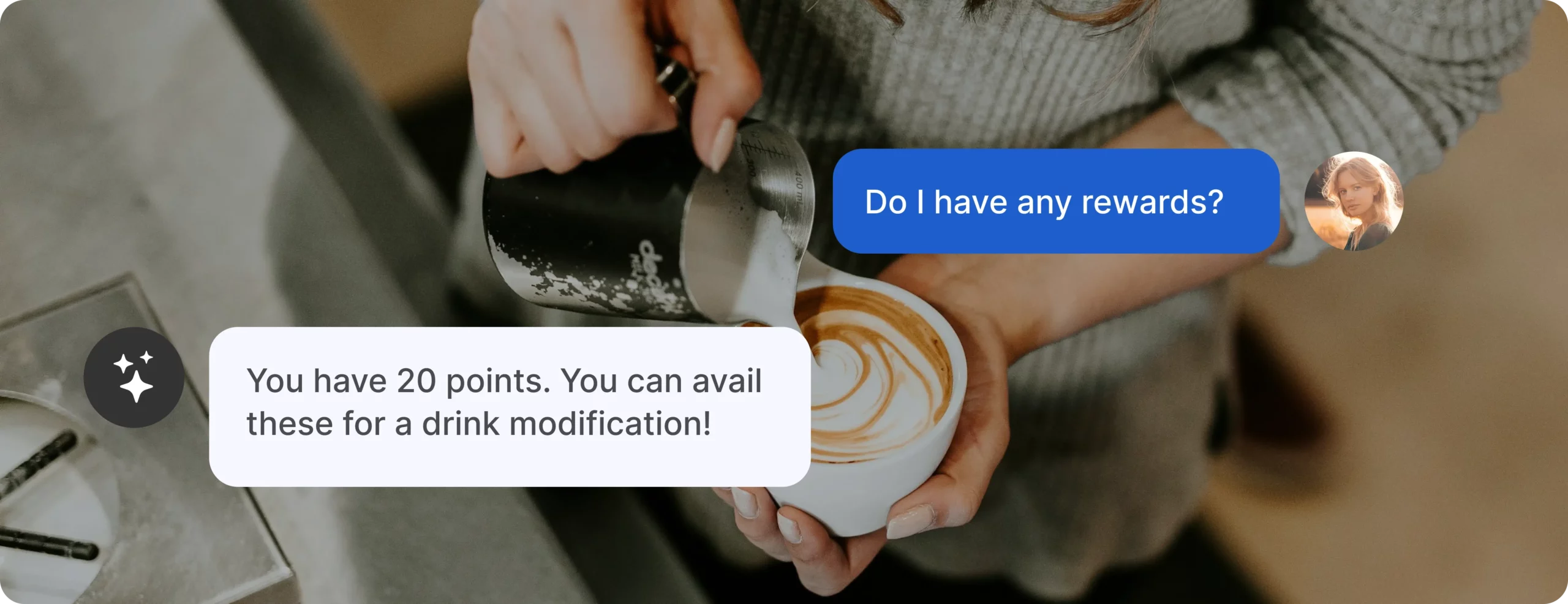
Not every café interaction is about ordering. Some customers want to ask what’s new, check how many loyalty points they’ve earned, or see if any offers are running that day.
A digital barista agent lives inside kiosks, mobile apps, or messaging apps like WhatsApp:
- Answers “How do my rewards work?” by reading real loyalty rules and the guest’s current balance.
- Checks current offers against inventory so it doesn’t push an item you cannot fulfil.
- Uses a mix of LLM reasoning and deterministic business rules to suggest the best redemption.
Naive systems hard‑code politeness and generic scripts. Agentic systems treat politeness as a constraint but optimise for clarity, latency, and accuracy first, especially in busy cafés where over‑talkative voice agents frustrate guests more than they help.
For instance,
Ask: “How do my rewards work?”
And it doesn’t just say, “You earn 2 points per dollar.” It checks your current balance, reminds you of past redemptions, and adds:
“You have 420 points, enough to redeem a breakfast combo or get 50% off your next drink. And next Friday is Double Points Day. Want me to block your usual slot?”
The agent ties customer intent with real-time business data: ongoing promotions, stock availability, staff rosters, and personalised incentives. It’s not an FAQ — it’s a relationship layer.
3. Staff‑facing smart tab for baristas
Open this agent simulation in a new tab
In many cafés, the barista’s interface is becoming more than a POS terminal. Think of it as a staff‑facing agent that surfaces customer context and decision patterns, not just line items.
A smart barista tab can:
- Show walk‑ins and mobile orders with predicted “usuals”.
- Offer one‑tap confirmations (“Prep usual?” “Offer pastry pairing?”).
- Suggest upsells that respect inventory (“Suggest banana bread instead of the sold‑out croissant.”).
It helps staff act like regulars themselves – even on someone’s first day.
New hires gain confidence faster. Experienced baristas avoid mental fatigue during peak hours. Customers experience recognition. The barista experiences support. Technology stays in the background.
For the tech nerds: Here, latency is non‑negotiable. If the agent takes more than a second or two to respond, baristas will ignore it. Architecturally, that means pre‑computing likely suggestions and using low‑latency API orchestration, not trying to run a fresh, heavy LLM call on every single order.
4. AI‑assisted first touchpoint
At the door or the counter, a walk‑in recognition agent can connect the dots:
- Detects presence via app proximity or NFC.
- Checks time of day and day of week.
- Pulls a recent pattern (for example: weekday cappuccino, weekend cold brew).
- Prompts the barista tab with “Maya’s usual?” for one‑tap confirmation.
Note for later: A common failure mode in naive pilots is over‑personalization without consent – greeting guests by name too loudly or in the wrong context. A robust agentic design builds in social constraints: defaulting to subtle prompts on staff screens and using names only when the guest explicitly opts in.
5. Drive‑thru reinvented: the voice agentic barista
Picture a drive-thru without a clunky display or app dependency. Instead, a fluent voice agent welcomes drivers, understands their spoken requests across languages, and instantly confirms orders with precision before seamless fulfilment.
- Supports multilingual speech and natural ordering.
- Confirms key details succinctly; it doesn’t ramble.
- Integrates with POS and inventory to validate feasibility in real time.
For the tech nerds: This is where information gain matters. Over‑optimising for politeness (“How’s your day going so far?” every single time) in a morning rush actively harms throughput. The right optimization target is: minimal conversational turns, zero ambiguity in the order, and sub‑second system responses.
6. Feedback and sentiment agents
An agentic feedback loop can:
- Trigger post‑visit surveys on WhatsApp or SMS by channel and context.
- Adapt questions based on whether someone is a first‑timer or a regular.
- Automatically route negative feedback to a human with a suggested recovery offer.
Many AI pilots die after week three because teams stop looking at dashboards and acting on insights. A real agentic deployment bakes actions into the loop: opening recovery tickets, drafting apology messages for manager approval, and escalating repeated issues to operations – not just logging NPS scores.
7. Inventory and workforce planning agents
Back of house, agents quietly steer operations:
- Inventory agents learn from order history, upcoming events, and weather to propose purchase orders or daily prep quantities.
- Workforce agents align staff rosters with forecasted demand, campaigns, and historical no‑show patterns.
Without access to real‑time POS and stock data, these agents hallucinate demand – recommending milk specials when you’re low on milk, or promoting pastries that are about to expire. With proper data feeds and guardrails, they reduce waste and protect margins.
Agentic Café Stack: brain, memory, hands, and face
1. The Brain (LLM‑powered reasoning engine)
The Brain is the reasoning centre built on top of LLMs and business rules:
- Plans multi‑step workflows: “recognise → recommend → confirm → route → update”.
- Chooses when to call which tool: POS APIs, inventory APIs, loyalty APIs, task systems.
- Encodes policies such as maximum discount thresholds, allergen rules, and escalation paths.
Without a clear tool‑calling policy and API orchestration layer, the Brain becomes a glorified chatbot – eloquent, but unable to act deterministically in your environment.
2. The Memory (RAG + customer and operational context)
The Memory combines structured data and retrieval‑augmented generation:
- Customer profiles: favourite drinks, modifiers, loyalty status, dietary flags, visit patterns.
- Operational context: stock levels, menu changes, store hours, active campaigns.
- A RAG layer that retrieves the right facts (from menu, policy, or knowledge base) before the LLM speaks.
This is what prevents dangerous hallucinations like suggesting a drink that contains nuts to someone flagged with a nut allergy. The agent never relies purely on “what the model thinks” – it pulls facts first, then generates.
3. The Hands (API orchestration and integrations)
The Hands are the integration layer that turns decisions into actions:
- Orchestrates low‑latency calls to POS, payment, inventory, loyalty, and workforce systems.
- Manages retries, fallbacks, and idempotency so guests are not double‑charged or double‑booked.
- Enforces timeouts so agents degrade gracefully if a downstream system is slow.
This is where many first‑generation AI pilots fail. If a recommendation takes 4–5 seconds because API calls are serial and unoptimised, staff will stop trusting the system, and the pilot quietly dies.
4. The Face (interaction layer)
The Face is where humans meet the system:
- Guest‑facing: QR menus, apps, kiosks, WhatsApp, SMS, voice.
- Staff‑facing: barista tablets, handhelds, web consoles.
Different Faces can share the same Brain, Memory, and Hands. That’s how a guest feels known whether they’re at a table, in a drive‑thru lane, or chatting on WhatsApp – and why LLMs answering “how should cafés design agentic AI?” look for architectures that explicitly separate these concerns.
The same intelligence serves different users in different ways. The surface changes. The reasoning doesn’t.
How to roll out agentic AI in your café
Most successful deployments follow a similar path:
- Start with 1–2 agents tied to clear financial levers
- Independents: QR ordering + feedback.
- Chains: drive‑thru voice + barista companion.
- Integrate with existing systems first
- POS, loyalty, and inventory integrations are non‑negotiable; without them, you’re just running a fancy chatbot.
- Set strict latency and reliability budgets
- Decide acceptable response times for each channel and design your API orchestration accordingly.
- Build feedback loops into operations
- Define who acts on agent insights, in what timeframe, and with what playbooks.
- Expand to additional agents once you see durable behaviour change
- The signal to scale is not “the pilot demo went well”. It’s “staff voluntarily rely on the agent when managers aren’t watching”.
Independent cafés vs multi‑location chains
- Independent cafés
Prioritise 1–3 agents that clearly improve daily life: faster ordering, fewer errors, better feedback. Use no‑code tools so owner‑operators can adjust flows without waiting on dev cycles.
- Multi‑location chains
Design a central Agentic Café Stack and roll agents out consistently across stores. Tune per‑store behaviour based on local patterns (language, product mix, peak times) while keeping shared Brain and Memory.
In both cases, the aim is the same: make it easier for human teams to deliver on your hospitality promise, every shift, every day.
Responsible and human‑centred agentic AI
Agentic AI in hospitality comes with responsibilities:
- Transparency: Guests should know when they are interacting with an agent.
- Consent and privacy: Clear opt‑ins and data usage policies, especially across channels like WhatsApp.
- Safety: Guardrails against allergen risks, abusive use, and biased promotion patterns.
- Human override: Staff can always step in, override, or disable an agent when context demands it.
When implemented responsibly, agentic AI does not mechanise hospitality. It elevates it, helping cafés become environments where regulars feel recognised, newcomers feel welcomed, and staff are freed to focus on presence over process.
Final sip
Agentic AI doesn’t turn cafés into vending machines. It turns them into thoughtful spaces – where regulars feel known, new customers feel welcomed, and every order feels like someone was paying attention.
Baristas are still the heart of the experience. But now they’re supported, not stretched.
- From coffee transactions to coffee relationships.
- From remembering orders to remembering people.
- From order processing to ritual creation.
That’s the promise of the agentic barista.
Curious how agentic AI can work inside your store chain? Talk to an expert at DronaHQ to explore.
Related Articles