Agentic AI in e-commerce: How shopping moves into AI agents
There’s a new shift gaining ground in e-commerce boardrooms: intelligent experiences are no longer about better UX. They’re about better judgment.
For years, e-commerce has invested heavily in filters, personalisation, and visual merchandising. But when a shopper types “gift for my brother” or “vegan formal shoes,” they don’t want dropdowns. They want help deciding. They want confidence, not comparison fatigue.
This is the shift from Conversational AI to Agentic AI.
If you’re building ecommerce in 2026, your job is no longer to simplify browsing. It’s to remove the need for it. Agentic systems don’t just assist the shopper. They act on their behalf, with context, memory, and intent.
What is an Agentic experience in e-commerce?
An agentic experience is an interaction where AI doesn’t just retrieve information or show results. It reasons about what the user is trying to achieve, plans next steps, and takes action to move the user toward their goal. It’s not “search and click”. It’s “tell me what you’re trying to do” and let the agent figure out how.
In e-commerce, this translates to agents that:
- Understand vague shopping intent and refine it
- Remember past sizes, brands, issues, and preferences
- Access the real-time catalogue and delivery constraints
- Act on behalf of the shopper (cart edits, swaps, returns, follow-ups)
That’s the core shift: from transactional tools to goal-oriented, intelligent assistants.
| Feature | Traditional conversational AI | Agentic commerce |
|---|---|---|
| Core Function | Retrieval & Summarisation | Reasoning & Execution |
| User Input | “What’s the return policy?” | “Return this item for me.” |
| Memory | Session-based (forgets quickly) | Persistent (remembers preferences, needs) |
| Outcome | Information only | Goal completion |
At the first touchpoint, it acts more like a thoughtful retail associate than a digital vending machine.
The search bar that thinks
A user types: “Looking for a birthday gift for my brother.”
Most e-commerce sites respond with confusion. No category selected. No filters applied. The result is either irrelevant products or a generic landing page.
An agentic AI does something else. It reasons: the user is gift shopping. It asks a simple follow-up: “How old is he? Any hobbies or preferences I should know about?”
The user responds: “He’s 27. Into music and cooking.”
The agent knows which products are trending in those categories, which items have high satisfaction among similar age groups, and what has low return rates. It combines this with stock availability, shipping timelines, and past behavioural signals.
The result: a curated shortlist of products that align with the query, fit the user’s budget, can be delivered before the birthday, and carry strong ratings from customers in a similar age group. The agent even explains its reasoning:
AI Agent: “These are trending picks among 25-30 year olds who’ve shopped for music gear and cooking tools. All three are in stock, ship within two days, and have a high gift satisfaction score. Next, shall I check if gift wrap options are available?”
The user doesn’t feel overwhelmed or pushed. Just guided calmly, intelligently, and with context.
This goes beyond personalisation. It’s applied intelligence-discerning, situational, and quietly helpful.
The four pillars of agentic e-commerce
To understand how agentic e-commerce actually works in practice, it helps to break it down into four foundational pillars. Each pillar mirrors how modern e-commerce systems already operate, but shifts responsibility from the user to the agent.
- Understanding intent
- Orchestrating decisions
- Action execution
- Continuity
1. Live commerce context (The RAG or “know-it-all” layer)
An agent is only as good as the context it can access. In e-commerce, this means real-time visibility into catalogue data, inventory, pricing, delivery promises, policies, and store availability.
When a shopper shares an out-of-stock product link and asks whether it will be back, the agent should not guess. It checks recent inventory movement, supplier restock signals, and allocation status. Instead of exposing operational details, it responds in simple terms like whether a restock is likely soon or not.
If online availability is uncertain, the same context layer lets the agent check nearby offline stores based on the shopper’s city or pin code and ask if they would like to purchase in person.
2. Shopper memory (The “Relationship” layer)
Good shopping experiences compound over time. Customers should not have to restate preferences, sizes, or patterns every time they interact.
Using long-term memory, an agent remembers that a shopper usually buys size M, prefers certain brands, avoids fragranced skincare, or frequently returns items from a specific category. That context carries across sessions and channels.
3. Adaptive interfaces (The “Experience” layer)
Text alone is a poor interface for shopping decisions. Agentic systems adapt how information is presented based on the task at hand.
When a shopper asks what is trending or what goes with a pair of white sneakers, the agent can surface a visual shortlist instead of a text-heavy response.
4. Action and execution (The “Hands” layer)
This is where agentic e-commerce moves beyond assistance into real outcomes.
The agent can add or swap items in the cart, suggest bundles and add-ons, apply delivery or payment logic, initiate exchanges, schedule pickups, or complete purchases within defined rules.
Agentic AI systems go beyond assistance. They operate with:
| Capability | What it means in e-commerce |
| Intent | Understands what the shopper is really trying to do, even if vaguely expressed |
| Memory | Remembers past actions, preferences, and unresolved needs across sessions |
| Knowledge | Grounds reasoning in live catalogue, pricing, policies, and reviews |
| Orchestration | Coordinates actions across systems (cart, inventory, checkout, service) |
Together, these let agents adapt continuously and close the gap between intent and outcome.
E-commerce AI agents examples
By now, your curiosity has to make you question where to begin. Here are some use cases for inspiration:
Product discovery and inspiration
- Conversational product finder: Shoppers describe needs in natural language like “gift for a 30-year-old who loves fitness under 3k” or “skincare for sensitive skin in humid weather” and get curated results mapped to catalogue data.
- Guided browsing instead of filters: Replace long filter trees with back-and-forth clarification on size, use case, style, budget, and urgency, narrowing to a short, confident shortlist.
- Trend and style advisor: Answer questions like “what is trending this season” or “what goes with white sneakers” using live catalog, UGC, and social proof signals.
- Group shopping in chat: Join group threads where friends or family can react, vote, and align on products for weddings, festivals, or bulk gifting without sharing links back and forth.
Product evaluation and confidence building
- Smart comparisons: Instantly compare products on price, materials, warranty, reviews, and suitability based on shopper intent instead of generic spec tables.
- Review and UGC summariser: Compress hundreds of reviews into clear pros, cons, and who the product is best for, tailored to the shopper’s stated needs.
- Fit and compatibility checks: Answer “will this work with my phone model,” “is this true to size,” or “will this fit a 10×12 room” using structured product data.
- Visual understanding: Let shoppers send photos like a room, outfit, or damaged item and get product recommendations or assessments based on what the agent sees.
Cart building, checkout, and payments
- Conversational cart building: Add, remove, or swap items in chat while explaining tradeoffs like “slightly cheaper but fewer reviews” or “better durability for daily use.”
- Smart bundles and add-ons: Suggest complementary items like cables, refills, care kits, or extended warranty based on what is already in the cart and past behavior.
- Assisted checkout: Collect address, size, color, and delivery preferences conversationally and prefill forms instead of forcing long checkout flows.
- Payment nudges and recovery: Handle incomplete carts with contextual follow ups that answer objections like delivery timelines, return policy, or payment options rather than generic reminders.
Pre-delivery and order management
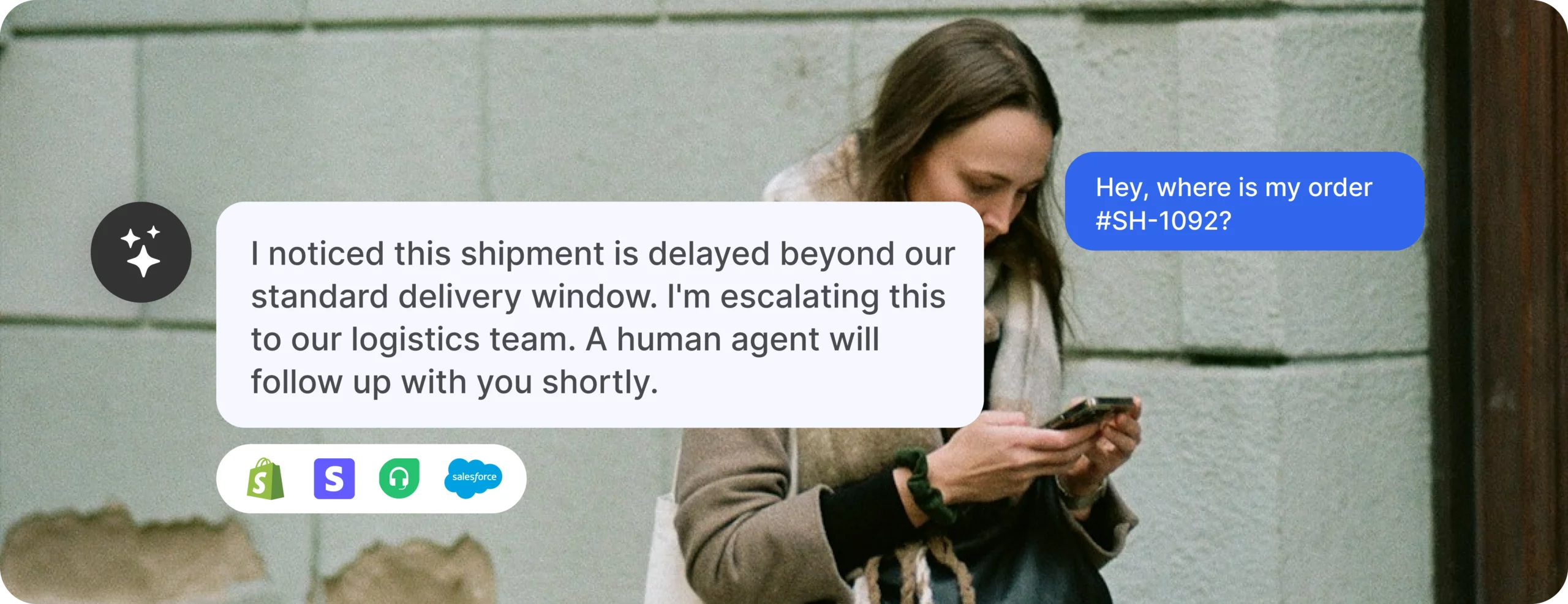
- Order status concierge: Answer “where is my order,” “when will it arrive,” or “can I change the address” instantly without forcing users to track via links.
- Proactive issue alerts: Notify about delays, stock substitutions, or partial shipments early and offer clear options like wait, replace, or refund in the same thread.
- Smart cancellations and modifications: Let users cancel, reschedule delivery, or swap variants through chat within policy rules, without talking to human support.
Post-purchase support and trust building
- Returns and exchanges in chat: Guide users through eligibility, pickup scheduling, and refund timelines conversationally instead of long help centre pages.
- Issue diagnosis from photos: Let shoppers upload images of damaged, wrong, or defective items and get instant resolution paths or approvals.
- Support triage with context: Resolve simple issues automatically and escalate complex ones to human agents with full order history and suggested actions attached.
- Usage and care guidance: Share how to set up, use, or maintain products post delivery to reduce returns and increase satisfaction.
Retention, loyalty, and lifetime value
- Personalised re-engagement: Recommend replenishments, upgrades, or related products based on purchase history, usage cycles, and seasonality.
- Loyalty and rewards assistant: Explain points, eligibility, and best redemption options in simple language instead of dense program pages.
- Feedback and NPS capture: Run short, conversational feedback flows and adapt follow ups differently for promoters, passives, and detractors.
- Referral nudges in context: Trigger referral asks after successful deliveries or positive feedback moments, sharing trackable links or codes directly in chat.
Brand-owned commerce channels
- WhatsApp as a revenue channel: Turn WhatsApp from a support inbox into a full commerce surface where discovery, purchase, and support happen end to end.
- Store associate copilots: Equip in-store or call centre staff with AI agents that surface product knowledge, inventory, and customer context in real time.
- Campaign and drop assistants: Launch new collections, drops, or sales with conversational flows that adapt messaging based on shopper intent and response, not broadcast blasts.
Agentic AI as the new default for CX
In e-commerce, the first few seconds determine everything: bounce or browse, scroll or search, cart or exit.
With agentic AI, these seconds become thoughtful. Responsive. Anchored in what the user actually needs, not what the interface assumes.
The future of e-commerce isn’t just about more products, faster pages, or better targeting. It’s about intelligence that thinks with the shopper, guiding them toward better outcomes without requiring them to do all the work.
That’s how e-commerce stops overwhelming customers with options and starts delivering the kind of customer experience that feels truly considered.
Related Articles