
How agentic AI is reimagining the coffee shop experience
We are not in the coffee business serving people, but in the people business serving coffee – Howard Schultz
Coffee shops have always been about more than caffeine. They’re about rhythm, routine, and recognition. Your local barista remembering your name, your order, your mood – that’s the magic of a great café. But as chains grow and foot traffic swells, delivering that level of thoughtful service at scale has become harder.
Staff turnover is high. Morning queues are unforgiving. New hires are expected to memorise menus and regulars’ preferences within days. The hospitality ideal is stretched under operational pressure.
Enter agentic AI in coffee shops
Agentic baristas are not robots behind the counter, and not chatbots replacing human interaction. They are AI-powered systems that support baristas and customers by carrying context, memory, and reasoning across the café experience. They reduce the cognitive load normally carried in a barista’s head.
Agentic AI doesn’t just assist – it acts. It recognises returning customers, remembers their preferences, and takes initiative. It’s the difference between asking, “What can I get you today?” and saying, “Double espresso, no sugar – ready to confirm?”
From order taking to preference recognition
To move from reactive service to predictive delight, cafés need systems that plugin the data points they already have on them. Most cafés still operate in reactive mode: wait for the customer to speak, tap it in, move on. But what if the system could recognise the customer, pull up their past orders, detect time-of-day or seasonal patterns, and suggest before they speak?
An agentic barista system enables exactly this. It acts with context:
- Knows your weekday vs weekend routine
- Adapts suggestions when you break the pattern (“iced today?”)
- Flags availability (“We’re out of oat milk. Want almond instead?”)
Guest-facing interfaces: tableside agentic menus
Open this agent simulation in a new tab
For seated customers scanning a QR code, the experience is no longer just a static digital menu. Instead, an interactive model opens up:
- Welcomes them by name if known
- Shows usual orders, recent add-ons, preferences
- Offers customisation (“Less sweet today?”)
- Guides checkout and pickup (“Your drink will be at counter 2 in 4 minutes”)
The preferences and intent captured here flow directly into the barista-facing system. Orders arrive with clarity. No need for repeats. Less friction. Better accuracy.
What used to be “self-service” becomes self-aware service.
The digital barista
A personal concierge for discovery and rewards
Open this agent simulation in a new tab
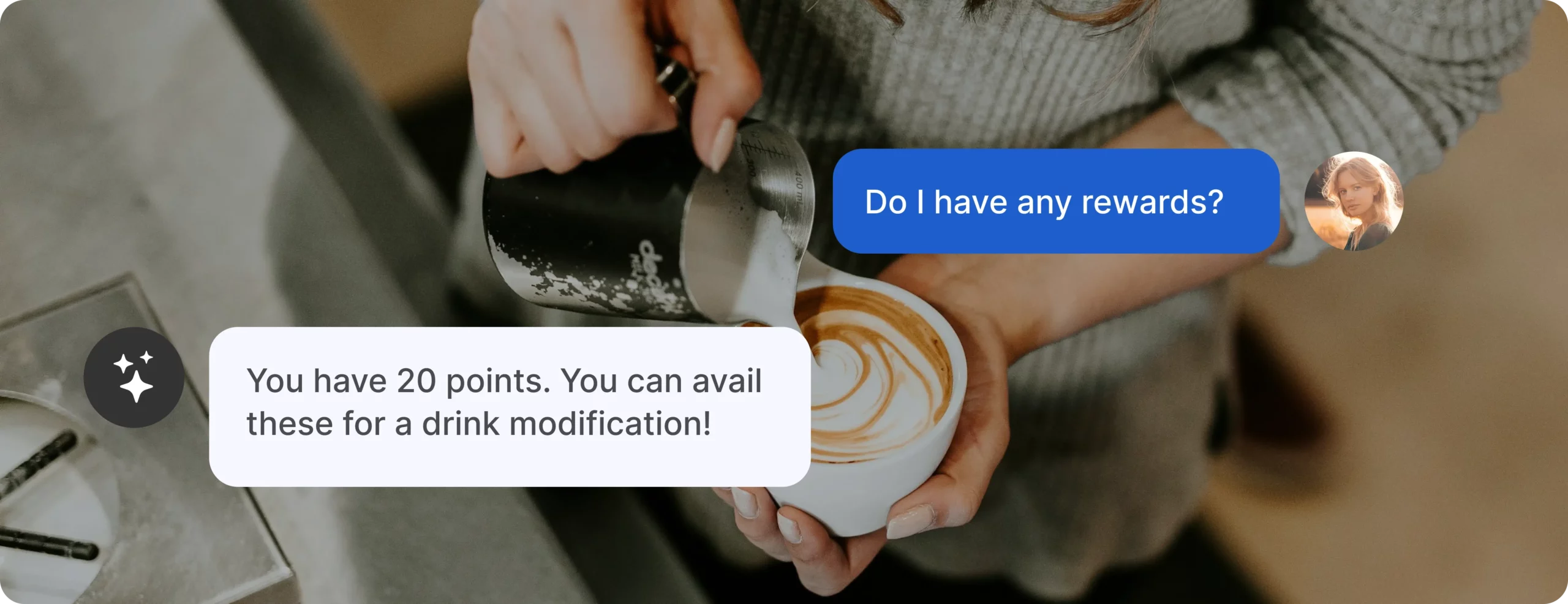
Not every café interaction is about ordering. Some customers want to ask what’s new, check how many loyalty points they’ve earned, or see if any offers are running that day.
This is where a digital barista steps in: an agentic assistant built into kiosks, mobile apps, or WhatsApp-style chat that responds conversationally but with context.
Ask: “How do my rewards work?”
And it doesn’t just say, “You earn 2 points per dollar.” It checks your current balance, reminds you of past redemptions, and adds:
“You have 420 points, enough to redeem a breakfast combo or get 50% off your next drink. And next Friday is Double Points Day. Want me to block your usual slot?”
The agent ties customer intent with real-time business data: ongoing promotions, stock availability, staff rosters, and personalised incentives. It’s not an FAQ — it’s a relationship layer.
Staff-facing interfaces: a smart tab for baristas
Open this agent simulation in a new tab
In many cafés, the barista’s interface is becoming more than a POS terminal. Think of it as a digital barista companion – a tab-based screen that shows:
- Customer walk-ins with predicted orders
- One-tap confirmations (“Prep usual?”)
- Smart suggestions (“Try offering matcha to iced regulars today – trending!”)
It helps staff act like regulars themselves – even on someone’s first day.
New hires gain confidence faster. Experienced baristas avoid mental fatigue during peak hours. Customers experience recognition. The barista experiences support. Technology stays in the background.
A first touchpoint that feels personal
Picture walking into your neighbourhood café. A screen greets you: “Hey Maya, oat milk cappuccino today?”
You nod. It’s already being made.
The agentic barista read your walk-in via app proximity or NFC tap. It recognised the time (8:46 a.m. weekday), cross-checked your pattern (cappuccino + protein bar), and prompted action.
You didn’t order. You just showed up.
Drive-thru reinvented: the voice agentic barista
Now imagine a drive-thru setup where there’s no screen or app – just a friendly multilingual voice agent that greets:
“Hi there! What can I get started for you?”
The customer replies in their preferred language:
“One cappuccino, medium, with oat milk.”
The voice agent confirms the order, sends a payment link instantly via SMS or app, and directs the driver to pull up for pickup.
- Supports multilingual interactions
- Reduces the queue and speech mishearing
- Enables fast, contactless fulfilment
The interface shifts from screen to voice, but the intelligence – intent recognition, continuity, reasoning – remains the same.
The agentic stack behind the barista
Just like the smart chemist, the agentic barista experience is powered by four layers:
- The Brain (Reasoning Engine): Learns patterns, adapts to feedback, updates based on time, weather, supply, and individual preferences.
- The Memory (Customer Context): Remembers orders, modifications, loyalty rewards, favourite tables, dietary flags, and refill rhythms.
- The Hands (Integration Hooks): Ties into POS, inventory, mobile app, loyalty wallet, and prep station screens.
- The Face (Interaction Layer): Could be digital (touchscreen or mobile prompt), voice-based (for drive-thru), or human-assisted (“confirm Maya’s order on the handheld?”).
The same intelligence serves different users in different ways. The surface changes. The reasoning doesn’t.
When staff and systems work together
In a crowded café, human staff may forget – but the system won’t. It can nudge: “Next in the queue is Rahul. He usually orders hazelnut flat white and wants it strong. Shall I prep?”
Baristas get decision support. Customers get speed and surprise. And loyalty stops being a stamp card – it becomes a feeling.
This is not about replacing baristas. It’s about removing the mental burden that keeps them from being fully present. Memory, recommendations, and routing belong to the system. Warmth, timing, and tone belong to the human.
Final sip
Agentic AI doesn’t turn cafés into vending machines. It turns them into thoughtful spaces – where regulars feel known, new customers feel welcomed, and every order feels like someone was paying attention.
Baristas are still the heart of the experience. But now they’re supported, not stretched.
- From coffee transactions to coffee relationships.
- From remembering orders to remembering people.
- From order processing to ritual creation.
That’s the promise of the agentic barista.
Related Articles