
Vibe coding vs Low-code vs AI codegen – The ultimate breakdown
Modern software development has entered a new era. With AI accelerating how we build interfaces, backend logic, workflows, and even code itself, teams today must choose the right approach to deliver fast while maintaining reliability and governance.
This article compares Vibe Coding, Low-Code, and AI Codegen and introduces how DronaHQ’s enterprise-grade Vibe Coding bridges the strengths of all three.
Understanding modern software creation paradigms
Traditional development workflows are giving way to accelerated, AI-assisted models. Teams today rely on:
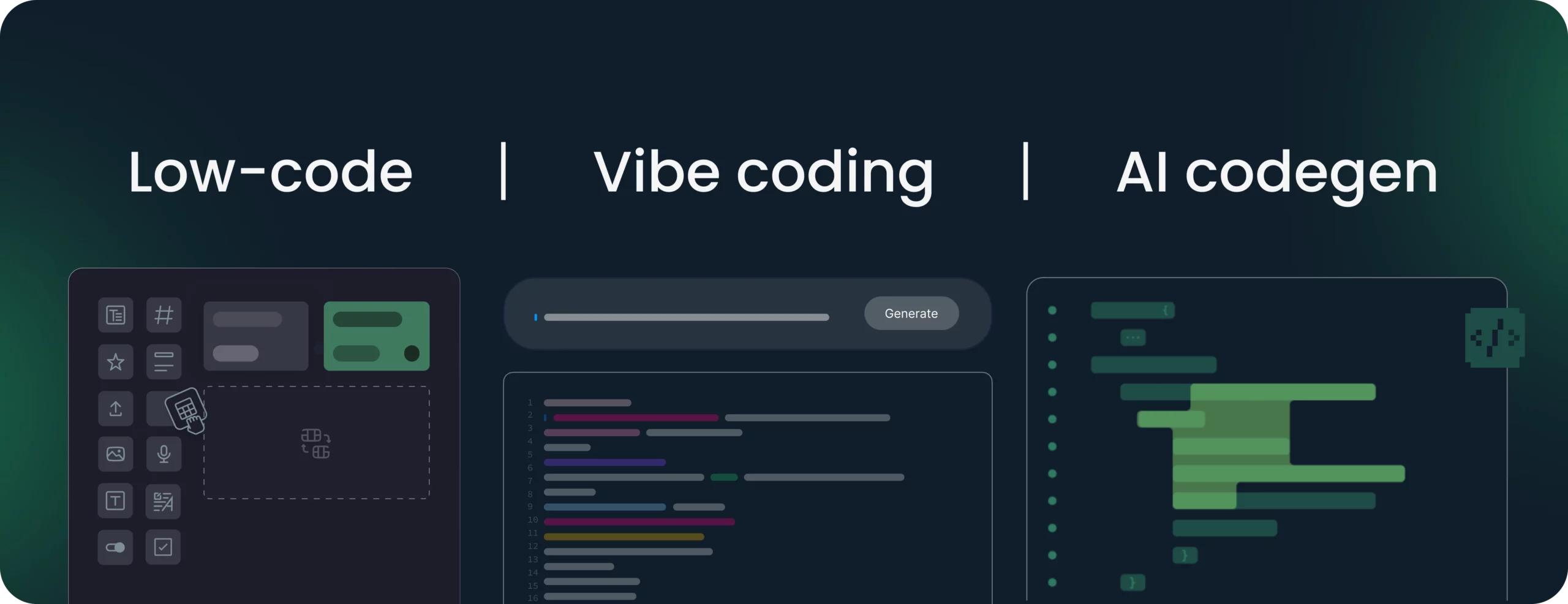
- Vibe Coding: AI-driven UI and logic generation using natural language
- Low-Code platforms: Visual builders for workflows and internal tools
- AI Codegen: Models that write code directly from prompts
Each offers speed, but the depth of control, governance, and deployment readiness varies greatly.
What is Vibe Coding?
“Vibe coding” is a generic industry term, not a standardised framework.
Many developers use assisted coding tools to ship production work, and the workflow is now common across engineering teams. Vibe coding describes this pattern of using AI to quickly draft UI and logic from natural language while still relying on the framework for structure, data binding, and application behaviour.
Tools like Cursor, Copilot, Gemini Code Assist, Bolt.new, Replit AI, and Lovable fall into this category.
The AI generates UI, functions, and backend logic in your chosen framework (React, Angular, Flutter, etc.). But data binding, state management, event handling, and API integration still depend on the underlying framework, not the AI.
How generic vibe coding actually works
This is the standard workflow across AI-assisted coding tools:
- Choose a Framework + AI Tool(e.g., React + Copilot, Flutter + Replit AI)
- Defining Data Models helps generate TypeScript interfaces, schemas, or backend models.
- Prompt the AI to generate UI Example: “Create a customer form with one-way data binding in React.”
The AI produces layouts and helper functions, but binding data, managing state, and handling events still depend on the framework’s primitives. - Manually Implement Data Binding: AI-generated code still requires:
- React
useState,useEffect - Angular
ngModel - Svelte
bind:value - Flutter controllers
- React
- Connect Backend APIs AI writes Axios/fetch wrappers, but developers must integrate and secure them.
- Debug & Validate Generic vibe coding often stops at “looks right,” leaving developers to handle:
- Missing validations
- Broken bindings
- Incorrect async handling
- Security gaps
👉 This is why most comments repeatedly say:
“Vibe coding tools are great for prototyping, but not for production-ready apps.”
DronaHQ: Vibe coding built for the enterprise
While generic vibe coding tools output code, DronaHQ outputs functional, editable, deployable apps.
DronaHQ elevates vibe coding into a full-stack app-building experience:
What makes DronaHQ’s Vibe Coding different?
1. You prompt your app → it generates:
This removes early ambiguity by turning scattered requirements into structured screens and flows.
- A complete BRD
- Full UI layouts
- Screen navigation flows
- React-based underlying architecture
2. Visual component explorer
Unlike code-only tools:
- Every generated UI element appears in a Component List
- You can click any component to modify styling, properties, and layout
- You can refine screens visually without touching code
This helps teams refine layouts without scanning large code files.
3. Visual data binding
Generic vibe coding = manually writing fetch calls & wiring state.
DronaHQ = a visual binding panel:
- Connect APIs, SQL, Sheets, or custom queries
- Bind query fields to UI components
- Preview data instantly
- No writing
useState, Redux, or Axios manually
4. Add events & logic without code
Instead of writing event handlers, you choose:
- Run Query
- Update Variable
- Navigate
- Write to DB
- Show Modal
- Conditional Branching
All through DronaHQ’s visual logic editor. This reduces errors that appear when state handling or query wiring is done manually.
5. Enterprise features are built in
Apps automatically inherit:
- Authentication & SSO
- RBAC (Role-Based Access Control)
- Audit Trails
- Version Control
- Environments (Dev / Staging / Prod)
Governance at this depth is difficult for codegen tools because they do not manage runtime access, deployment environments, or role based controls.
DronaHQ turns AI-generated screens into real, secure enterprise applications.
What is low-code development?
Low-code platforms allow teams to build apps using prebuilt components, visual flows, and minimal scripting.
Strengths
- Fast workflow automation
- Governed development
- Accessible to non-engineers
- Great for internal CRUD apps
Weaknesses
- Limited deep customisation
- UI flexibility can be restrictive
- Vendor lock-in risks
What is AI Codegen?
AI Codegen tools generate raw source code using LLMs. This is perfect for developers already experienced in large frameworks.
Strengths
- High flexibility
- Generates backend + frontend code
- Great for complex modules
Weaknesses
- Requires validation, debugging, and refactoring
- No built-in governance or deployment layer
Direct comparison: Vibe Coding vs Low-Code vs AI Codegen
Required skills
| Method | Skill required |
|---|---|
| Vibe Coding (Generic) | Moderate (AI + manual binding) |
| Vibe Coding (DronaHQ) | Low–Medium (AI + visual refinement) |
| Low-Code | Minimal ramp-up for non engineers |
| AI Codegen | Medium–High |
Skill levels assume basic familiarity with web development concepts such as APIs, data models, and application flows.
Flexibility & customization
- DronaHQ Vibe Coding: High (AI + visual editor + enterprise controls)
- Generic Vibe Coding: High, but code-heavy
- Low-Code: Medium
- AI Codegen: Very high
Automation capabilities
- DronaHQ Vibe Coding: UI, logic, data binding, events
- Generic Vibe Coding: UI + partial code
- Low-Code: Workflows
- AI Codegen: Code generation
The strengths & weaknesses of each approach
Vibe Coding (DronaHQ)
Strengths
- AI builds the skeleton, you refine visually
- Data binding and logic handled visually
- Deployable, secure, enterprise-ready apps
- Removes the manual pain points discussed in Reddit threads
Weakness
- Not intended for writing large backend systems
Low-Code
Strengths
- Business-friendly
- Fast workflow automation
- Governed app delivery
Weakness
- Limited for complex custom UIs
AI Codegen
Strengths
- Best for deep technical customization
- Generates real code in developer-preferred frameworks
Weakness
- Requires strict review
- No enterprise governance layer
Choosing the right approach for your project
Startup use cases
- MVP quickly → Vibe Coding
- Non-technical automation → Low-Code
- Complex architectures → AI Codegen
Enterprise use cases
- Governed internal apps → DronaHQ Vibe Coding
- Workflow automation → Low-Code
- Custom backend services → AI Codegen
Learning curve
- Easiest: Low-Code
- Moderate: DronaHQ Vibe Coding
- Hardest: AI Codegen
Where the future is headed
Development teams are moving toward hybrid creation models:
- Vibe Coding to instantly generate UI + logic
- Low-Code for workflow automation
- AI Codegen for complex engineering work
- Enterprise frameworks to secure everything
And DronaHQ sits at the intersection — offering a unified platform where:
AI builds the app, low-code refines it, and enterprise controls make it deployable.
FAQs: Compare vibe coding vs low-code vs AI codegen
1. Can Vibe Coding replace developers?
No. It accelerates UI/logic creation; developers still architect systems.
2. Does DronaHQ generate real, editable code?
Yes — including structured React layouts and screen flows.
3. How is DronaHQ different from generic vibe coding tools?
It includes data binding, logic editor, RBAC, audit logs, environments, and deployability.
4. Do I still need backend engineers?
For complex systems, yes. But for internal tools, DronaHQ handles most of the heavy lifting.
5. Can I use my APIs?
Yes — bind them visually using queries and connectors.
6. Is DronaHQ suitable for enterprise IT?
Absolutely. It’s built for governed development.
When comparing Vibe Coding vs Low-Code vs AI Codegen, the key insight is:
- Vibe Coding gives unmatched speed and creativity
- Low-Code gives governance and simplified logic
- AI Codegen gives full flexibility
DronaHQ combines all three.
It turns natural language prompts into real, secure, enterprise-grade applications — not prototypes, not demos, but production-ready tools your teams can trust.
Related Articles