
Top AI agent builders for HR and recruitment: enterprise comparison guide (2026)
What most articles do not cover is the part that matters most in enterprise environments: what happens after the demo. How do you govern the decisions an agent makes? Who approves its outputs? What happens when it is wrong? How do you produce a full audit trail of AI-assisted hiring decisions for a compliance review?
This guide is focused on that gap. It is written for HR ops leads, platform architects, and engineering managers evaluating AI agent platforms for real production deployment, not for sandboxed pilots.
What an AI agent actually does in an HR context
An AI agent is a software system that perceives inputs, reasons over them, and takes multi-step actions across connected tools without a human directing each step.
In HR, this looks like: an agent reads an incoming resume, scores it against a structured rubric, checks for red flags, logs the decision with a rationale, sends a calendar invite to the recruiter if the score crosses a threshold, and updates the ATS record, all in sequence, across systems.
The important distinction from a chatbot is operational scope. A chatbot responds to a query. An agent acts across systems, over time, with persistence. That difference is why the evaluation criteria are completely different.
The real stakes for enterprise HR teams
HR sits at the intersection of legal compliance, data sensitivity, and workforce strategy. Errors here compound fast, and accountability flows back to the employer.
The EEOC’s Uniform Guidelines on Employee Selection Procedures place the burden of validating selection tools on the employer, including AI-assisted ones. A vendor’s algorithm is not a liability shield.
According to Deloitte’s 2024 Global Human Capital Trends report, only 17% of organizations felt confident in their ability to govern AI in workforce decision-making. That is a low number, and it reflects how fast adoption has outpaced governance infrastructure.
An agent that screens 500 candidates in four hours without a single human review point is not an efficiency gain. It is a compliance exposure.
Why enterprises are moving on this now
Three things have converged in 2026.
Agent infrastructure has reached production maturity. Multi-agent systems were largely research demos two years ago. The orchestration frameworks, LLM APIs, and enterprise connectors needed to run them reliably in production have matured enough for real deployment.
Regulatory pressure has arrived. The EU AI Act classifies AI used in hiring as high-risk, requiring documentation, human oversight, and transparency by design. Several US states have passed or are actively advancing AI hiring transparency laws. Platforms without native audit trails are not viable in these environments.
Recruiting capacity has hit a structural ceiling. LinkedIn’s 2025 Future of Recruiting report found that application volume per role has increased sharply as candidate-facing AI tools proliferate. Recruiter headcount has not kept pace. The math does not work without automation.
These three forces together make AI agent adoption a planning decision, not a speculative one.
Why this is the only HR AI agent guide you’ll need
Most published content on AI agent builders for HR focuses on feature lists and pricing comparisons. Very few articles address the five failure modes that cause enterprise projects to stall.
1. Optimizing for demo quality instead of operational reliability
AI agents look coherent in demos. Production environments are different: API timeouts, inconsistent LLM outputs, edge cases in candidate data formats, broken field mappings. Enterprises need platforms with retry logic, deterministic checkpoints, and graceful fallback handling. Most content never asks whether a platform can handle a real-world failure.
2. Missing a governance layer
Governance in an AI agent context means structured records of who authorized what, on what data, at what time, and with what reasoning. Most platforms treat this as a post-hoc logging concern.
For HR, governance needs to be native to the workflow. A 2024 research paper on enterprise AI orchestration from arXiv identifies auditability as one of the three non-negotiable properties of enterprise compound AI systems, alongside modularity and human oversight.
3. Removing humans from the loop where it matters most
Fully autonomous AI is not appropriate for candidate rejection, offer generation, or role regrading. These decisions need a human in the approval path, not as a formality, but as a structural requirement.
Research published in MIT Sloan Management Review on human-AI collaboration consistently shows that hybrid human-AI decision processes outperform fully autonomous AI on accuracy in high-stakes domains.
4. No operational interface for the people doing the work
Most agent builders output to an API or trigger a webhook. The recruiter still has to navigate five different systems to see what happened. An operational layer means a single interface where recruiters view pending AI recommendations, review rationale, approve or override, and trigger next steps, without leaving the workflow.
5. Integration complexity that never gets solved
Connecting to enterprise ATS systems like Workday, Greenhouse, or SAP SuccessFactors involves field mapping, authentication, rate limiting, and data schema translation. Most platforms list integrations in their marketing materials. Fewer provide production-ready connectors with field-level documentation and error handling.
How the leading platforms compare
This table evaluates platforms on operational readiness for enterprise HR, not on general AI capability.
| Platform | Orchestration depth | HR/ATS integrations | Governance and audit logs | Human approval workflows | Operational UI | Deployment flexibility | Verifiability | Best fit |
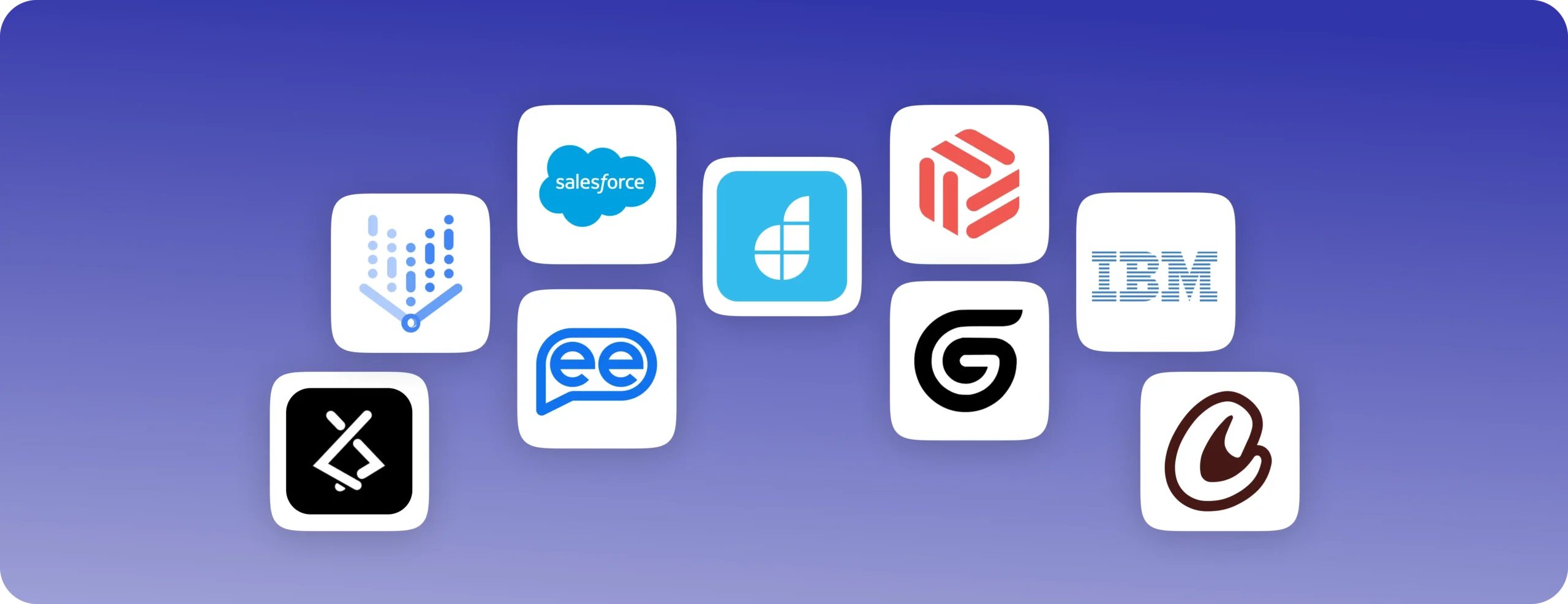
| DronaHQ | High | Strong | Yes (native) | Yes | Yes (low-code builder) | Cloud, VPC, self-hosted | High | Enterprises needing a full operational and workflow layer |
| IBM watsonx Orchestrate | High | Moderate | Yes | Partial | Moderate | Cloud, on-prem | High | Regulated industries with existing IBM infrastructure |
| Salesforce Agentforce | Moderate-High | Strong (Salesforce ecosystem) | Yes | Yes | High (CRM-native) | Cloud only | Moderate | Companies already running recruiting on Salesforce |
| Leena AI | Moderate | Moderate | Partial | Yes | Moderate | Cloud | Moderate | Employee service desk automation |
| Lyzr AI | Moderate | Low | Partial | Partial | Low | Cloud | Moderate | Developer-led teams building custom agents |
| Gumloop | Low-Moderate | Low | Minimal | Minimal | Low | Cloud | Low | SMBs, simple automations |
| Beamery | Low | Strong (HR-native) | Partial | Partial | Moderate | Cloud | Low | Talent CRM and sourcing teams |
| CrewAI | High (framework) | Low (code-only) | Minimal (custom build) | Minimal | None out of box | Self-hosted | Developer-defined | Engineering teams building from scratch |
| Vertex AI Agent Builder | High | Low | Moderate | Partial | Low | GCP only | Moderate | GCP-native teams with ML engineering capacity |
AI agent use cases in HR and recruitment, by workflow type
Candidate sourcing
A sourcing agent monitors job boards, LinkedIn, internal databases, and talent pools to surface candidates matching a role specification. It scores them, deduplicates across sources, and creates a ranked shortlist.
The critical design requirement here is explainability. The agent must show why each candidate was included or excluded, in language a recruiter can act on and a compliance team can audit. Opaque scoring is a liability in most enterprise and regulatory environments.
Resume screening
Screening agents parse applications against structured criteria and produce scores with rationale. The important design choice is keeping scoring deterministic rather than letting the model make unstructured judgment calls. Rule-based scoring layers on top of LLM parsing handle this better than free-form model inference.
Research from the National Institute of Standards and Technology (NIST) on AI bias in automated decision systems recommends explainable, documented criteria as a baseline for high-stakes automated selection.
Interview scheduling and coordination
This is one of the highest-ROI, lowest-compliance-risk starting points. The agent reads candidate and interviewer availability, proposes times, sends calendar invites, and handles rescheduling.
Because scheduling errors are recoverable and the decision stakes are low, this use case is a practical first deployment for enterprises testing AI agent infrastructure before moving to screening or selection workflows.
Employee onboarding
Onboarding agents handle the first-90-days checklist: access provisioning, training module assignment, document routing, welcome communications, and follow-up on incomplete tasks. The challenge is cross-department coordination. Onboarding spans IT, HR, and line management. Orchestration depth matters more here than in single-system workflows.
Internal HR helpdesk
These agents answer employee questions about benefits, PTO policy, payroll dates, and HR procedures. They pull from a structured knowledge base and escalate to a human HR rep when the query falls outside known categories.
Accuracy and escalation logic are the key evaluation criteria. An agent that confidently gives a wrong policy answer is worse than one that says the question needs human review.
Workforce analytics
Analytics agents surface patterns from HR data: time-to-fill trends by team, offer acceptance rates by role, attrition risk signals, headcount forecast gaps. They do not make decisions. They surface information for human decision-makers.
Gartner’s research on AI in HR functions identifies workforce analytics as the HR AI use case with the highest enterprise adoption and the clearest measurable ROI, partly because it carries lower compliance exposure than selection workflows.
Platform breakdown
DronaHQ
DronaHQ’s agentic platform is built around a practical problem: enterprises do not just need an AI agent, they need an AI agent that connects reliably to internal systems, produces a documented record of every action, and does not require engineering resources to maintain the connection layer. DronaHQ positions itself as an operational AI platform rather than a pure agent framework. It combines low-code interface building with agent orchestration, allowing teams to build both the backend agent logic and the frontend interface (recruiter dashboards, approval queues, audit views) in one environment.
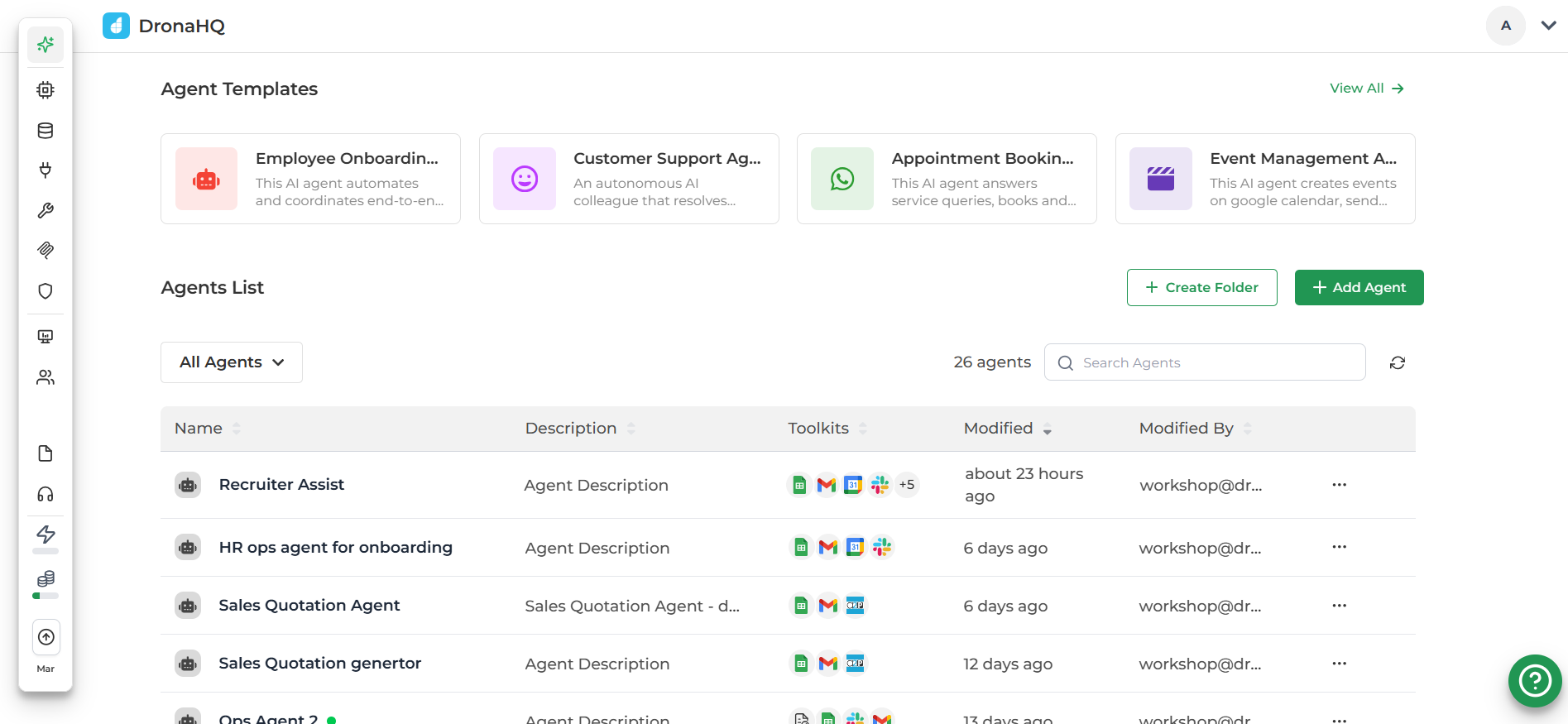
Strengths: 4,000+ OAuth integrations without API key overhead. Built-in audit trails with decision-level transparency. Context management across conversation threads. Rapid iteration through the testing playground. Flexible deployment: cloud, VPC, and self-hosted.
Tradeoffs: The pre-built agent marketplace is small, so most HR workflows require building from a blank canvas. That is manageable given the customisation depth, but it does mean a meaningful upfront configuration investment. Custom branding is restricted to the Business tier and above. Not the right fit for small teams or solo developers with no governance requirements.
Best for: Mid-to-large enterprises connecting AI agents across HR systems where governance, auditability, and integration reliability are non-negotiable from day one.
IBM watsonx Orchestrate
IBM’s enterprise AI platform includes multi-agent orchestration, enterprise skills libraries, and governance tooling. IBM OpenScale provides model observability and bias monitoring.
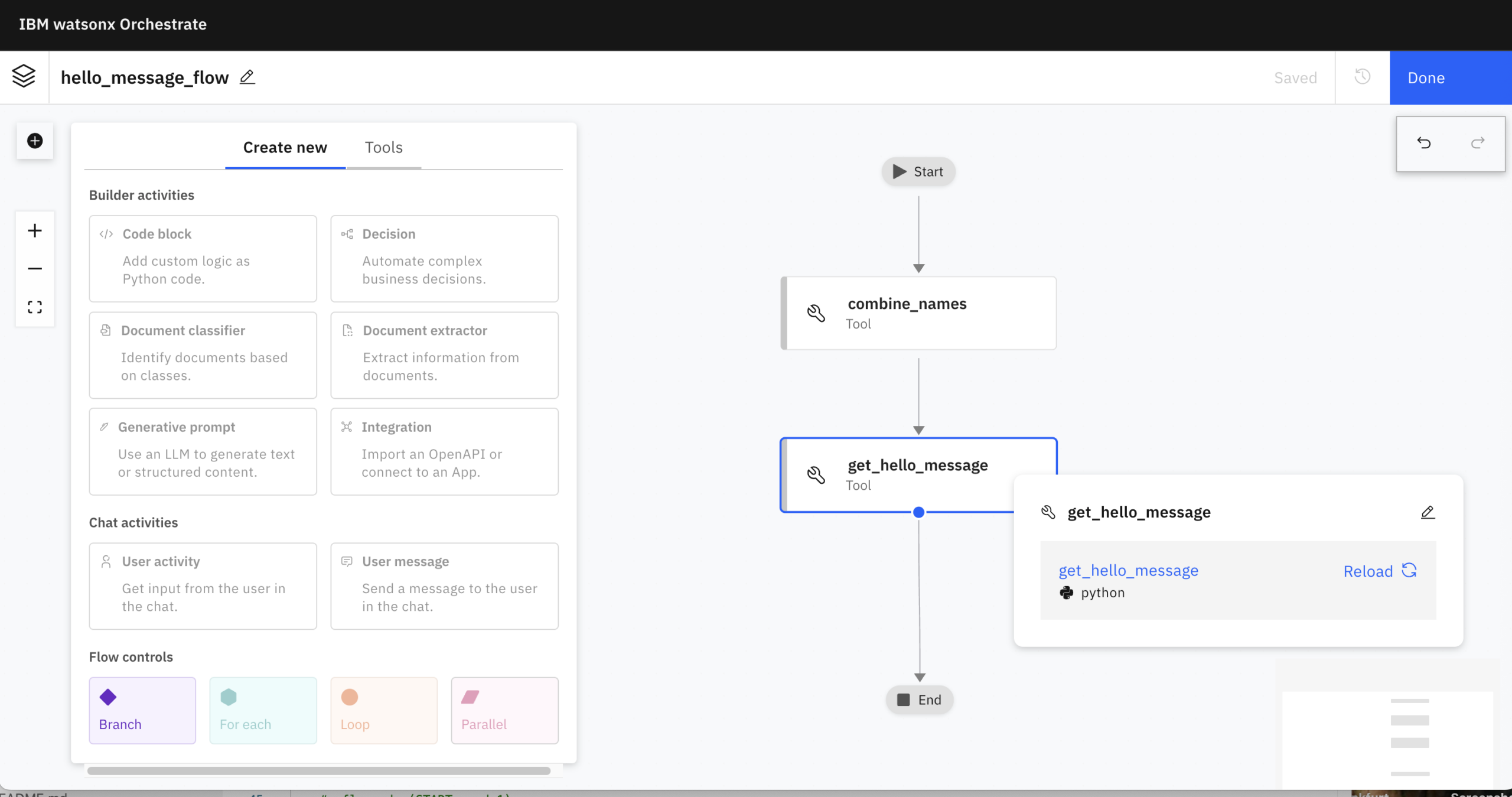
Strengths: Strong governance infrastructure. Mature enterprise integration support. Suitable for regulated industries where the provenance of every AI decision is a legal requirement.
Tradeoffs: Implementation complexity and cost are high. Best suited to organizations with dedicated AI/ML teams or an existing IBM partnership.
Best for: Large enterprises in financial services, healthcare, or public sector with existing IBM infrastructure.
Salesforce Agentforce
Agentforce is Salesforce’s agentic AI layer, embedded in the CRM platform. For companies running recruiting through Salesforce or connected HCM clouds, it enables agent-driven workflows within a familiar interface.
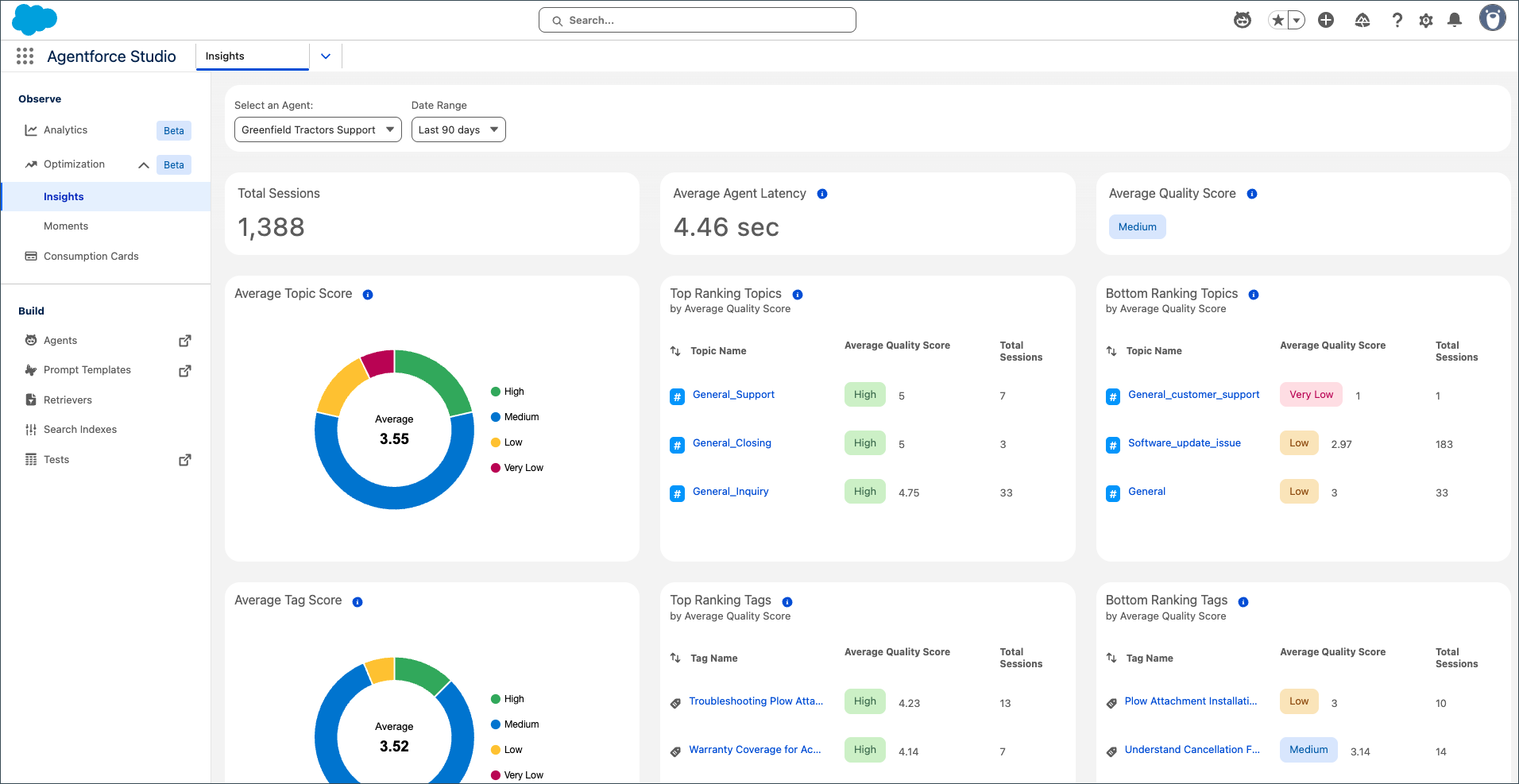
Strengths: CRM-native means no context switching for recruiters already in Salesforce. Approval workflows and record-keeping inherit Salesforce’s compliance structure.
Tradeoffs: Limited reach outside the Salesforce ecosystem. Integration with non-Salesforce ATS systems requires significant custom work.
Best for: Companies using Salesforce as their CRM and recruiting backbone.
Leena AI
Leena AI focuses on the employee-facing side of HR: service desk queries, HR communications, policy FAQ resolution, and onboarding communication. It is conversational-first.
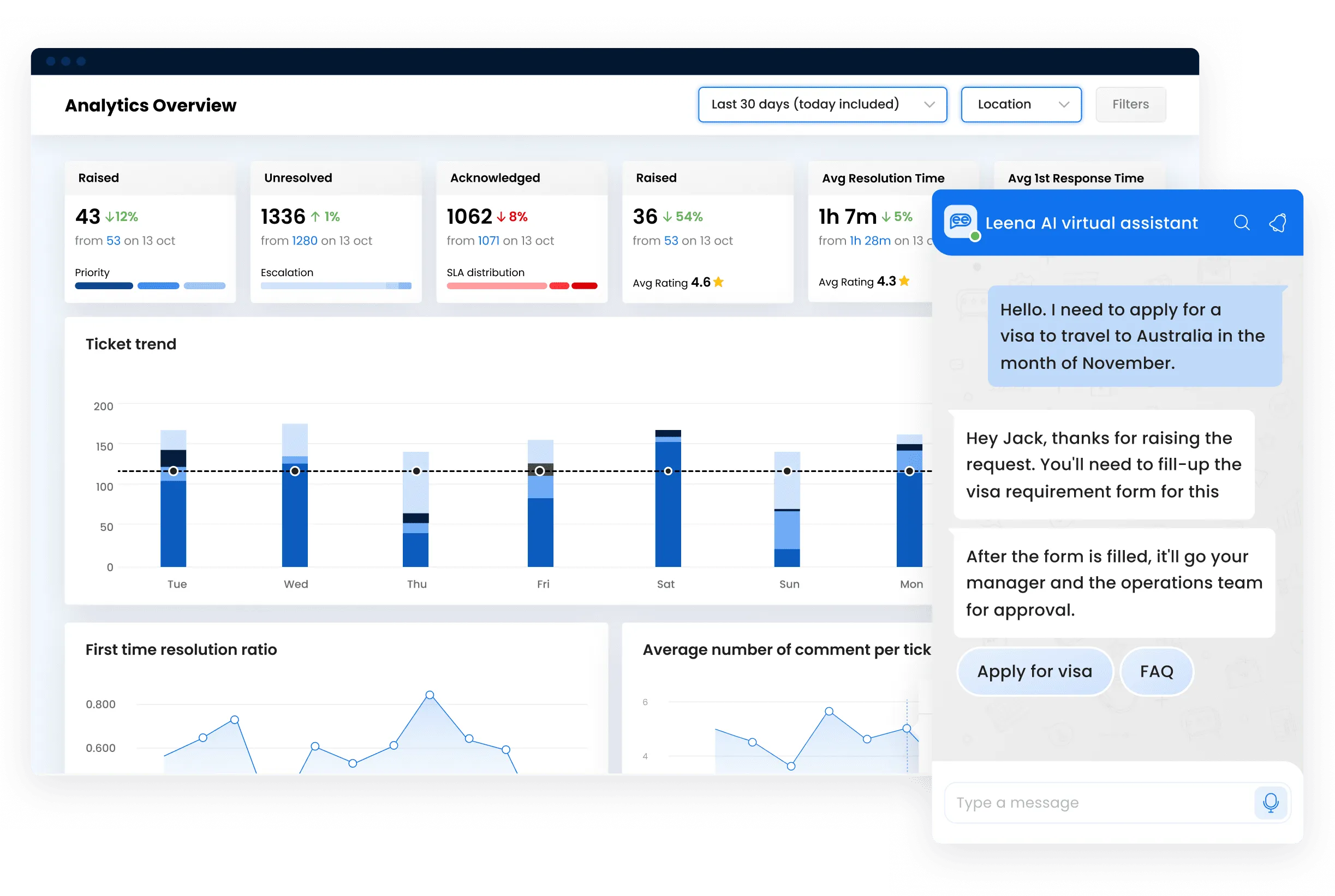
Strengths: Fast to deploy for HR helpdesk use cases. Reasonable integration coverage for popular HRMS platforms. Includes escalation logic out of the box.
Tradeoffs: Limited orchestration depth for multi-step recruiting workflows. The agent model is reactive rather than proactive.
Best for: Teams focused on reducing HR service desk volume and improving employee self-service response time.
Lyzr AI
Lyzr is a developer-focused agent framework. It provides components for memory, orchestration, and retrieval-augmented generation (RAG), but requires significant engineering to configure and deploy.
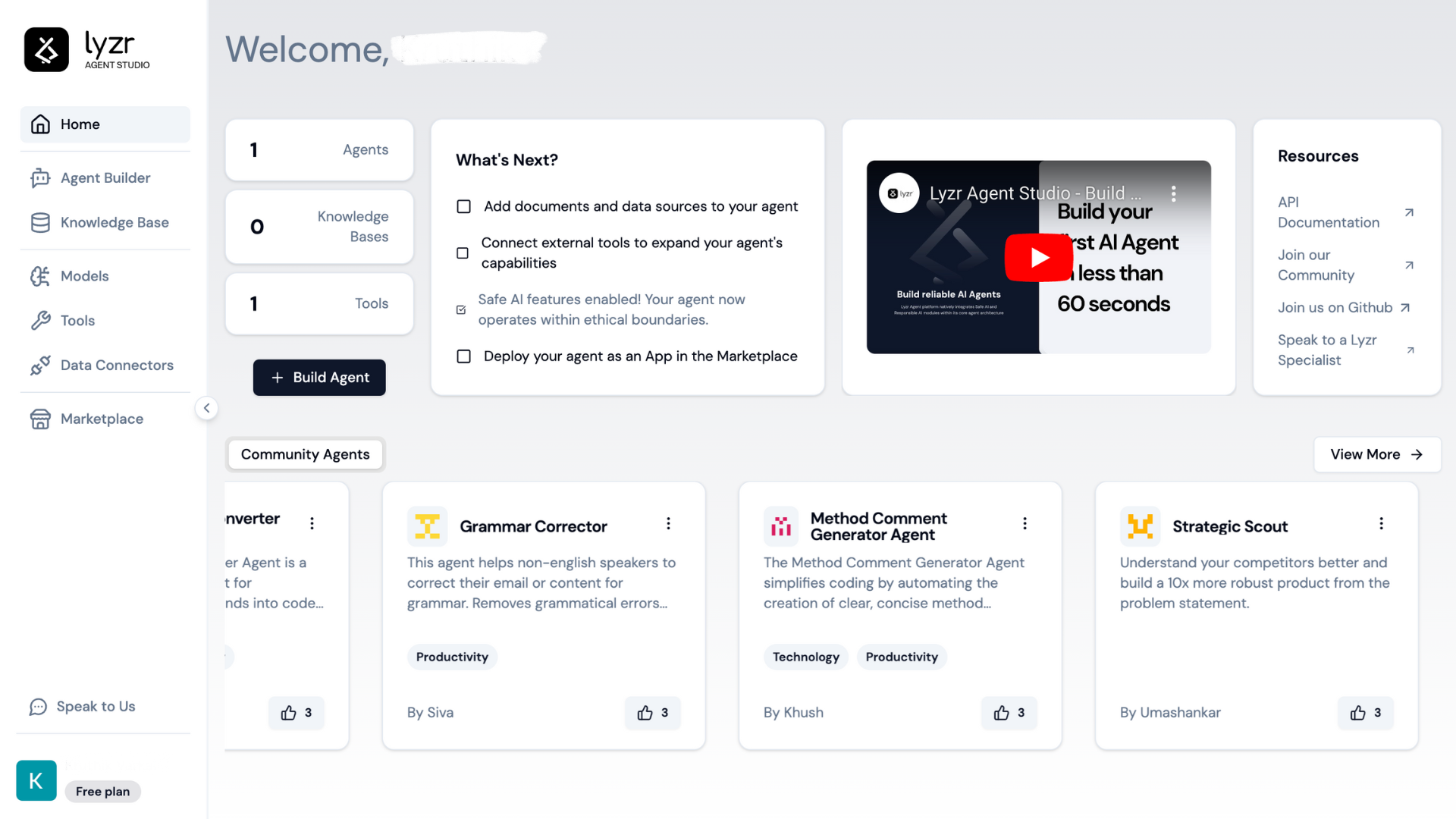
Strengths: High extensibility. No vendor lock-in. Suitable for teams that want full control over agent architecture.
Tradeoffs: No operational UI, governance framework, or HR-specific tooling out of the box.
Best for: Engineering teams with the capacity to build and maintain a custom HR AI system.
Gumloop
Gumloop is a visual automation builder with some AI workflow capabilities. It handles basic LLM-step automations with a drag-and-drop interface.
Strengths: Fast to prototype. Accessible to non-technical users for simple tasks.
Tradeoffs: Not built for enterprise HR requirements. Governance, audit logs, and complex integrations are not native.
Best for: Small companies automating simple tasks like email follow-ups or data formatting.
Beamery
Beamery is a talent intelligence platform with AI built into sourcing, talent CRM, and workforce planning. It is purpose-built for HR, not a general agent framework.
Strengths: Deep HR domain knowledge. Strong talent pipeline and sourcing features.
Tradeoffs: AI capabilities are tightly coupled to Beamery’s own data model. Extending beyond core use cases requires substantial effort.
Best for: Talent acquisition teams focused on sourcing and pipeline management.
CrewAI
CrewAI is an open-source multi-agent Python framework. Developers define agents with roles, assign tasks, and coordinate them through code.
Strengths: Maximum flexibility, no vendor lock-in, active open-source community.
Tradeoffs: No operational UI, no governance framework, no enterprise support by default. Deploying in a production HR environment requires building significant infrastructure around it.
Best for: Research teams or engineering-heavy companies prototyping agent architectures.
A framework for evaluating AI agent builders for enterprise HR
Use this as the evaluation structure before any platform decision.
Orchestration depth. Can the platform handle multi-step conditional workflows across multiple systems? Does it handle errors, retries, and timeouts without manual intervention?
Governance and auditability. Does every agent action produce a structured log? Can you reconstruct the complete decision trail for any hiring action? Is this built-in or does it require a separate logging infrastructure?
Human-in-the-loop design. Where does the platform enforce or allow human review? Is this configurable per workflow type? Can approvals route to specific roles or teams?
Integration ecosystem. Which ATS, HRMS, and communication tools does it connect to natively? What is the process for adding a custom connector? Who maintains it when the upstream API changes?
Operational interface layer. Does the platform include interfaces for the humans working alongside the agents? Can a recruiter see all pending recommendations, review rationale, and take action in one screen?
Deployment and security. Can it run on-premises or in a private cloud? Does it support SSO, RBAC, and data residency requirements?
Verifiability. Can you inspect what the agent actually did, not just what it was configured to do? This matters for post-hoc audits and regulatory examinations.
How to deploy AI agents in HR without the common failures
Start with lower-stakes workflows. Interview scheduling and onboarding task routing are solid first deployments. They return measurable ROI without the compliance exposure of screening or selection.
Build governance before you build at scale. Define what gets logged, who reviews what, and what triggers human escalation, before you run volume through the system.
Do not automate a broken process. An AI agent will make a broken workflow faster and more broken. Map the workflow manually first. Fix obvious gaps. Then automate the reliable parts.
Run staged rollouts. Deploy to one team, one role type, or one geography. Monitor decision quality, recruiter satisfaction, and compliance adherence before expanding.
Train recruiters on working with agents. Recruiter skepticism and misuse are more common failure modes than platform issues in early deployments. Clear training on when to override, how to interpret agent rationale, and what to escalate resolves most of this.
Where enterprise HR AI is heading
The current adoption wave is still largely exploratory. The next phase is standardization: enterprise-wide agent orchestration layers, shared governance infrastructure, and regulatory frameworks that treat AI-assisted hiring decisions equivalently to documented human ones.
The platforms that remain viable through that shift will be those that can demonstrate decision-level auditability, not just task-level automation. Enterprises building operational AI infrastructure now, with governance built in from the start, will spend significantly less on remediation when compliance requirements harden.
Frequently asked questions
Q: What is an AI agent builder? An AI agent builder is a platform that lets teams create software agents capable of planning and taking multi-step actions across connected systems without human direction at each step. In HR, this includes screening, scheduling, and onboarding workflows that span multiple tools and data sources.
Q: How do AI agents differ from chatbots in recruiting? Chatbots respond to queries. AI agents act across systems over time. A recruiting agent can screen a resume, update an ATS record, send a calendar invite, and log a compliance note in one autonomous workflow, without a human directing each step.
Q: What makes an AI agent platform enterprise-ready for HR? Enterprise readiness in HR requires native governance and audit logging, configurable human approval workflows, stable multi-system orchestration, and deployment options that meet data residency and security requirements.
Q: Can AI agents replace recruiters? No. AI agents handle high-volume, repeatable tasks: screening, scheduling, follow-ups, data entry. Judgment-intensive decisions involving candidate fit, offer negotiation, and panel calibration still require human expertise and accountability.
Q: What governance requirements apply to AI used in hiring? In the US, the EEOC’s Uniform Guidelines on Employee Selection hold employers responsible for validating AI-assisted selection tools. The EU AI Act classifies hiring AI as high-risk, requiring documentation, human oversight, and transparency by design.
Q: Which HR workflow should enterprises automate first with AI agents? Interview scheduling is the recommended starting point. It delivers measurable recruiter time savings, involves lower compliance risk than screening or selection, and provides a foundation for evaluating agent infrastructure before expanding to higher-stakes workflows.
Related Articles