
Understanding data binding in vibe coding
Vibe coding is not a formal framework. It is a broad term used for building applications through AI-assisted prompts in tools such as GitHub Copilot, Gemini Code Assist, Cursor, Lovable, Bolt.new, and Replit AI.
These tools operate on top of existing frameworks. The AI produces JSX, Dart, Angular templates, or Svelte code by following the rules of that framework. This means the data binding approach, state patterns, and event flows still depend fully on the underlying stack. The AI does not create a new binding system. It simply writes code that matches the binding conventions of React, Angular, Svelte, Flutter, or whatever stack you pick.
How generic vibe coding tools handle data binding
Across most AI-driven coding tools, the workflow is largely consistent.
Choose your framework and AI tool
You start by selecting your stack. For example, React with Copilot, Angular with Gemini Code Assist, or Flutter with Replit AI. The AI then produces UI components and supporting logic that follow the conventions of that stack.
Define data models
Most teams prompt the AI to generate interfaces, schemas, or models. This gives structure to the upcoming UI.
Example: “Define a User type and build a React form bound to this model.”
Generate UI through prompts
The AI produces tables, forms, list views, and screens based on prompts. It writes the code, but the binding rules are still dictated by the framework.
Apply actual data binding
This step is always manual in most vibe coding.
- React uses state hooks and event handlers
- Angular uses ngModel
- Svelte uses bind
- Flutter uses controllers
The AI simply writes calls to these mechanisms.
Connect backend data
The AI can draft Axios services, fetch wrappers, GraphQL queries, or Firebase utilities. Integration quality and security remain in the developer’s control.
Validate and debug
Developers handle validations, async behaviour, error cases, imports, and code structure. This is where vibe coding starts to show its limits, because generated code often needs cleanup before it becomes reliable.
How DronaHQ changes the data binding workflow
DronaHQ applies AI to the app’s structure rather than only the code. It keeps the speed of vibe coding while moving binding, logic, and integration into visual and governed layers that match enterprise standards.
AI generates both UI and logical structure
DronaHQ produces screens, layouts, navigation, and a structured BRD. This provides a stable foundation rather than a loose collection of code files.
Component list and visual data binding
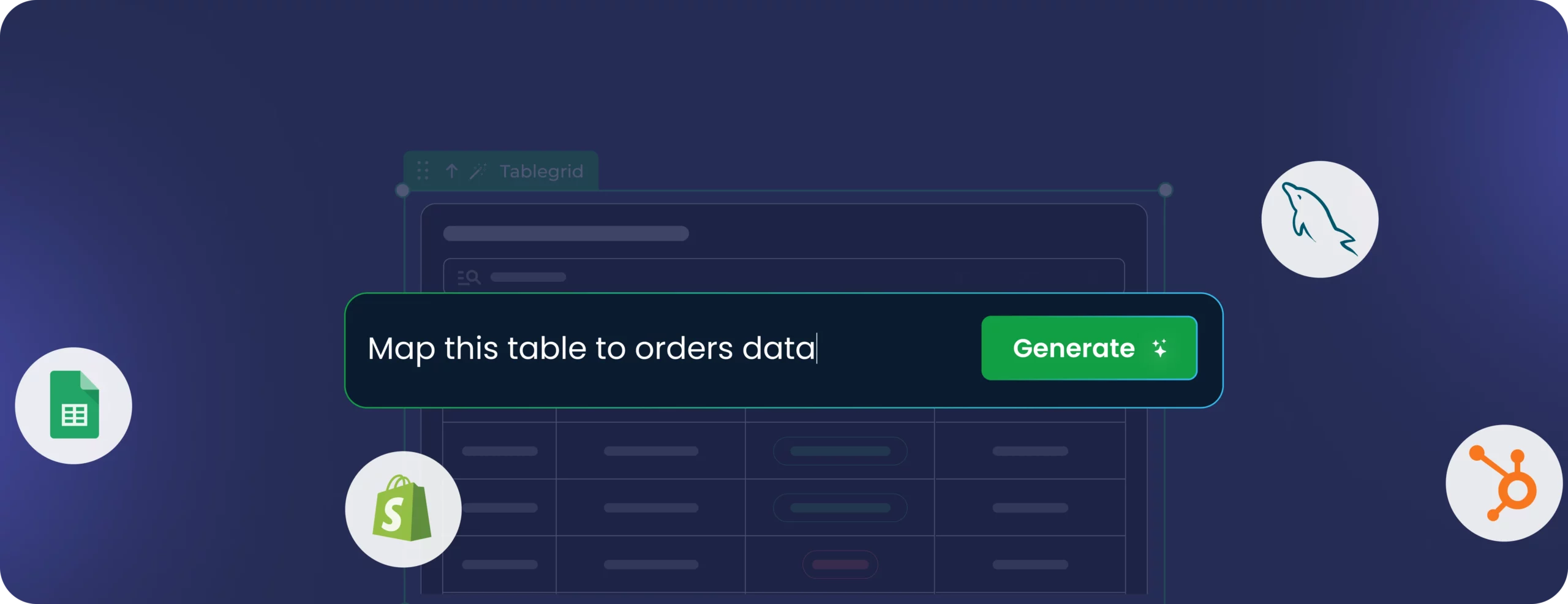
Every generated component appears in a component tree. You can select any table, form, input, card, or button and bind it directly to queries, APIs, SQL databases, spreadsheets, or variables.
No need for state hooks, effects, Axios calls, or Redux patterns.
Visual events and logic
Instead of writing handlers in code, you choose actions from the logic editor. You can run queries, update variables, navigate, show modals, write to databases, or add conditional branches. This keeps logic traceable and consistent for teams.
Enterprise layer included
Applications built on DronaHQ inherit authentication, SSO, RBAC, audit logs, versioning, and dev to prod environments. Codegen tools do not provide this because they focus on generating files rather than governing the application lifecycle.
Comparison of generic vibe coding and DronaHQ vibe coding
Read a detailed comparison on vibe coding vs low-code vs AI codegen here>
| Feature | Generic AI tools | DronaHQ vibe coding |
|---|---|---|
| UI generation | Yes | Yes |
| App structure | Basic files | Structured screens and flows |
| Data binding | Manual | Visual binding |
| Events and logic | Manual | Visual logic editor |
| Backend setup | Manual | Connectors and visual queries |
| Security | Not provided | Enterprise ready |
| Deployment | Manual | Deploy from platform |
Generic vibe coding tools help teams write code more quickly. DronaHQ focuses on the entire application lifecycle. This includes data binding, logic, flows, and operational controls. The result is an AI assisted development model that fits real engineering workflows and enterprise governance.
Related Articles