
The CFO’s Next Question: Time to Put a Price on Every AI Outcome
Enterprise AI is mired in “agent sprawl,” with no answer to the CFO’s core question: “What is our cost per outcome?” A DronaHQ co-founder argues that the solution requires a structural shift to a platform that exposes the true economics of every agentic job.
DronaHQ’s No‑Code Agentic Platform Abstracts Engineering and Puts a Price on Every Outcome
The hidden cost problem in enterprise AI
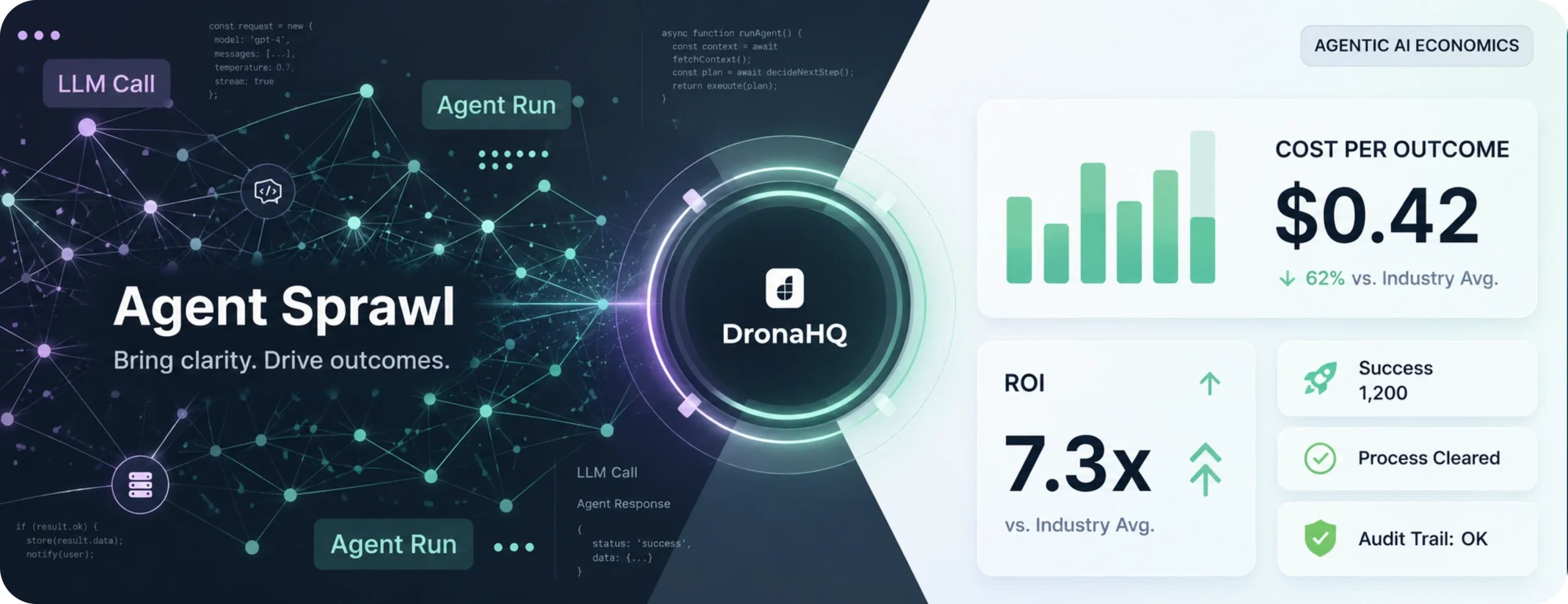
In some large enterprises today, the numbers are already startling. Between experiments in different business units and vendor-led pilots, it is no longer unusual to find catalogues of ten thousand or more agents scattered across the organisation – some live, some abandoned, many overlapping in purpose. What began as a handful of promising experiments has quietly become agent sprawl at industrial scale, and yet one basic question still can’t be answered with confidence: which of these agents are actually worth what they cost?
Why nobody can answer “what’s our cost per outcome?”
Inside these organisations, dashboards glow with graphs showing tickets handled, conversations completed, documents processed. AI teams talk about models and prompts and context windows. Business teams share anecdotes of impressive demos. But when the CFO leans forward and asks, “What is our cost per outcome?”, the room hesitates. The hesitation is not because people don’t care about ROI; it’s because the stack was never designed to expose it.
The problem is structural. Most AI projects are stitched together from models, orchestration engines, internal tools, and human reviewers, each living in a different layer. Model bills arrive from one vendor. Infrastructure and orchestration costs sit on another line. Human-in-the-loop review time is buried in timesheets or never properly measured. The business outcome itself – a resolved ticket, a processed claim, a cleared quality defect – lives in yet another system. Very few organisations have any way of tying all of this together into a single, defensible number for a single job.
A Financial Blind Spot at Scale
As the number of agents climbs into the thousands, that gap becomes more than an academic concern. It is not just an engineering or governance headache; it is a financial blind spot. When an enterprise is running thousands of agents across dozens of workflows, the difference between a low-ROI use case and a high-ROI one can move real numbers on a P&L. In that context, a platform that refuses to treat agents as free abstractions and instead insists on attaching a price to every outcome is less a feature choice and more a governance stance.
Rethinking the agent stack from the cost layer up
It is into this landscape that DronaHQ is introducing its no-code Agentic Platform, and it is tellingly not positioning itself around the next model upgrade. The core promise is more fundamental: abstract the engineering so that teams can build and deploy agents without assembling their own stack, and, just as importantly, expose the economics so that every agentic job carries a visible price per outcome.
DronaHQ comes from more than a decade of helping enterprises build operational software: internal tools, workflows, and applications that sit close to systems of record and have to survive audits, approvals, and production traffic. In that world, the measure of success was never a flashy demo; it was whether a workflow actually moved a metric that mattered to the business. The Agentic Platform is an extension of that philosophy into the AI era.
On the surface, it offers what many teams say they want: a no-code environment where business and operations leaders can describe the intelligence they need – how an agent should behave, what data it can see, what actions it can take – and let the platform handle the plumbing. They can click together RAG agents that read and reason over internal documents, data agents that analyse and reconcile records across systems, and OCR agents that turn PDFs and images into structured, auditable data. The same intelligence can then be reached over chat, voice, or APIs, so an agent can sit inside a support portal, answer calls in a contact centre, or be invoked programmatically from existing applications without duplicating logic.
The real innovation — pricing every outcome
Under the surface, the organising idea is not the orchestration; it is the accounting. The platform is built so that every time an agent runs, the work it does is both traced and priced. Each job is treated as a unit of work with a cost. Model usage, orchestration steps, tool calls, and human reviews are not just logged; together they form the cost basis for that specific outcome.
In practical terms, this changes how ROI is discussed. A large insurance broker using DronaHQ to process renewals and portability cases is not limited to generic claims about faster turnaround. Its document agents read incoming PDFs, look up current coverage, generate revised proposals, and route them for human review where needed – and the broker can see that each policy can be turned around for on the order of forty to fifty cents per document, end to end, including the agent stack running on DronaHQ cloud. They can compare that against the previous human-only process and argue their case in numbers, not anecdotes.
The same pattern shows up in customer support. A retail company rolling out support agents is no longer restricted to reporting that “AI handled 60% of tickets this quarter.” On DronaHQ, support agents pull live order data, reference policy, and update systems under strong governance, and the company can see that the cost per resolved ticket has dropped from a few dollars to well under a dollar – in some cases approaching fifty cents per resolution – with a clear audit trail of how each outcome was reached. Again, the value is not only in the automation, but in being able to price that automation precisely.
All of this is reinforced by a pricing model that mirrors the product’s philosophy. DronaHQ does not ask customers to commit to large subscriptions in the hope that value will appear later. Instead, it charges per job: enterprises pay for the agentic work that actually runs. For CFOs, there is a certain symmetry in that. A platform built to show cost per outcome internally also shows cost per outcome at the billing layer. There is no need to amortise a sunk platform cost across dozens of experiments; if a use case does not justify itself, it can be shut down without the shadow of a stranded subscription.
What changes when cost is visible by default
When you design a system in which cost per outcome is observable by default and pricing is aligned with that view, it changes behaviour. Business leaders can run focused experiments, watch the real-time economics of a workflow, and decide early whether an agent should be scaled up, redesigned, or retired. In some cases, the most valuable outcome is negative: a clear, data-backed conclusion that a particular workflow should not be agentic at all.
In an environment where some companies have already created five-figure fleets of agents, the ability to say “no” with numbers is as important as the ability to say “yes” with enthusiasm.
Related Articles