
5 Workflows where ecommerce AI agents beat generic chatbots
AI in ecommerce has moved beyond simple chat widgets that answer FAQs. Today, ecommerce AI agents act as goal-oriented assistants that can plan, reason, and take actions across your stack to drive revenue, reduce cart abandonment, and resolve CX bottlenecks in ways a traditional ecommerce chatbot cannot.
Unlike a basic ecommerce chatbot that reacts to user questions inside a chat window, ecommerce AI agents operate across the entire customer journey — from product discovery and checkout to returns and post-purchase operations.
Chatbots vs AI Agents in E-commerce: What’s the Real Difference?
In ecommerce, a chatbot is typically a rules-based or flow-based assistant that responds to customer questions using predefined scripts or basic NLP. An ecommerce chatbot may trigger simple actions like creating a support ticket or sharing a link, but it generally operates within a fixed decision tree.
An ecommerce AI agent, by contrast, is a goal-driven system that understands intent and context, reasons over real-time data, and executes multi-step workflows across systems such as your catalog, OMS, CRM, marketing platform, and inventory tools. The objective is not just to answer a question, but to achieve a measurable business outcome such as higher conversion, lower returns, faster resolution time, or improved customer lifetime value.
Chatbots primarily operate inside a conversation. They respond to prompts and escalate when flows break. Ecommerce AI agents observe behavior across sessions, anticipate needs, and coordinate actions across systems — adjusting recommendations, recovering carts, resolving refunds, and updating backend systems without waiting for a perfectly phrased question.
| Dimension | Ecommerce Chatbot | Ecommerce AI Agent |
|---|---|---|
| Primary role | Answers FAQs and handles scripted support flows. | Pursues business goals such as higher conversion, lower abandonment, and faster refunds. |
| Context depth | Limited to current session and a few attributes. | Uses browsing behavior, purchase history, inventory, and logistics data to personalize decisions. |
| Actions | Shares information and collects inputs. | Edits orders, checks stock, launches campaigns, triggers returns, and coordinates systems. |
| Learning | Improves through manual flow edits. | Improves based on feedback, behavioral data, and performance outcomes. |
| Business impact | Reduces support workload. | Directly influences revenue, AOV, cart recovery, CSAT, and cost-to-serve. |
Workflow 1: Guided Product Discovery and Personal Shopping
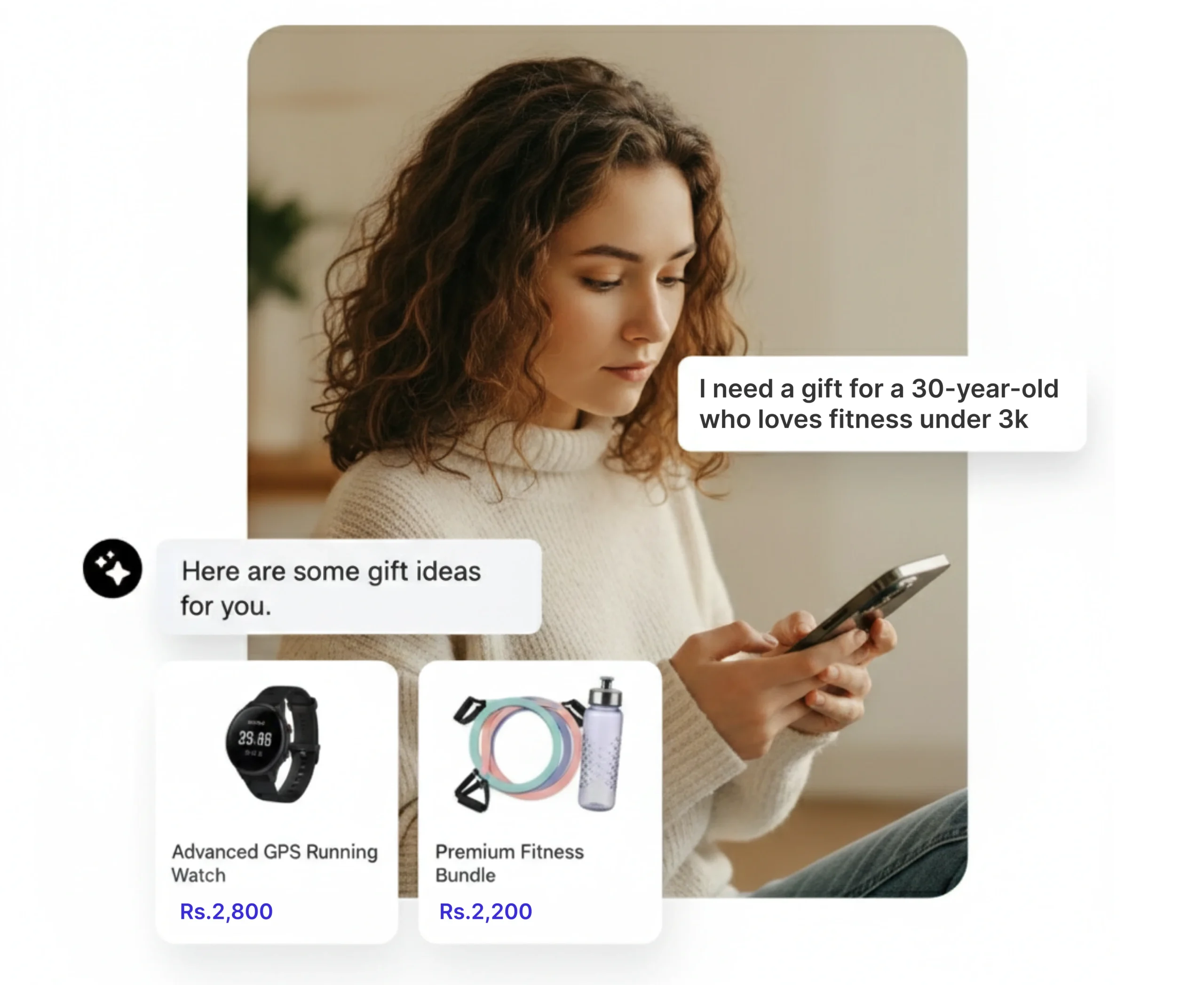
Most ecommerce chatbots support basic discovery. They answer questions like return policies or shipping zones and may run a simple quiz. However, they struggle when a shopper has layered requirements involving budget, size, availability, and delivery windows.
Ecommerce AI agents for guided selling act more like personal shoppers. They can:
• Read product metadata, reviews, and real-time availability to recommend relevant options.
• Combine browsing behavior and purchase history to personalize bundles or cross-sells.
• Engage proactively on product and category pages based on signals, not just chat prompts.
For ecommerce brands focused on improving conversion rate and AOV, this is one of the clearest use cases for AI agents in ecommerce.
Workflow 2: Cart Recovery and Checkout Rescue
Cart abandonment remains a major ecommerce challenge. A traditional ecommerce chatbot may show a generic pop-up or send a reminder email, but these flows rarely adapt to the reason for abandonment.
Ecommerce AI agents can treat each cart as a distinct scenario by:
• Detecting real-time friction signals such as payment retries or device switching.
• Choosing the appropriate recovery channel based on user history.
• Resolving blockers directly, including payment assistance or contextual incentives within margin guardrails.
Instead of static reminder flows, ecommerce AI agents personalize recovery strategy per customer and per context.
Workflow 3: Customer Support That Actually Resolves Issues
An ecommerce chatbot works well for repetitive questions such as order tracking. It often fails when the issue involves damaged goods, multi-SKU exchanges, or policy exceptions.
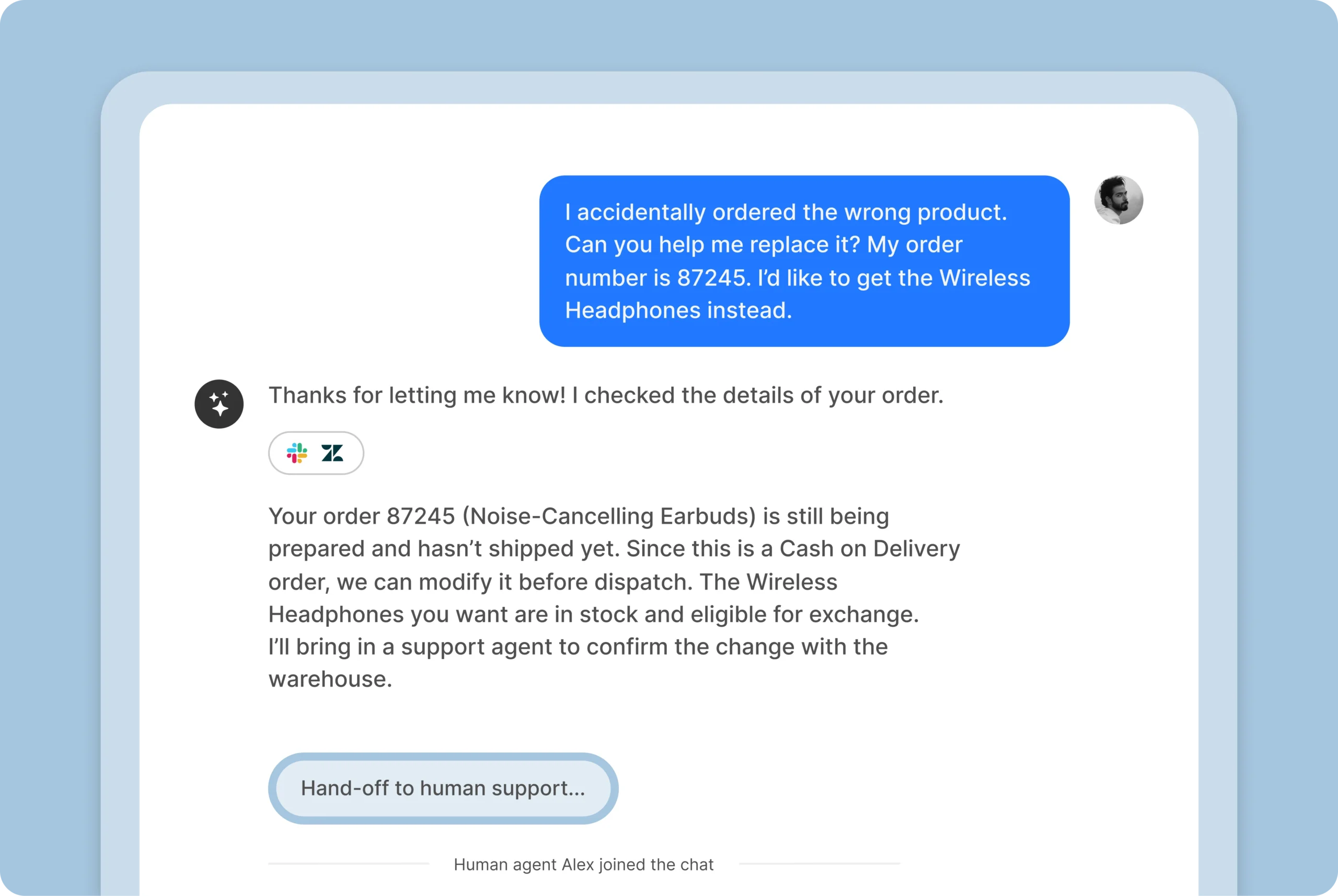
An ecommerce AI support agent can:
• Pull order data, shipment history, prior tickets, and images.
• Apply policy logic within predefined guardrails.
• Execute decisions across systems, including refunds, replacements, and label generation.
The shift from chatbot-based deflection to agent-based resolution allows ecommerce brands to reduce handle time and improve first-contact resolution.
Workflow 4: Returns, Refunds, and Exchanges
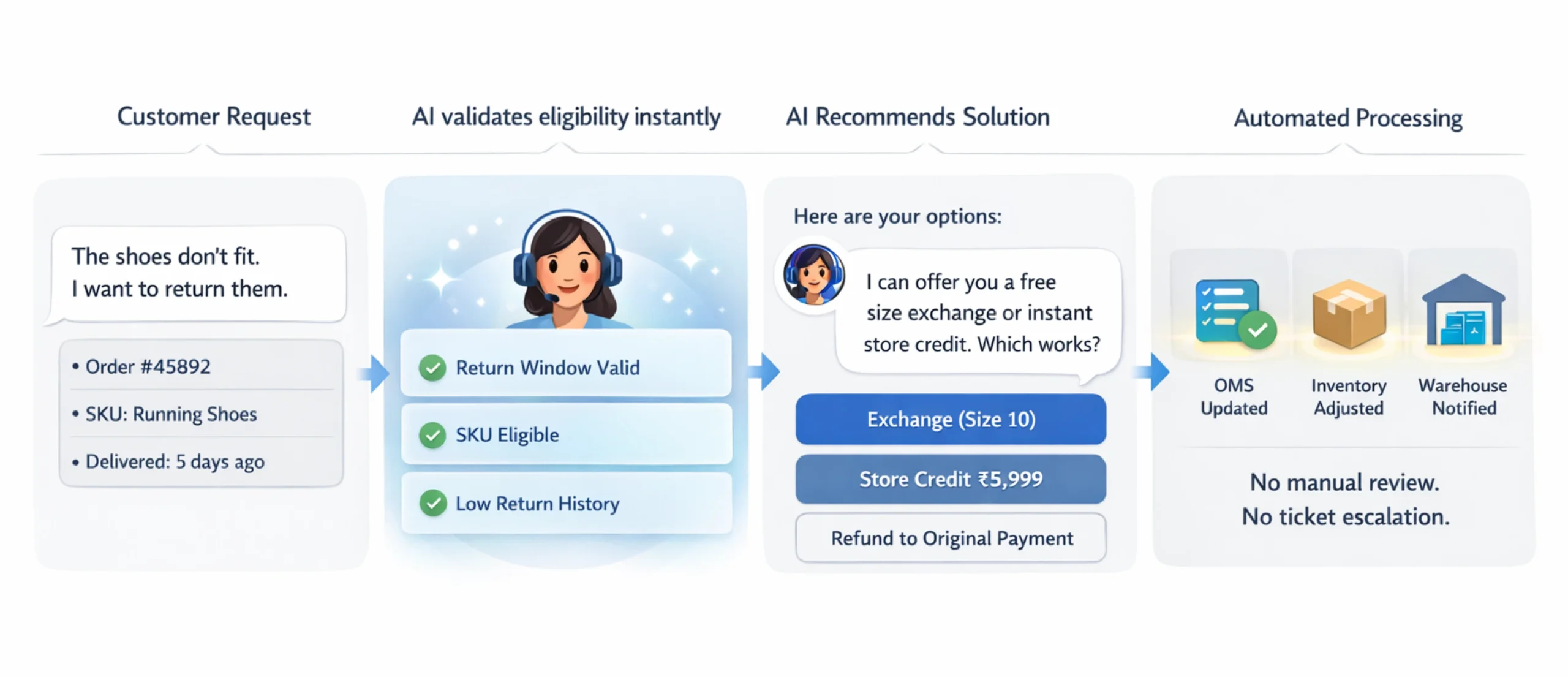
Most ecommerce chatbots treat returns as form collection. This adds manual review and delays.
An ecommerce AI agent can manage returns operationally:
• Validate eligibility based on SKU, time, and customer history.
• Recommend refund, exchange, or store credit aligned with business rules.
• Update OMS, inventory, and warehouse systems automatically.
Over time, these ecommerce AI agents can also detect patterns driving returns and surface operational insights to merchandising and supply chain teams.
Workflow 5: Inventory-Aware Promises and Post-Purchase Operations
Ecommerce chatbots typically provide static answers about availability and shipping.
Inventory-aware ecommerce AI agents coordinate promises with real-time inventory and logistics data. They can:
• Check availability across warehouses and stores before committing delivery windows.
• Suggest substitutes when stock is low.
• Trigger internal workflows during disruptions.
This is where ecommerce AI agents extend beyond support and influence pricing, promotions, and fulfillment decisions.
When Is an Ecommerce Chatbot Still Enough?
For early-stage ecommerce brands with small catalogs and limited operational complexity, a well-designed ecommerce chatbot can handle FAQs and basic support efficiently.
Chatbots can also function as a triage layer, routing intents to specialized ecommerce AI agents or human teams. The upgrade from ecommerce chatbot to ecommerce AI agent typically becomes necessary when static flows can no longer manage rising operational complexity.
How to Upgrade from an Ecommerce Chatbot to Ecommerce AI Agents
Transitioning from chatbot automation to ecommerce AI agents does not require replacing your stack. It requires layering intelligence across workflows.
Start by identifying high-impact workflows:
• Guided selling and product discovery
• Cart recovery
• Customer support
• Returns and exchanges
• Post-purchase and fulfillment coordination
Then integrate agents with core systems such as PIM, OMS, CRM, ticketing, and marketing tools. Define clear decision thresholds and escalation rules.
Over time, ecommerce brands can evolve from a single AI support agent to a coordinated ecosystem of ecommerce AI agents operating across revenue, operations, and CX.
Build Ecommerce AI Agents with DronaHQ Agentic Platform
If you want to move beyond a traditional ecommerce chatbot and deploy production-ready ecommerce AI agents, you do not need to rebuild infrastructure. With an agentic platform like DronaHQ, you can orchestrate guided selling agents, cart recovery agents, support agents, and operations agents on top of your existing stack and start validating impact quickly.
Related Articles