
How AI agents on WhatsApp are reshaping online travel booking
For most online travel agencies, WhatsApp has lived at the edges of the journey. A confirmation arrives. A payment link follows. A flight delay alert pops up. Useful, but disconnected from how travel decisions actually form.
AI agents change that dynamic by letting WhatsApp hold the entire arc of a trip, from the first half-formed idea to real-time support on the road. When done well, the channel starts to feel less like messaging and more like a travel concierge that accompanies the traveller throughout.
The shift is subtle but important. Travel stops being a sequence of screens and starts behaving like an ongoing conversation.
Planning a trip the way people actually think
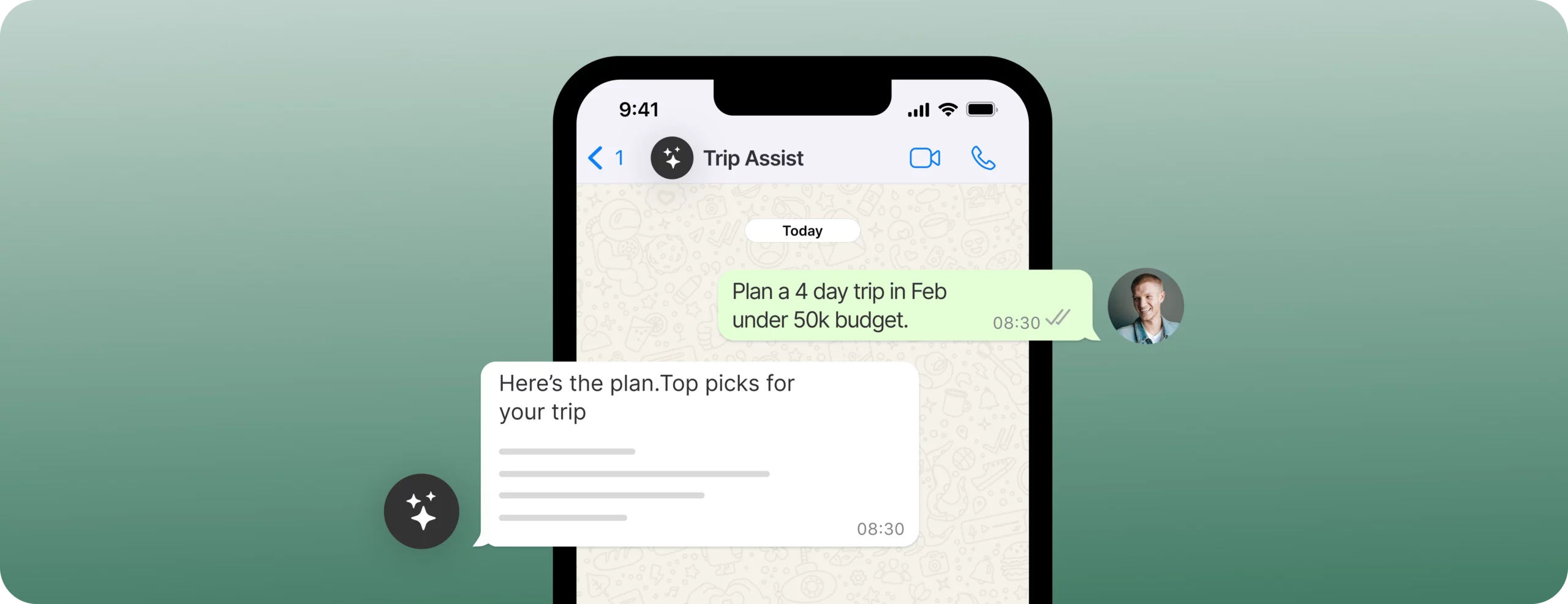
Most travellers do not start simply with a destination and exact dates. They start with a question. “We have a long weekend in August. Budget is flexible. Somewhere with beaches and nightlife. Visa on arrival preferred.”
In a WhatsApp conversation, an AI agent can work with that input directly. It can suggest a shortlist of destinations that fit the constraints, explain tradeoffs between routes, and even point out better travel windows if prices or weather improve by shifting dates slightly.
The same pattern applies when people ask very practical questions. “What is the cheapest non stop flight from Mumbai to Dubai next weekend with baggage included?” Instead of sending links, the agent can return a small, curated set of options pulled from the OTA’s own inventory, with enough context to help the traveller decide.
Group travel brings this into sharper focus. Friends or family already plan trips inside WhatsApp threads. An agent that joins the conversation can track preferences, note disagreements on dates or hotels, and help the group converge on a shared shortlist without anyone leaving the chat to cross-check details elsewhere.
Agent examples:
- Conversational trip planner: Capture dates, budget, interests (“beaches + nightlife + visa on arrival”), and suggest destinations, routes, and ideal travel windows, similar to Expedia’s Romie assistant on messaging.
- Package and fare discovery: Let users ask open questions (“cheapest non-stop BOM–DXB next weekend with baggage?”) and get curated options pulled from the OTA engine.
- Group planning in chats: Join group threads to align on dates, split preferences, and converge on a shortlist for flights/hotels/tours without leaving WhatsApp.
From conversation to confirmed booking, without friction
Once a destination and a plan emerge, the expectation is simple. Do not make the traveller start over.
Within the same WhatsApp thread, travellers can move from exploring options to selecting flights, hotels, cabs, or tours. Passenger details are collected conversationally, with the agent guiding what is needed next rather than presenting a long form upfront.
One of the most tangible improvements here is how information is captured. Travellers often already have old tickets, passport photos, or forwarded emails sitting on their phone. Instead of typing names, dates, and PNRs again, they can share those files and let the agent prefill details for confirmation.
After booking, the conversation does not reset. The agent can compile flights, stays, transfers, and activities into a structured itinerary that lives inside WhatsApp. If a flight time changes or a hotel is updated, the itinerary reflects it without the traveller hunting through email threads.
Agent examples:
- End‑to‑end booking in chat: Search, select, and book flights, hotels, cabs, or tours directly in WhatsApp, including upselling add‑ons and collecting passenger details.
- Smart form‑filling: Extract names, dates, passport details, and PNRs from photos, PDFs, or forwarded emails (e.g., old tickets) to prefill bookings, instead of manual typing.
- Itinerary generation & sharing: Auto‑compile flights, stays, transfers, and activities into a structured itinerary message/PDF that updates dynamically if any leg changes.
The days before departure, handled with context
The period between booking and travel is usually noisy and fragmented. Visa questions surface. Someone forgets to upload a document. A check in window opens. Payments remain partially complete.
In a WhatsApp based flow, these moments are handled in sequence. A traveller can ask, “Do I need a visa for this trip?” and receive country specific guidance. Packing reminders and weather tips can appear closer to departure, not weeks earlier.
Cross sell fits naturally when it is tied to what the traveller is already doing. Insurance when an international booking is confirmed. Extra baggage when shopping heavy destinations are involved. Airport transfers when arrival times are late. The offers feel like suggestions, not interruptions.
Reminders also become personal. Instead of generic nudges, the agent follows up on incomplete bookings, pending payments, or missed check in steps based on the traveler’s actual status.
Agent examples:
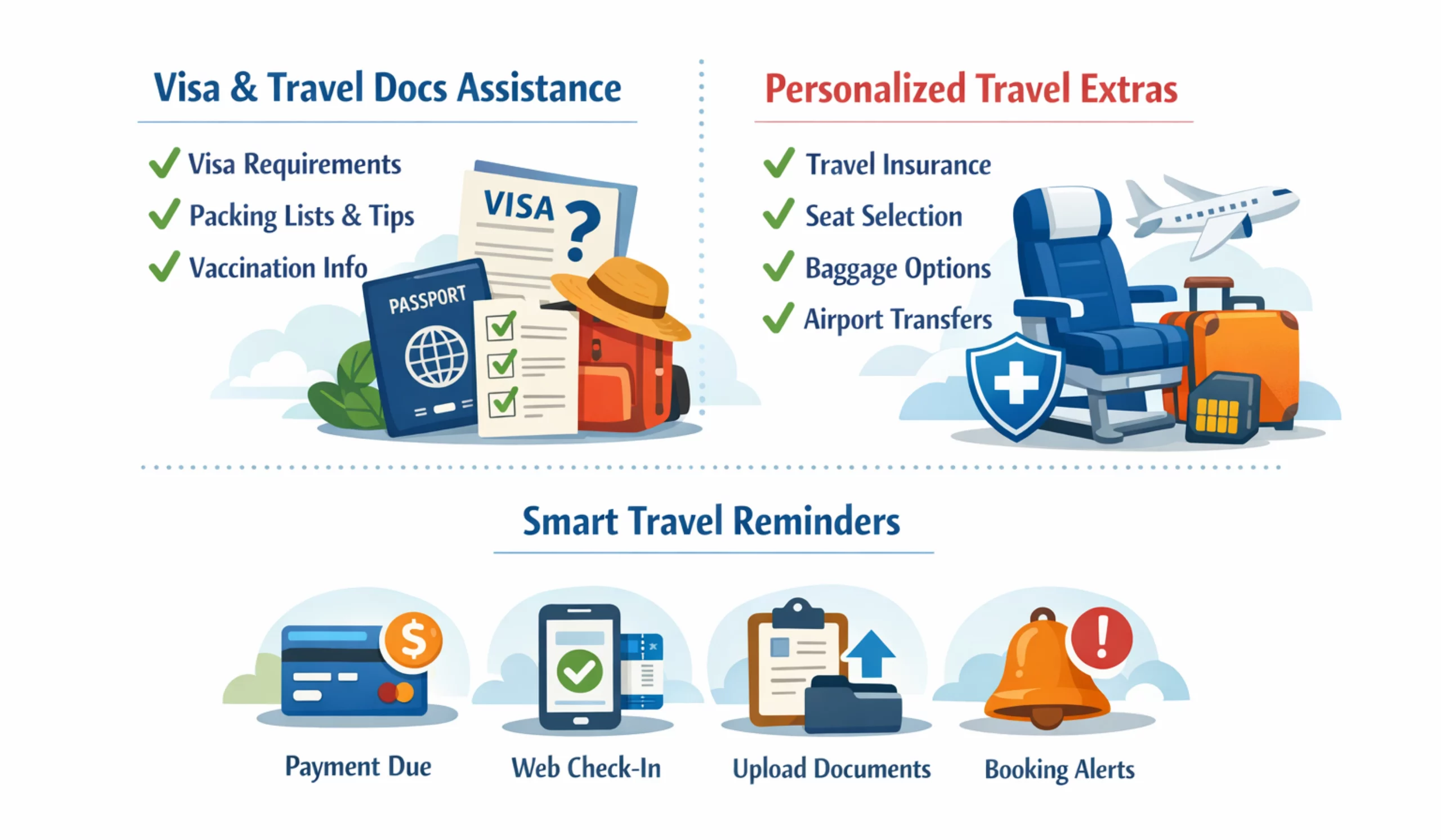
- Visa, docs, and checklist assistant: Answer “Do I need a visa for X?” and share country‑specific requirements, packing lists, and vaccination/weather tips.
- Contextual cross‑sell: Offer insurance, seat selection, meals, extra bags, airport transfers, and local SIMs based on booking context and traveller profile, not generic blasts.
- Smart reminders: Payment reminders, balance due, web check‑in nudge, document upload, and incomplete‑booking recovery flows tailored to each traveller.
Support that stays with you during the trip
Once travel begins, the questions change. “What is my hotel address?” “How long will it take to reach the airport right now?” “Where can I find vegetarian food near me?”
Because the agent already knows the itinerary, it can answer these quickly inside the same thread. There is no need to search inboxes or apps while on the move.
Disruptions are handled in the same space. When a flight is delayed or a gate changes, the agent can explain what has happened and outline next steps. If alternatives are available, they can be discussed right there, instead of pushing the traveler toward a call center.
For issues that cannot be resolved automatically, the handoff matters. Conversations can be escalated to human agents with full context, so the traveller does not have to start from scratch at a stressful moment.
Agent examples:
- Live travel copilot: Handle “what’s my hotel address?”, “Best veg restaurants near me?”, or “how long to the airport now?” by combining booking data with maps and local info.
- Disruption management: Proactively notify about delays, gate changes, cancellations, and offer rebooking options or alternative routes in the same thread.
- On‑trip support triage: Resolve simple issues (voucher not received, wrong pickup point) and escalate complex cases to human agents with full context and suggested actions.
After the trip, the relationship does not disappear
When the journey ends, WhatsApp does not need to go quiet. Feedback can be collected conversationally, while the experience is still fresh. Responses can guide follow ups, whether that means resolving a complaint or thanking a satisfied traveller.
Over time, the same conversation becomes a memory. Past destinations, budgets, and seasons inform future suggestions. A traveller who visited Dubai in winter might be shown similar warm weather options next year. Loyalty points and referrals can be explained and redeemed without dashboards or fine print.
Agent examples:
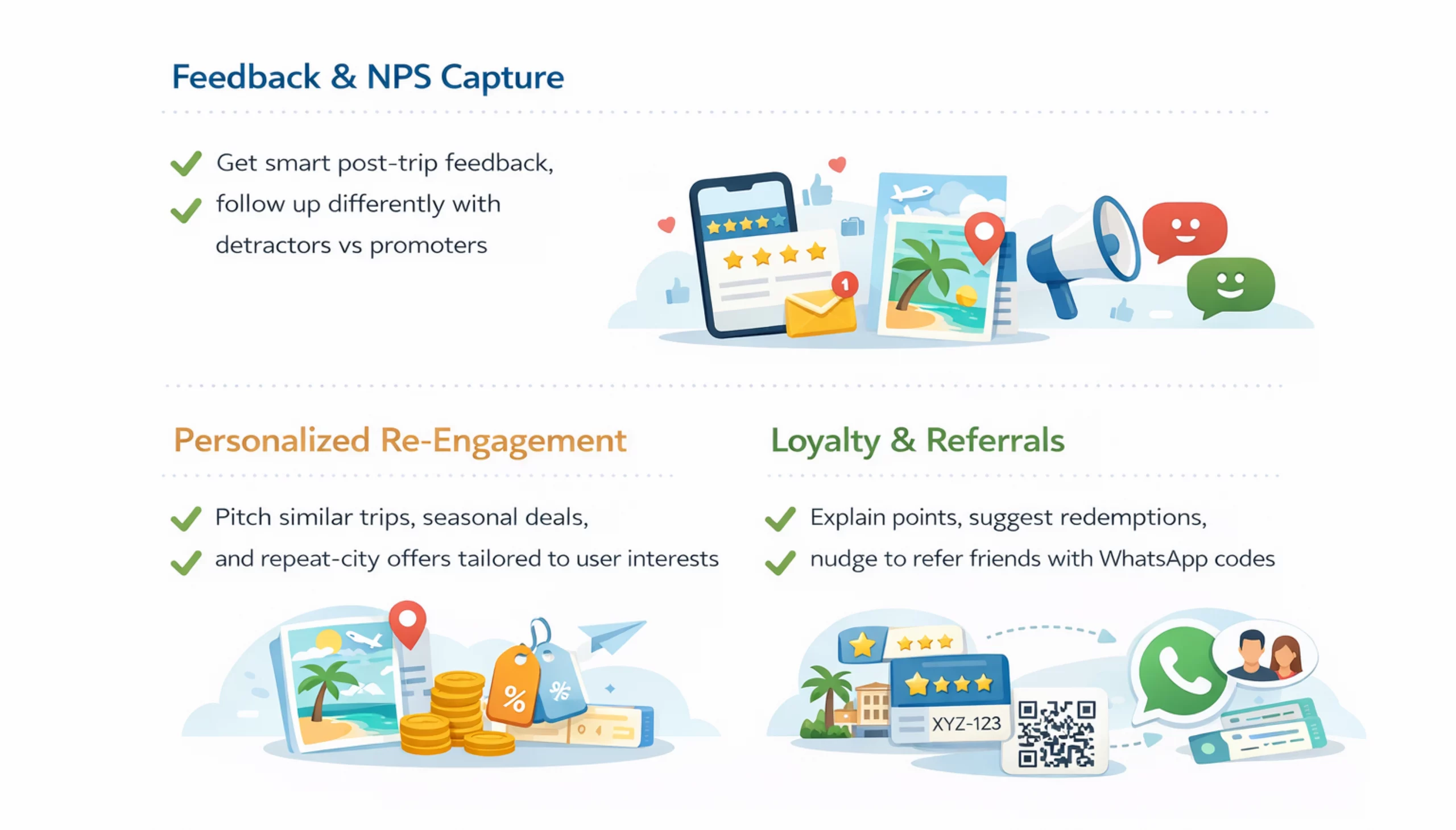
- Feedback and NPS capture: Trigger smart, conversational feedback flows post‑journey and follow up differently with detractors vs promoters.
- Personalised re‑engagement: Use past destinations, budgets, and seasons to pitch relevant seasonal deals, repeat‑city offers, or “similar to your last trip” itineraries.
- Loyalty & referrals: Explain points, suggest redemptions on eligible routes/hotels, and nudge users to refer friends with trackable referral codes via WhatsApp.
Why this experience matters
None of this requires replacing websites or mobile apps. It requires recognising that travel is rarely linear and that people prefer to think out loud when making decisions.
When AI agents are used thoughtfully, WhatsApp becomes a place where discovery, booking, coordination, and support flow together. For OTAs, that creates continuity. For travellers, it makes travel feel simpler and more human.
The result is not a louder channel, but a deeper one. A conversation that begins with an idea and ends long after the trip does.
Related Articles