
Agentic workflows in manufacturing on top of ERP and MES
The manufacturers that gain the most from agentic AI will not be the ones chasing standalone AI tools. They will be the ones that build agentic workflows on top of the ERP and MES systems already running the business.
That is where the practical opportunity sits for manufacturing. Most enterprises already have ERP systems managing orders, planning, procurement, financial controls, and approvals. They already have MES systems managing production state, work instructions, quality checkpoints, and traceability on the plant floor. In many cases, they also have maintenance platforms, historian data, quality tools, supplier systems, and internal portals layered around them. The missing piece is rarely software. The missing piece is a usable workflow layer that can pull context across these systems and help teams act faster without turning every new requirement into a fresh software project.
What agentic AI means in manufacturing
Agentic AI in manufacturing should not be framed as a chatbot with better language skills. It is more useful to think of it as a system that can interpret plant and enterprise context, decide the next bounded step, and move work forward through the systems the enterprise already trusts.
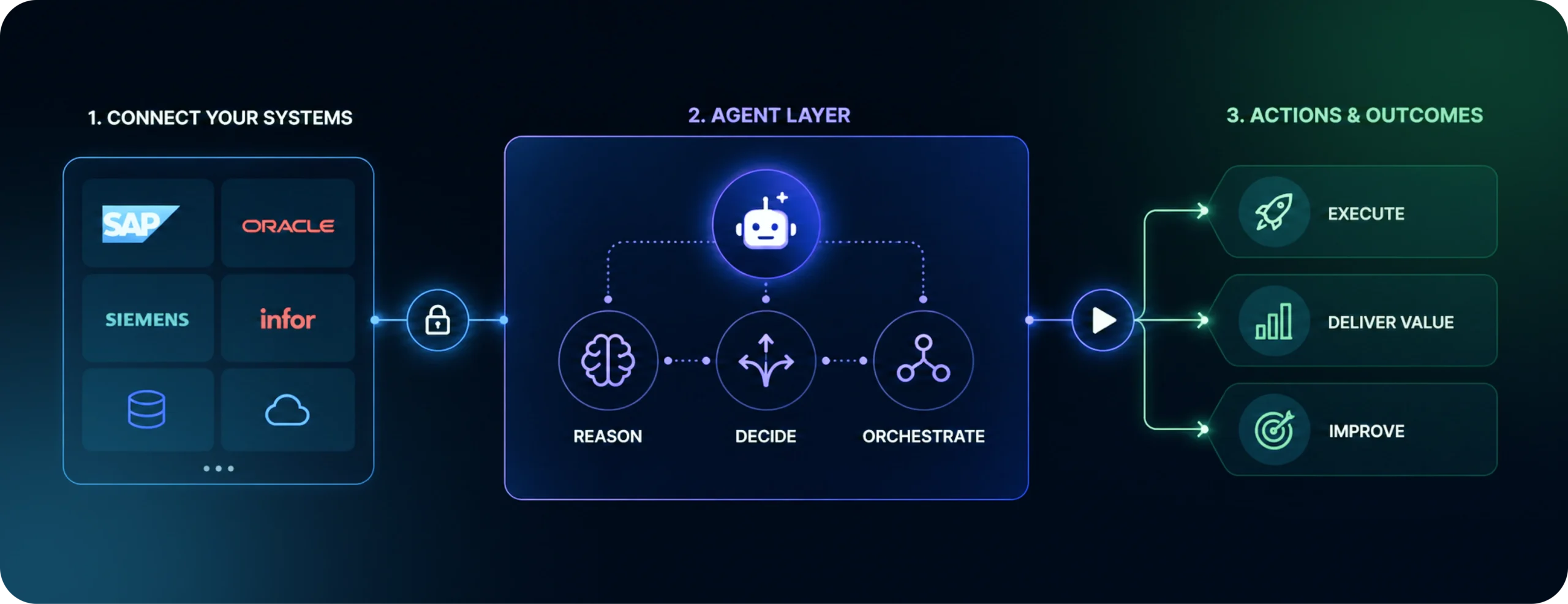
That matters because manufacturing work rarely sits inside one application. A quality issue may start in MES, depend on supplier lot context from ERP, require calibration history from maintenance systems, and eventually affect a shipment promise or customer commitment. A stalled production plan may involve machine performance, material availability, labor allocation, and downstream fulfillment. These are coordination problems as much as data problems.
This is also where the distinction between copilots, automations, and agentic workflows starts to matter: A copilot may help summarize, suggest, or answer. A simple automation may move data from one system to another once a condition is met. An agentic workflow goes one step further. It assembles the relevant context, follows a defined action boundary, and pushes the work into the next appropriate state. In manufacturing, that is often the difference between one more alert and a workflow that actually helps a team clear an operational bottleneck.
Why ERP and MES are still the right foundation
Manufacturers do not need to replace ERP or MES to benefit from agentic AI. In most cases, that framing creates the wrong kind of discussion from the start.
ERP and MES already hold the process state, approval logic, production context, and operating history that matter. They are still the systems of control and record. Replacing them is not only expensive. It is unnecessary for the majority of AI workflow use cases manufacturers are trying to solve right now.
The more credible path is to build on top of them.
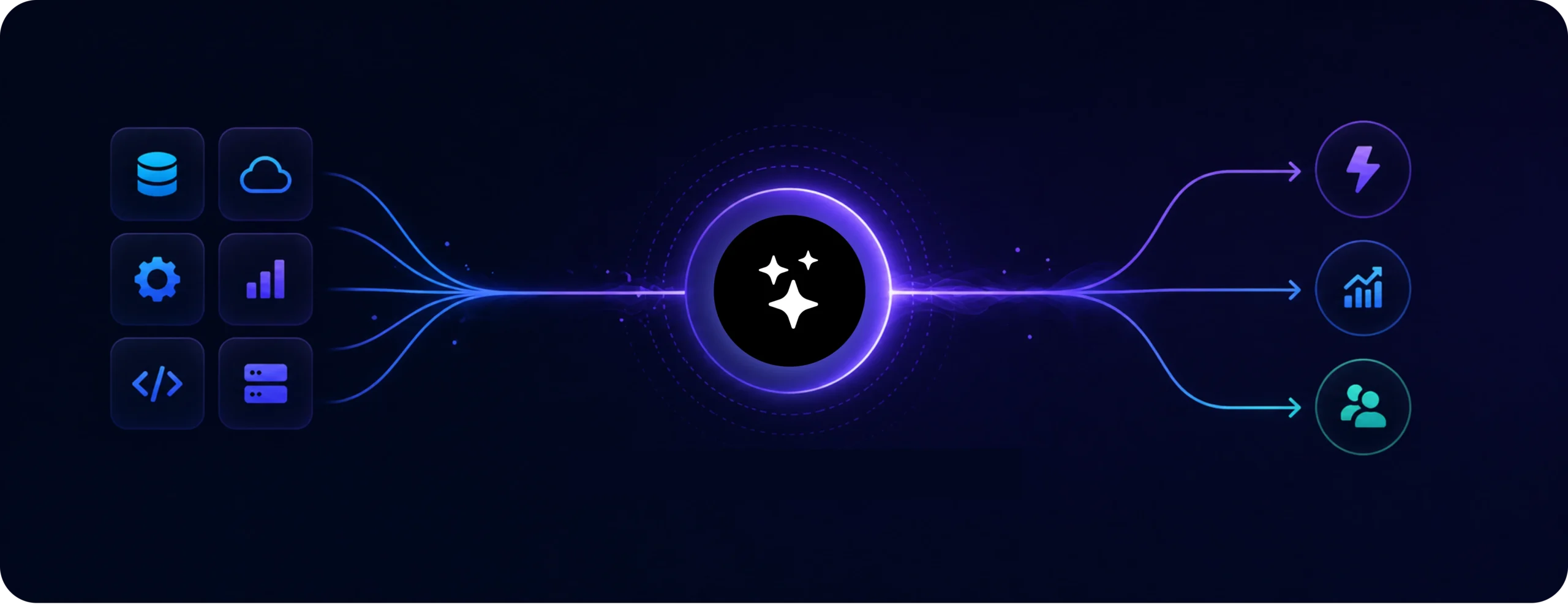
That means using ERP and MES as the structured backbone while adding a workflow and copilot layer above them. This layer can connect plant and enterprise signals, surface the right information to the right role, and move work forward without forcing teams to swivel across disconnected dashboards, email threads, spreadsheets, and custom forms.
This is why rip-and-replace is the wrong framing. The real architectural question is not whether AI will displace ERP or MES. It is whether manufacturers can make those systems more responsive, usable, and connected to actual operating decisions.
What this looks like on the plant floor and across enterprise teams
The best way to understand this model is to look at the handoffs that currently slow manufacturing down.
For instance, a defect spike appears on one line. A planner sees that a material delay now affects the production sequence for the next shift. A technician keeps seeing the same recurring issue on an asset. A plant issue starts as an operational exception and then turns into a fulfillment or customer commitment problem for the enterprise.
In many environments, the signals already exist. What slows the response is the way teams still have to move through tickets, emails, spreadsheets, and ad hoc coordination to decide what happens next.
Agentic workflows help because they can pull these signals together, present the next action to the right role, and keep the workflow moving through systems that already matter in the operation.
Manufacturing workflows where agentic AI is most useful
Quality deviation follow-up
A defect spike or quality deviation is one of the clearest examples. The next step may depend on supplier lot details, calibration history, inspection results, deviation trends, and engineering change context. A workflow built on top of ERP and MES can pull that information together before routing the issue for containment, additional inspection, escalation, or approval.
Production scheduling exception
A material delay and machine underperformance can force rescheduling, production reprioritization, and cross-functional coordination. Instead of leaving that work scattered across planning systems and email chains, an agentic workflow can assemble the affected orders, constraints, and approval path in one sequence.
Maintenance copilot for technicians
A technician dealing with a recurring asset issue does not need one more dashboard. They need fast context. A maintenance copilot can bring together work order history, SOP steps, parts availability, service notes, and prior fixes into a guided interface that helps the technician act faster and escalate more cleanly.
Escalation from plant issue to enterprise commitment risk
Some issues start local and then spread outward. A plant disruption may affect shipment timing, customer commitments, or downstream fulfillment. A workflow that pushes structured context from plant systems into ERP or enterprise operations systems helps the issue move without forcing teams to reconstruct the story each time it changes hands.
The IT and OT operating model
One of the biggest reasons this model is useful is that it does not require giving up control to gain speed.
IT still owns the parts of the system that should remain centralized. That includes connectors, system access, identity, approval boundaries, audit trails, deployment environments, and governance rules.
OT teams and operations leaders gain something different. They get copilots and workflows that are usable in the flow of work. They get faster adaptation around exceptions. They get interfaces that reflect how the plant actually operates rather than how a generic enterprise module expects work to happen.
This split matters. Without it, “no-code AI” quickly becomes a risky story. With it, manufacturers can give teams more useful tools without opening the door to uncontrolled changes in production-critical systems.
Where agentic workflows belong in manufacturing
This model works best in workflows that happen often, involve coordination across multiple systems, and need guidance within clear boundaries.
That includes quality follow-up, scheduling exceptions, technician guidance, and escalation management. These are workflows where context is distributed, timing matters, and teams benefit from having the next step assembled for them.
It is less suitable for decisions that carry high safety risk, major compliance implications, or production changes that require tighter human oversight. In those cases, the workflow can still help with preparation, evidence gathering, and routing, but the final authority should remain closer to the responsible human role.
What manufacturers should avoid
There are a few traps worth naming clearly.
- Deploying thin copilots with weak connector depth. If the system cannot reach the records, events, and approvals that matter, it will stay superficial.
- Allowing OT-side workflow building without IT guardrails. Faster assembly is valuable. Ungoverned changes are not.
- Treating no-code as a substitute for architecture. Faster workflow creation only works when connectors, permissions, approval logic, and auditability are already thought through.
- Trying to jump straight to full autonomy. In manufacturing, credibility usually comes from workflows that are bounded, useful, and well-governed, not from ambitious claims about hands-off operations.
Closing view
ERP and MES are not going away. In manufacturing, the competitive advantage is shifting to the workflow and copilot layer built on top of them.
The manufacturers that move first here will not be the ones with the loudest AI story. They will be the ones that make existing systems more responsive, more usable, and better coordinated across the plant and the enterprise.
That is why building agentic workflows on top of ERP and MES matters. It gives manufacturers a path to apply AI where it counts, without discarding the systems already carrying the business.
Start your agentic AI journey with DronaHQ. Learn how in our next workshop.
Related Articles