
What is an agentic AI platform? How it differs from workflow automation
A lot of teams say they want an AI agent. What they often build first is a workflow.
It looks close enough in a demo. A ticket comes in, a model classifies it, a few rules run, an action gets triggered, and everyone in the room starts calling it agentic. The confusion usually shows up later, when the system has to interpret a fuzzy request, decide which tool to use, pull context from the right source, recover from a bad intermediate result, or ask for help instead of guessing.
That is the point where language stops being cosmetic and starts becoming architectural.
The category is moving fast. Gartner predicted in August 2025 that up to 40% of enterprise applications will include integrated task-specific AI agents by 2026, up from less than 5% in 2025. At the same time, it also warned that more than 40% of agentic AI projects could be cancelled by the end of 2027 because of cost, unclear value, or weak risk controls. That combination tells you something important: Interest is real, but the confusion is also real.
This guide explains what an agentic AI platform actually is, how it differs from workflow automation, and why that distinction matters if you want to build systems that survive beyond the demo and make it into production.
Why is this category so confusing right now?
The market is not struggling because agentic AI is too advanced to understand. It is struggling because too many different product types are being described with the same label.
Right now, “agentic AI platform” can refer to at least four very different things.
- It might mean a workflow automation tool with an LLM step added to the middle.
- It might mean a builder for tool-using agents.
- It might mean an orchestration layer that handles planning, context retrieval, and execution.
- Or it might mean a governance and deployment environment wrapped around agents built elsewhere.
A workflow product can include AI reasoning. An agent platform can still rely on deterministic workflows under the hood. A model framework can help create agent behaviour without being a platform in the full sense. Once all of those products start using the same language, the category gets blurry fast.
There is also a marketing reason. “Automation” sounds mature and operational. “Agentic” sounds like the future. So a lot of products are now positioned somewhere between the two. Gartner even has a term for this broader hype problem. In its June 2025 forecast about failed agentic projects, it warned of “agent washing,” where products are marketed as agentic without actually delivering the capabilities teams assume the label implies (source).
That matters because teams end up buying for the word instead of buying for the job to be done.
If what you need is deterministic task automation with a bit of AI support, a workflow tool may be perfect. If what you need is a system that can interpret a goal, choose tools at runtime, retrieve context from business systems, and adapt its path as conditions change, you are in a different category entirely.
What workflow automation actually does well
Workflow automation is not a lesser category in this conversation. It is the more mature one.
A workflow system is designed to follow a known path. A trigger happens, a condition is checked, a rule routes the work, and the next step is determined ahead of time. That deterministic design is exactly why workflow tools are so useful. When the process is repetitive, structured, and predictable, you usually do not want open ended reasoning. You want consistency.
Think about a few common examples:
- If an invoice arrives, extract the fields, validate them, and send the approval request to the right person.
- If a support ticket contains a specific keyword and comes from a certain account tier, route it to the correct queue.
- If a lead submits a form, enrich the record, update the CRM, and trigger the correct follow up sequence.
These are excellent workflow problems because the path is mostly known in advance. The value comes from giving the system freedom to decide what the job is.
This is why workflow automation often scales so well inside operations teams. It reduces variance. It makes behaviour inspectable. It is easier to test because the branches are explicit. It is easier to govern because the acceptable paths are already defined.
The trouble starts when variance is the job.
Once the system has to resolve ambiguity, pick between tools dynamically, inspect intermediate results, revise its plan, or decide whether it has enough context to proceed, predefined branching starts to feel strained. You can still keep adding more rules, more fallback paths, and more exception handling. Many teams do. But at some point you are no longer simplifying the problem. You are just hardcoding around uncertainty.
That is usually the moment people start describing their workflow as an agent, even though the system is still fundamentally rule driven.
What makes a system agentic
A system starts to feel agentic when the next step is not fully hardcoded in advance.
That does not mean it becomes magical, autonomous, or somehow free from structure. It means the system is working from a goal rather than a locked sequence of steps. It can interpret what needs to happen, decide how to proceed, use tools as needed, and adapt when the first path does not work.
This is the practical difference. A workflow says, “when X happens, do Y.” An agentic system says, “given this objective, figure out the best next action within these constraints.”
That usually includes a few recognisable behaviours. The system can reason through ambiguity instead of only matching a rule. It can choose between multiple tools instead of following a single predetermined path. It can retrieve context from the right source when the answer is not already in memory. It can inspect an intermediate result and decide whether to continue, revise, escalate, or ask for more information.
A simple example makes this easier to see. Imagine a procurement request comes in for a software purchase. A workflow can route the request based on threshold, category, and department. An agentic system can go further. It can read the request, identify what is missing, check vendor history, review budget status, compare the request against policy, ask clarifying questions if the request is incomplete, and then decide whether to approve, reject, or escalate.
The difference is where judgment lives. In a workflow, judgment has already been encoded into the branches. In an agentic system, some of that judgment is being performed at runtime, inside guardrails, with access to tools, context, and fallback paths.
That is the foundation for understanding what an agentic AI platform actually is.
What is an agentic AI platform?
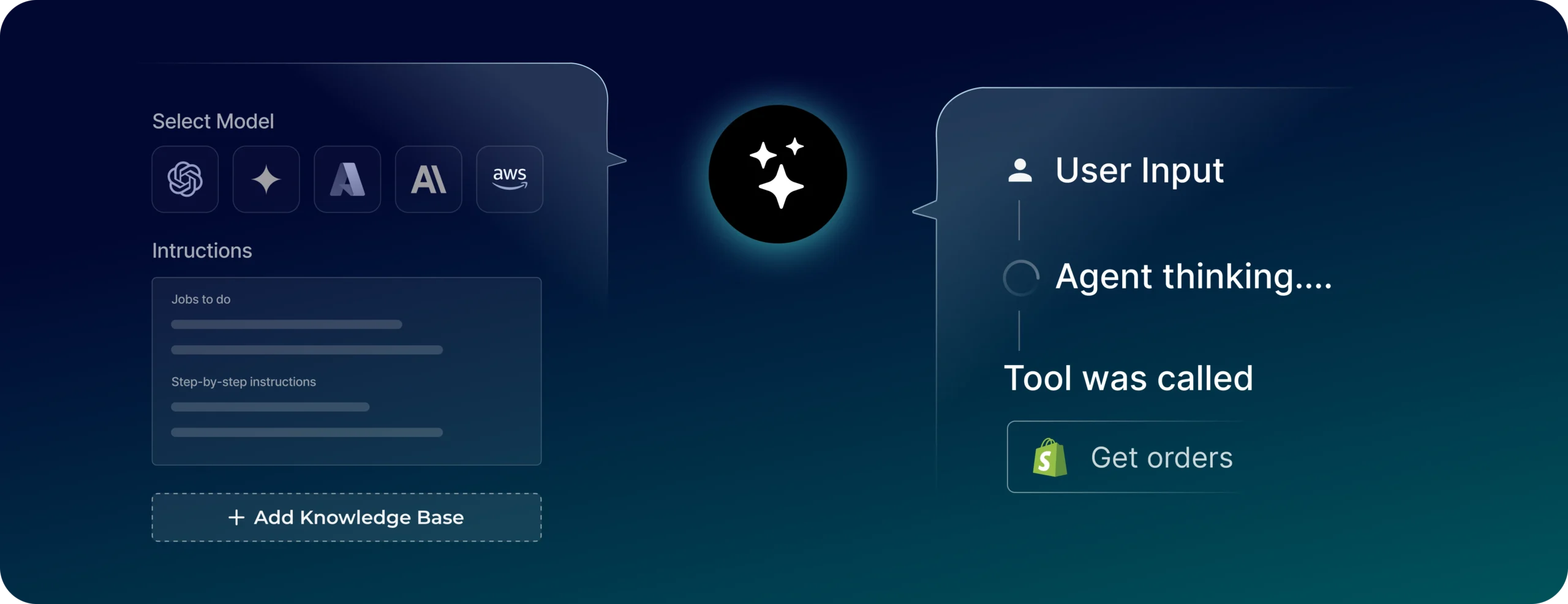
An agentic AI platform is the environment where AI agents are built, connected to tools and enterprise data, given goals and guardrails, observed in operation, and deployed into real business processes.
That definition sounds broad because the category is broad. But the distinction is still useful. A model can generate language. A framework can help structure prompts, memory, or tool use. A workflow engine can connect systems and automate steps. A platform is the layer that makes those pieces operational together.
This is where a lot of teams get tripped up. They assume an agent is just a model with a few tools attached. In practice, the moment an agent has to work across real systems, the surrounding platform starts doing most of the heavy lifting. It has to connect the agent to business data, control what the agent is allowed to access, trace what happened during execution, and provide the runtime where the system can act without becoming opaque or unsafe.
UiPath describes agentic AI through autonomy, planning, orchestration, and action across enterprise systems. Salesforce frames agentic AI around systems that can understand context, make decisions, and take action with less human direction. Automation Anywhere places emphasis on reasoning, acting, learning, and coordinating work across tools and processes. Put those views together, and a pattern becomes clear. An agentic AI platform is not just about generating answers. It is about creating the operating environment where agents can reason, retrieve context, use tools, take action, and remain governed.
In practical terms, a real agentic AI platform usually includes several layers working together.
It needs a reasoning layer so the agent can interpret a goal and decide what to do next. It needs tool use and execution so the agent can actually query systems, update records, trigger workflows, or escalate work. It needs context retrieval so the agent can pull the right information from enterprise systems instead of guessing. It needs memory or state so the system can preserve continuity across a task or process. It needs governance so permissions, policies, and safety boundaries are enforced. And it needs observability so teams can inspect what happened, why a decision was made, and where something went wrong.
That last part matters more than the market sometimes admits. The more dynamic the system becomes, the more important control and oversight become. Without them, “agentic” quickly turns into “unpredictable.”
A useful way to think about it is this: workflow automation tells software exactly what path to follow. An agentic AI platform gives software a goal, access to the right tools and context, and a bounded environment in which it can figure out the path.
Once the job involves runtime judgment, tool choice, recovery, and adaptation, you are no longer choosing only a model or only a workflow engine. You are choosing the environment in which that agent will operate.
Agentic AI platform vs workflow automation
This is the comparison that most teams need much earlier than they realise.
A workflow system and an agentic AI platform can both connect tools, trigger actions, and move work across systems. On the surface, they can look surprisingly similar. Under the surface, they are optimised for different kinds of work.
Workflow automation is optimised for predefined execution. You know the steps, the branch conditions, and the acceptable outputs in advance. The system is there to run that sequence reliably.
An agentic AI platform is optimised for runtime judgment. The system is given a goal, access to tools and context, and a bounded environment in which it can decide how to move toward the outcome.
The difference becomes easier to see when you compare the two side by side.
| Dimension | Workflow automation | Agentic AI platform |
| Unit of execution | Predefined step or sequence | Goal oriented task |
| Decision making | Rule based branching | Runtime reasoning within guardrails |
| Path to outcome | Fixed or partially branched | Adaptive based on context and results |
| Tool use | Prewired in the flow | Chosen dynamically based on need |
| Context handling | Passed through predefined steps | Retrieved at runtime from relevant systems |
| Failure handling | Explicit fallback branches | Judgment, retry, escalation, or revision |
| Memory and state | Limited process state | Contextual state across the task |
| Governance | Process controls | Agent controls plus process controls |
| Best suited for | Predictable repeatable work | Ambiguous multistep operational work |
Imagine a customer writes in asking why a refund has not been processed:
- In a workflow system, you might classify the ticket, check refund status from one system, and route the case based on predefined conditions. That is useful and often exactly what the business needs.
- In an agentic system, the software can go further. It can read the request, pull order history, inspect payment status, check whether the refund was blocked by policy or timing, look for prior communication, decide whether it has enough context to respond, and then either answer the customer, escalate to a human, or initiate the next operational step.
The difference is that the second system is designed to handle uncertainty as part of the job.
If the work is structured and repeatable, a workflow tool is often the right answer. If the work requires the system to interpret context, choose actions, and recover when the first path does not work, then a workflow engine alone usually starts to feel stretched.
This is also why the two categories should not be treated as opponents. Most production systems will use both. Workflows remain the backbone for deterministic execution. Agentic platforms add the reasoning layer needed when the next step cannot always be hardcoded in advance.
Why the distinction matters in production
A workflow can look impressive in a demo because the path is curated. The inputs are cleaner, the branches are known, and the edge cases are limited. Production is different. Requests arrive incomplete, tools fail, data is inconsistent, and the system has to decide whether to continue, retry, escalate, or stop.
You can keep layering rules on top, but the more the system has to interpret context at runtime, the more you need agent level controls.
That means visibility into why the system chose an action, guardrails on what it can access, and human checkpoints for higher risk decisions. Without that, teams end up with something that looks autonomous but is hard to trust.
This shows up quickly in customer operations, IT support, procurement, claims, and revenue workflows. These are all examples of enterprise AI agents in practice. They are hard because the system has to handle ambiguity without becoming reckless.
It changes what architecture you need, what controls you need, and what kind of system can actually survive past a polished demo.
What a real agentic AI platform should include
If a platform is serious about agentic AI, it should provide more than model access and workflow connectors.
At a minimum, it should let teams define goals, connect agents to tools and enterprise data, manage context, and trace decisions during execution. It should also support permissions, guardrails, and human review where needed.
A strong platform usually includes:
- goal-based agent design
- dynamic tool calling and action execution
- context retrieval from enterprise systems
- memory and state management
- human in the loop controls
- observability and decision tracing
- security governance and permissions
- deployment support for production operations
Some platforms will also support multi agent coordination, but that only matters once the fundamentals are already strong.
For teams comparing products in this space, this is also where it helps to study how different AI agent builders and platforms approach orchestration, context, governance, and deployment.
When you need workflow automation and when you need an agentic AI platform
Use workflow automation when the path is known, the rules are stable, and consistency matters more than runtime judgment.
Use an agentic AI platform when the system has to interpret goals, choose tools dynamically, work with changing context, and recover when the first path does not work.
In practice, most enterprise systems will use both. Workflows handle deterministic execution. Agentic platforms handle the parts of the job that cannot be fully hardcoded in advance.
If your team is crossing that line now, this is usually the point where trying a platform in a real business workflow tells you more than reading product definitions ever will. A hands on evaluation of something like the DronaHQ Agentic Platform can make that distinction much easier to judge.
Where this is headed next
The category is still messy, but the direction is becoming clearer.
Agents are moving from experiments into application patterns inside enterprise software. Gartner expects integrated AI agents to appear in 40% of enterprise applications by 2026, up from less than 5% in 2025. At the same time, weak projects will continue to get filtered out, especially when teams mistake AI flavored workflows for production ready agent systems.
The next wave of platforms will compete less on vague agent claims and more on orchestration, governance, observability, and how safely agents can operate across real systems.
Conclusion
Workflow automation is still one of the most useful categories in enterprise software. But it was built to execute known paths.
Agentic AI platforms matter when the path has to be figured out at runtime.
If the software you are building needs to reason, choose, adapt, and act across real systems, the distinction stops being semantic. It becomes architectural.
And once you are at that stage, the next decision is not just which model to use. It is which platform gives your agents the context, controls, and execution environment they need to operate in production.
Related Articles