
How agentic AI is redefining hospitality customer experience at scale
Hospitality has always been about customer experience; anticipating needs, remembering preferences, and delivering moments that feel effortless and personal.
What has changed is scale.
Guests expect the same level of attentiveness whether they are browsing online, checking in at a property, or planning their next stay months later. Delivering this consistently across thousands of guests, properties, and touchpoints is no longer possible through manual processes alone.
This is where agentic AI is reshaping the hospitality business. Not as a visible layer of technology, but as an intelligence layer that understands context, remembers history, and acts with intent across the entire customer journey.
When it works well, it doesn’t feel like AI. It feels like thoughtful hospitality.
From automation to experience intelligence
Most hospitality systems are excellent at managing transactions—bookings, inventories, service requests, loyalty points, and payments. What they struggle with is continuity of experience.
Agentic AI bridges this gap by operating with:
- Intent: understanding what the customer is trying to do
- Memory: remembering preferences and patterns over time
- Knowledge: grounding decisions in what is actually available
- Orchestration: coordinating actions across systems and teams
Instead of reacting to isolated requests, AI agents work toward experience outcomes—much like an experienced hospitality professional would.
The digital concierge that remembers you
Intent, Memory, and Knowledge in Action
A guest opens the app and asks: “Can you suggest a good property for our next vacation?”
An ordinary system responds with filters and listings.
An agentic concierge pauses—and thinks.
- It understands the short-term intent: the guest is planning a trip.
- It recalls long-term memory: past stays show a preference for quieter locations, nature views, and wellness activities.
- It pulls from enterprise knowledge: live property inventory, room availability, restaurant themes, spa and wellness services, and upcoming activities.
- It responds in the guest’s preferred language.
Instead of a list, the guest receives guidance:
“Based on your past stays, you might enjoy a quieter property with scenic surroundings. There is availability next month at a location known for its nature trails and wellness programs. Would you like me to check room options or spa availability there?”
It feels less like searching and more like being advised by someone who knows the guest.
1. Seamless welcome loop
Check-In and Check-Out That Know Context
Check-in is often the first in-person impression of a stay. Agentic AI makes this moment feel considered rather than procedural.
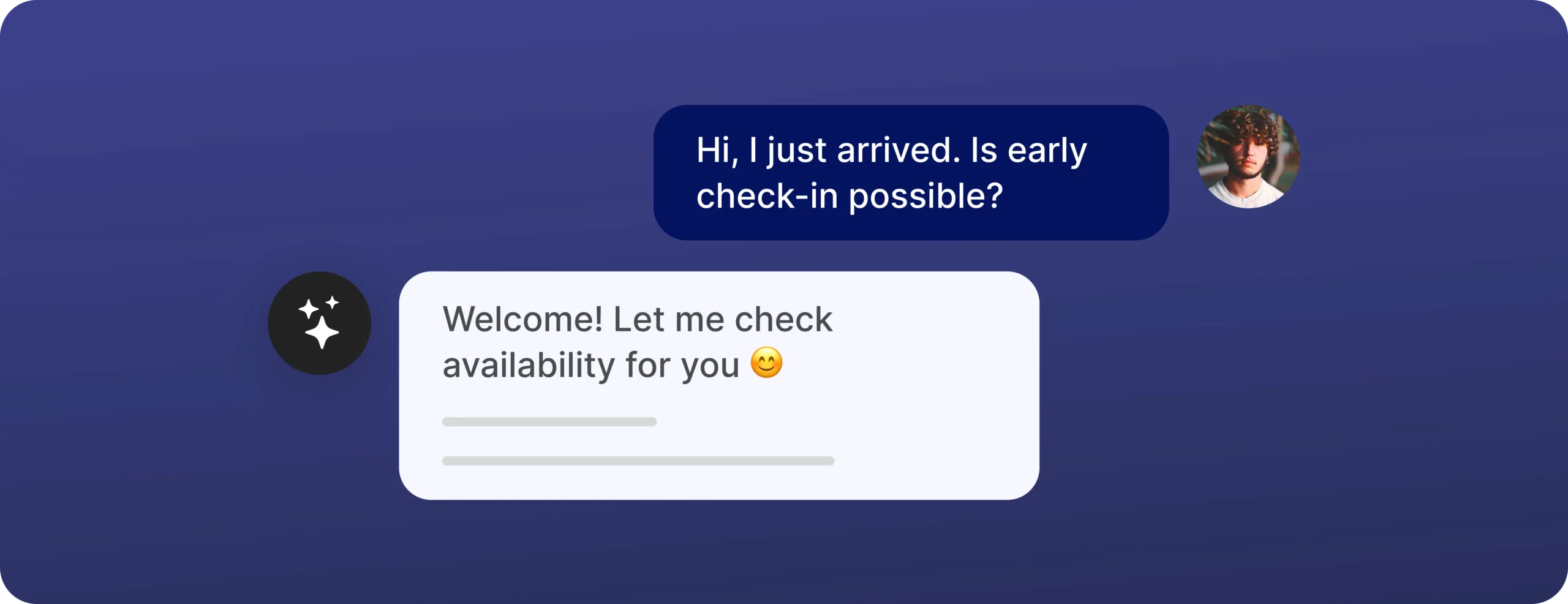
Imagine this scenario: A guest’s flight details indicate an arrival at 10:00 AM—well before standard check-in time. The system checks the live room inventory and sees that rooms are already available.
Instead of waiting for the guest to ask, an AI agent reaches out proactively:
“We see that you’ll be arriving earlier than standard check-in time. Your room is already available, and we’d be happy to offer you an early check-in so you can settle in and relax right away.”
To the guest, it feels like a thoughtful message from the front desk.
Behind the scenes, agentic workflows have:
- Interpreted arrival context from travel details
- Checked real-time inventory and room readiness
- Applied eligibility rules
- Triggered a timely, personalised communication
At check-out, the same continuity applies. The experience reflects the full stay, summarising key moments, prompting feedback, and suggesting next steps—without feeling abrupt or transactional.
2. Stay experience engine
Context that evolves in real-time
Customer needs change once they are on the property.
A guest who initially asked about activities later opens the app and types:
“Anything relaxing we can do this evening?”
Agentic AI understands that intent has shifted.
It looks at:
- Recent interactions during the stay
- Historical interest in wellness experiences
- Live availability for spa, yoga, or quiet dining
- Time of day and remaining duration of stay
The response feels timely and relevant:
“If you’re looking to unwind, there’s a sunset yoga session at 6 PM and spa availability this evening. Would you like me to reserve a slot for you?”
If the guest switches languages, the conversation continues seamlessly.
The experience adapts—not because rules changed, but because context did.
3. Orchestration backbone
Operations that move in sync with experience
Every guest request triggers operational complexity.
When a guest asks for an additional service or special arrangement, agentic AI does not treat it as a single task. It understands intent, urgency, and dependencies.
A single request can automatically:
- Check availability
- Create tasks for the right teams
- Notify staff with the right context
- Track progress and close the loop with the guest
Instead of staff chasing updates across systems, operations move in sync with experience expectations.
Efficiency improves, but more importantly, experience consistency improves.
4. Experience customizer
Loyalty That Feels Personal, Not Promotional
Weeks after checkout, a guest receives a message that feels familiar in tone:
“You mentioned enjoying wellness experiences during your last stay. We thought you might like this upcoming retreat focused on relaxation and nature.”
This is not a coincidence.
Agentic AI uses long-term memory—preferred property types, dining choices, wellness interests, travel patterns, and language preferences—to shape communication.
Loyalty stops feeling like a points program. It starts feeling like recognition.
5. Feedback engine
From Comments to Continuous Improvement
After a stay, feedback arrives through surveys, reviews, and messages.
Agentic AI does more than store this feedback. It understands sentiment, identifies patterns, and connects insights back to experience and operational decisions.
If multiple guests highlight similar concerns, patterns surface early. Responses feel timely and personal, not templated. Learnings flow directly into future experiences, adjusting recommendations, expectations, and operations.
Feedback becomes part of the experience loop, not the end of it.
What enables these agentic experiences
Behind these moments is a combination of capabilities working together:
- Language models that understand intent and nuance
- Short-term memory that keeps interactions grounded in the moment
- Long-term memory that preserves preferences and behaviour over time
- Knowledge built on existing enterprise dat,a such as inventory, services, and offerings
- Agentic orchestration that coordinates actions across systems and teams
- Multilingual interaction that makes experiences accessible and inclusive
Together, these elements transform isolated interactions into connected, evolving customer experiences.
Agentic AI as a customer experience accelerator
Agentic AI is not meant to replace the human essence of hospitality. It is meant to scale it.
By handling cognitive load—remembering preferences, understanding intent, and coordinating actions—agentic AI allows teams to focus on empathy, judgment, and meaningful human connection.
For guests, the result is simple:
- Experiences feel smoother
- Interactions feel personal
- Moments feel intentional
Looking ahead
Customer experience is becoming the most durable competitive advantage in hospitality.
Agentic AI provides a new foundation—one where experiences adapt, remember, and improve continuously.
The future of hospitality customer experience isn’t automated. It’s agentic.
Related Articles