
Top 7 Lyzr alternatives for enterprise AI agents in 2026
Lyzr entered the market at the right moment. Enterprises wanted AI agents, but many teams did not want to stitch together models, orchestration, safety controls, retrieval, and deployment from scratch. Lyzr’s appeal came from making that stack feel more accessible. The problem is that enterprise AI agent buyers in 2026 are much less impressed by “you can build an agent” than they were a year ago. They now care about harder questions: how well does the system orchestrate work, how tightly does it connect to enterprise data and tools, how much control does the team keep, how fast can agents move into production, and what starts to break once the first agent becomes ten.
That is why the Lyzr alternatives conversation matters. Some teams outgrow Lyzr because they want more control and engineering depth. Others want a stronger enterprise control plane, a better fit with their cloud stack, tighter workflow execution, or clearer governance once agents move from demos into real operations. This guide focuses on the platforms that genuinely belong in that decision.
Read also: Guide to deploying Enterprise agents
What is Lyzr?
Lyzr is an enterprise AI agent platform for building, deploying, and managing AI agents with orchestration, retrieval, safety controls, observability, and API-based integration already baked in. In practical terms, it is built for teams that want to move faster than a fully custom agent stack would allow, but still need something more serious than a lightweight chatbot builder.
It is best for companies that want role-based agents, multi-step automation, enterprise retrieval, and a more guided route into production. It fits especially well for teams that want a lower-friction builder experience, prebuilt blueprints, and a platform opinion on how enterprise AI agents should be assembled.
Lyzr review
A guided enterprise agent platform that lowers the setup burden, but can feel limiting once teams want deeper control. Lyzr is an enterprise agent framework and platform for teams building AI agents around business workflows, internal knowledge, and operational automation. It is best for teams that want to ship agents quickly with orchestration, safety features, and retrieval already packaged. People start looking for alternatives when they want more flexibility in orchestration, a stronger fit with their existing stack, clearer enterprise workflow execution, or more room to customise beyond a guided builder model.
The 7 best Lyzr alternatives for enterprise AI agents
1. DronaHQ
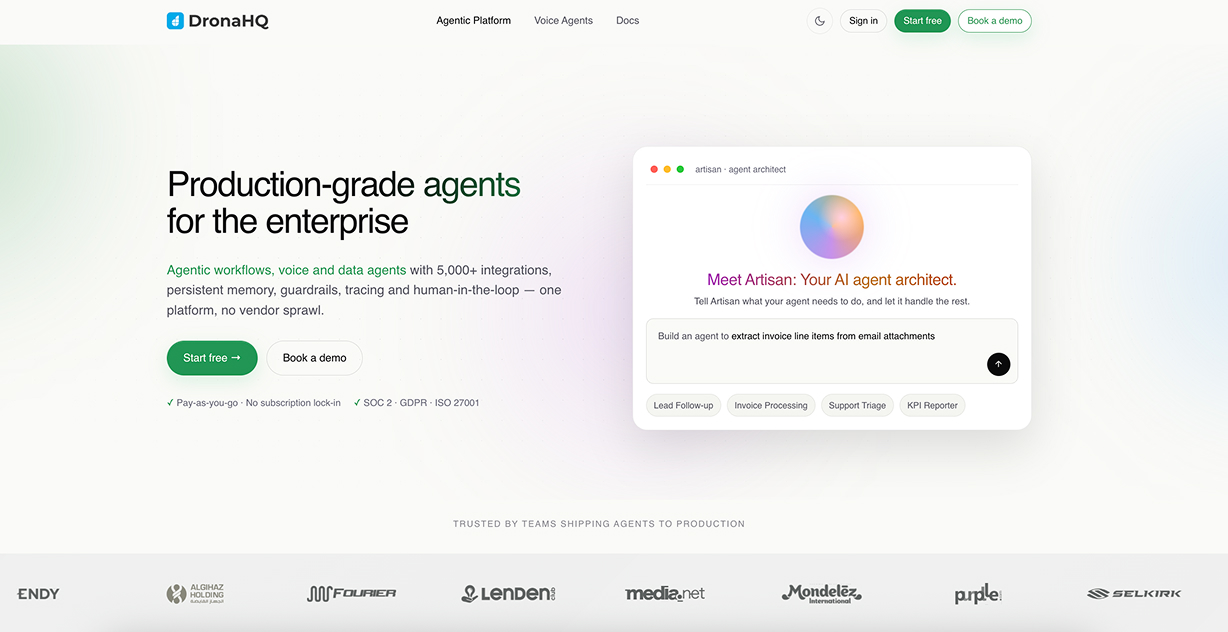
Best for enterprise teams that need AI agents to live inside real business workflows. DronaHQ is an AI-powered developer platform for building enterprise AI agents, internal apps, and workflow automations. It is best for product, operations, and engineering teams that care less about “agent demos” and more about governed execution across enterprise systems.
Why it stands out
- One toolkit for chat, voice, database, and API agents.
- 4,000+ OAuth tool integrations without API key management and multiple built-in triggers
- Audit trails and governance for compliance and transparency into the reasoning behind every agent action.
- Better fit when the agent needs an execution layer, not just orchestration and reasoning
- Combines agents, workflows, integrations, UI, and human checkpoints in one managed setup
- For teams that need agents to interact with structured business processes, rather than only answer questions
Where it weakens
- Not the lightest option for teams only experimenting with standalone copilots
- The platform is broader than Lyzr, which can be a plus or a minus depending on how focused the team wants the tool to be
Pricing: Agentic platform pricing includes pay-as-you-go and enterprise plans. View pricing
2. Vertex AI Agent Builder
Best for enterprises already committed to Google Cloud. Vertex AI Agent Builder is Google’s production-oriented suite for building, scaling, and governing AI agents within the Vertex ecosystem. It is best for engineering-heavy teams that want agent infrastructure aligned with Google Cloud rather than a separate agent product layer.
Why it stands out
- Strongest fit for teams already building on Google Cloud and Vertex AI
- Better cloud-native alignment than Lyzr for organizations standardizing on Google infrastructure
- Supports the full agent lifecycle with production, governance, and scaling in view
- More attractive for teams that want to mix custom agent logic with Google’s broader AI and data stack
- Pricing is usage-based rather than packaged like a startup product, which suits some enterprise buyers better
Where it weakens
- Heavier and more cloud-native than teams looking for a guided builder may want
- Less approachable for non-technical teams than Lyzr’s more opinionated platform experience
- Cost and architecture planning can get complex fast once usage grows
Pricing: Usage-based pricing with Agent Engine and model costs. View pricing
3. Microsoft Copilot Studio
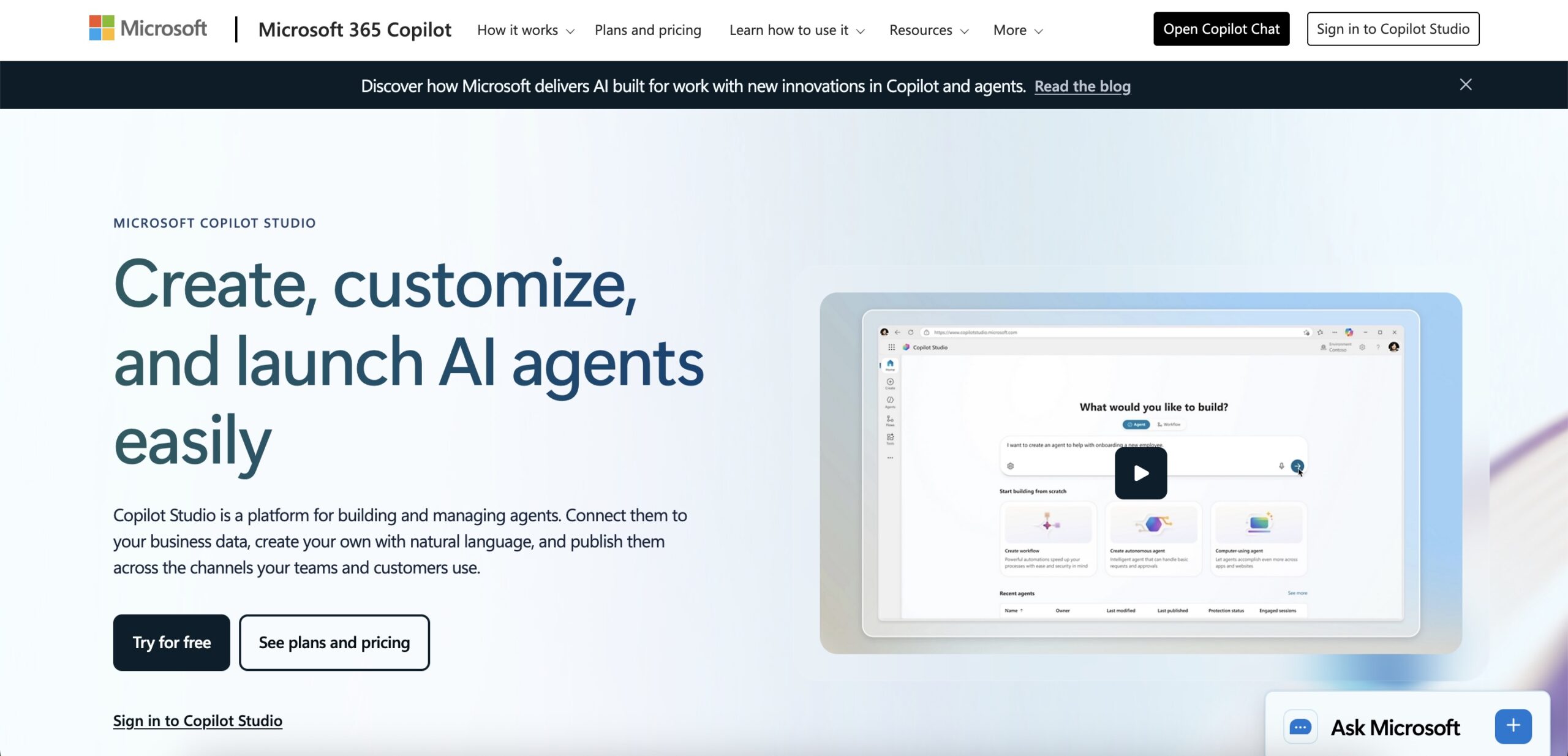
Best for enterprises already living inside Microsoft 365 and Power Platform. Copilot Studio is Microsoft’s end-to-end platform for creating agents through natural language and graphical tools, with strong integration into Microsoft’s enterprise stack. It is best for teams that want agents close to Microsoft workflows, documents, and business systems.
Why it stands out
- Natural fit for enterprises standardized on Microsoft 365, Entra, Teams, and Power Platform
- Easier route than Lyzr for organizations that already trust Microsoft’s enterprise controls and admin model
- Strong option for internal productivity agents and department-facing automation inside Microsoft environments
- Lets business teams participate more directly through graphical tooling and natural language setup
- Stronger internal distribution path if agents are meant to live inside Microsoft Copilot experiences
Where it weakens
- Less compelling for companies outside the Microsoft ecosystem
- Can feel constrained if the team wants full stack freedom or deeper custom orchestration patterns
- Pricing through credit packs and Azure usage can become less intuitive than it first appears
Pricing: Capacity packs start at $200 per month for 25,000 Copilot Credits. View pricing
4. CrewAI
Best for teams that want multi-agent collaboration with more engineering freedom. CrewAI is an agentic workflow and multi-agent platform for teams that want crews of AI agents working together across tools and tasks. It is best for builders who like the enterprise AI agent category but want more flexibility and developer depth than a guided platform like Lyzr provides.
Why it stands out
- Strong multi-agent collaboration model for task decomposition and coordinated execution
- Better fit than Lyzr for teams that want a more engineering-led approach to agent design
- Useful when complex agent teamwork is the real requirement, not only single-agent business automation
- Offers both a visual editor and APIs, which helps mixed technical and semi-technical teams
- Enterprise plan supports private infrastructure and stronger organizational rollout
Where it weakens
- Less turnkey for business teams that want fast guided deployment with a strong default platform opinion
- Multi-agent flexibility can add complexity rather than reduce it
- Some teams may still need to do more architectural thinking than they expected
Pricing: Free tier available. Enterprise pricing is custom. View pricing
5. LangGraph
Best for teams that want deep control over stateful agent orchestration. LangGraph is a low-level framework and platform layer for building, managing, and deploying long-running, stateful agents. It is best for engineering teams that want control over orchestration logic, not a highly packaged enterprise builder.
Why it stands out
- Strong choice for teams that care deeply about state, control flow, and resilient agent behavior
- More flexible than Lyzr for developers building custom agent systems from the ground up
- Better fit for engineering organizations that already know they do not want a heavy platform opinion
- LangGraph plus LangSmith gives teams visibility into debugging, tracing, and iteration
- Well suited for teams building agent infrastructure as a core product capability rather than as a packaged business tool
Where it weakens
- Steeper path for non-technical teams or business-led deployments
- Less of a guided enterprise product than buyers expecting packaged templates may want
- The freedom is valuable, but it also shifts more design responsibility onto the team
Pricing: Open-source framework with optional LangSmith and platform pricing. View pricing
Read also: What is LangGraph? Review + Top Competitors
6. Kore.ai
Best for large enterprises that want a mature agent platform with strong governance and industry coverage. Kore.ai is an enterprise agent platform with multi-agent orchestration, observability, search and data layers, and a large catalog of prebuilt industry applications and accelerators. It is best for organizations with complex service, employee, and process automation requirements.
Why it stands out
- More mature enterprise posture than many newer agent platforms in this market
- Strong governance, observability, and centralized agent management story
- Broad library of prebuilt applications, accelerators, and industry-specific assets
- Better fit than Lyzr for heavily regulated sectors that want a more established enterprise vendor profile
- Useful when the buyer wants one platform spanning service, work, and process automation at scale
Where it weakens
- Can feel heavier and more procurement-led than newer platforms
- Less appealing for lean teams that want fast experimentation without enterprise process overhead
- Public pricing is not transparent, which makes early evaluation harder
Pricing: Enterprise quote-based pricing. Explore platform
7. IBM watsonx Orchestrate
Best for enterprises that want agent orchestration tied to broad workflow automation and IBM-grade governance. watsonx Orchestrate is IBM’s platform for building, connecting, and managing AI agents across systems, workflows, and business operations. It is best for companies that want agents tightly connected to enterprise automation, governance, and broad system orchestration.
Why it stands out
- Strongest fit for buyers who want AI agents embedded in enterprise automation rather than treated as isolated assistants
- Combines multi-agent orchestration, agent builder, and agent catalog in a more traditional enterprise platform model
- More credible than Lyzr for organizations already aligned with IBM’s governance and deployment posture
- Useful for cross-app workflow automation where the agent has to coordinate work, not just generate answers
- Multiple deployment and buying paths make it relevant for larger enterprise procurement models
Where it weakens
- Can feel heavy for teams that want a leaner, faster-moving builder experience
- Less attractive for startups or mid-market teams trying to get early wins without enterprise platform complexity
- IBM-style buying and setup will not appeal to teams that prefer modern self-serve product motions
Pricing: Essentials starts at $530 per month, with additional MAU-based pricing. View pricing
Quick comparison table
| Platform | Best for | Strongest edge | Likely limitation | Pricing starting point |
| DronaHQ | Enterprise operational agents | Combines agents, workflows, UI, and execution | Broader than pure agent frameworks | Pay-as-you-go |
| Vertex AI Agent Builder | Google Cloud enterprises | Deep cloud-native alignment | More technical and architecture-heavy | Usage-based |
| Microsoft Copilot Studio | Microsoft-first enterprises | Native fit with Microsoft 365 and Copilot | Less flexible outside Microsoft stack | $200 per capacity pack |
| CrewAI | Multi-agent engineering teams | Strong collaborative agent model | Requires more technical design discipline | Free, enterprise custom |
| LangGraph | Developer-led custom agent systems | Stateful orchestration control | Steeper path for non-technical teams | Open source, platform extras |
| Kore.ai | Large regulated enterprises | Mature governance and industry coverage | Sales-led and less transparent early on | Custom |
| IBM watsonx Orchestrate | Enterprise workflow automation | Strong orchestration plus enterprise automation posture | Heavy for teams that want lighter rollout | $530/month |
Related Articles