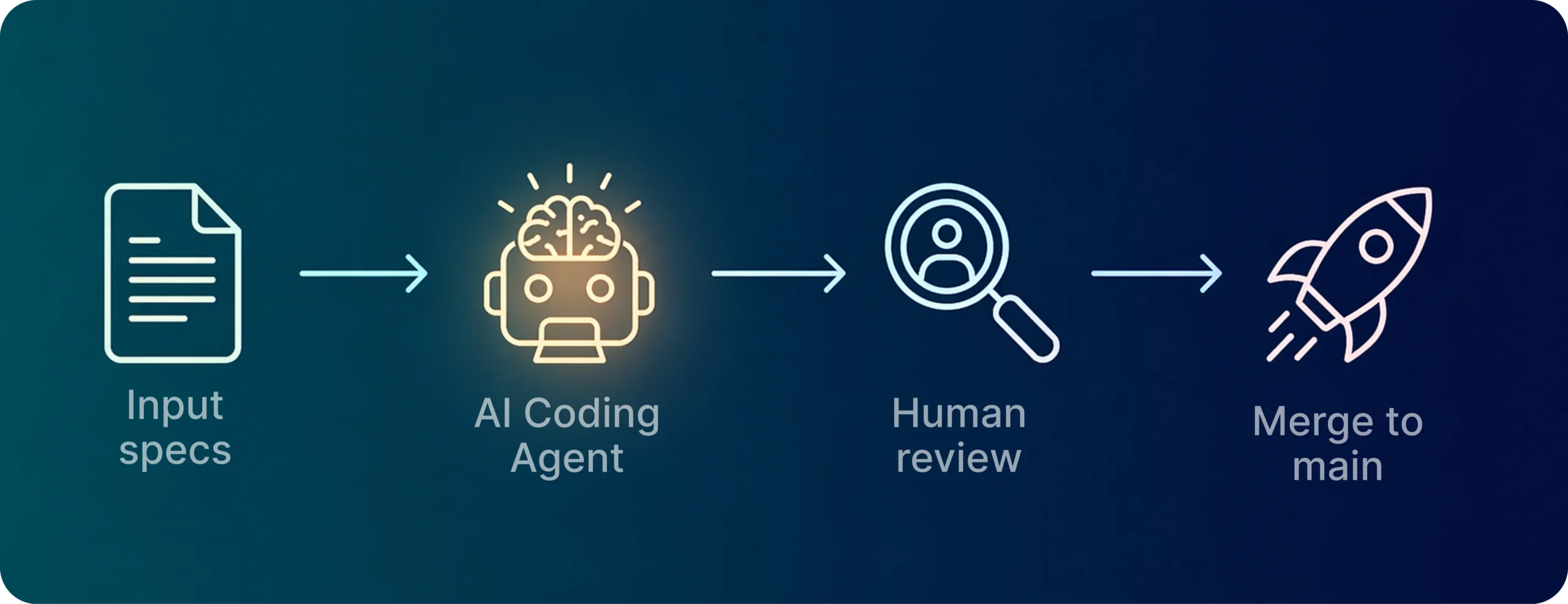

Agentic SDLC: A practical guide to AI-led software delivery in 2026
TL;DR
Agentic SDLC is a software development lifecycle where AI agents do real work across planning, coding, testing, and operations, under clear rules and human oversight.
Boards now expect productivity gains that basic coding copilots cannot deliver, and early data shows teams using GenAI in six or more SDLC stages release nearly twice as often and cut defects by up to 96% in some samples.
This article explains, in simple terms, what agentic SDLC means, why it matters in 2026, how it works phase by phase, and how your team can adopt it safely.
What is an agentic SDLC?
Agentic SDLC is a way of running the software development lifecycle where AI agents are built into the process from end to end. These agents are not just code suggestion tools. They can:
- Read context, such as code, tickets, and logs
- Reason about a goal, such as “add this feature with tests”
- Take actions via tools like Git, CI/CD, and monitoring
- Loop and self-correct under set rules and human review
In a traditional SDLC, humans do all of this. In an AI-assisted SDLC, humans still own every step, but use copilots in the IDE and sometimes AI help in documentation or test hints. In an agentic SDLC, small, focused agents take on full tasks, like generating tests, opening pull requests, summarizing incidents, or drafting specs, within trusted boundaries.
You can think of it like this:
- Traditional SDLC: tools support humans
- AI-assisted SDLC: tools speed up humans
- Agentic SDLC: agents work alongside humans, with humans in charge
The biggest gains in 2026 are coming from teams that treat AI as part of the SDLC design, not just as an add-on inside editors.
Read also: enterprise AI agents explained
Why agentic SDLC is emerging now
Productivity expectations are rising
McKinsey estimates that generative AI could add between 2.6 and 4.4 trillion dollars a year across analyzed use cases, and that its value roughly doubles when it is embedded inside existing software and workflows rather than left at the surface. For software engineering alone, analysis suggests a 20 to 45% productivity uplift from generative AI, mainly in coding, refactoring, and analysis tasks.
These figures are in the decks of boards and investors. They create pressure on engineering leaders to show real, not just anecdotal, productivity gains.
Spend and usage are shifting into the SDLC
Gartner expects global spending on AI software to grow from 124 billion dollars in 2022 to 297 billion dollars in 2027, roughly a 19.1% CAGR, with generative AI software rising from 8% to 35% of AI software spend. Fortune Business Insights estimates that the generative AI in software development lifecycle market alone will grow from about 845 million dollars in 2026 to 9.49 billion dollars by 2034, a 35.3% CAGR.
Developer behavior already reflects this shift. 2026 software development statistics show that around 84% of developers are using or planning to use AI tools in their work, and more than half say they use AI every day. AI in development is now normal, not novel.
Read also: what is an agentic AI platform
Data favors lifecycle-wide adoption, not point tools
The strongest evidence for agentic SDLC comes from looking at breadth of use across the lifecycle, not just the presence of AI in one tool.
PwC’s 2025 to 2026 “Agentic SDLC in practice” research, based on 377 technology leaders and professionals, found:
- 70% of software teams use GenAI at moderate or high levels across their SDLC
- 54% of teams use GenAI in six or more SDLC stages
- These broader users release software nearly twice as often and report defect reductions of up to 96%, when measured through tracked bug and defect metrics
Those numbers are regional and self-reported, but they tell a clear story: when GenAI is built into planning, development, testing, and operations together, outcomes shift much more than when it is only in the IDE.
Agents themselves are surging
- Across over 20,000 organizations, multi-agent workflows grew 327% in less than four months
- Over 80% of new databases on its platform are now created by AI agents, not humans
- Companies using AI evaluation tools get nearly 6x more AI projects into production, and those using AI governance tools get over 12x more projects into production
- Yet only 19% of organizations have deployed AI agents at scale, highlighting a large execution gap
Agentic SDLC is how teams start to close that gap: they evolve the SDLC so it can safely host and control these agents, instead of leaving them as scattered experiments.
Bonus read: Top low-code AI agent builders in 2026
Agentic SDLC vs AI-assisted SDLC: clear differences
Where AI lives
- AI-assisted SDLC: AI lives mostly in the IDE or chat tools. It helps write code or answer questions, but does not move tickets, change pipelines, or act on logs.
- Agentic SDLC: AI agents are embedded in systems of record and pipelines, issue trackers, repos, CI/CD, and observability, so they can act on real workflows.
What AI is allowed to do
- AI-assisted: Suggest code; humans still commit, test, deploy, and remediate.
- Agentic: Perform defined tasks end to end, such as generating tests, opening pull requests, drafting release notes, or summarizing incidents, all under policy and review.
How humans spend their time
- AI-assisted: Humans still carry most of the coordination and glue work: rewriting specs, chasing approvals, writing tests, and doing manual triage.
- Agentic: Humans set goals, review agent work, resolve tricky edge cases, and design systems. Agents take on repetitive or cross-cutting work.
Agentic SDLC requires teams to prepare for new ways of working, agents as “team members” that must be managed, not just tools that are used.
How agentic SDLC works across the lifecycle
Requirements and planning: from raw input to clear work
In an agentic SDLC, agents help turn messy input into structured work.
They can:
- Read customer feedback, support tickets, and meeting notes and generate user stories with acceptance criteria
- Identify themes and duplicates in the backlog and suggest a prioritized roadmap
- Keep requirement docs and tickets in sync as scope changes
A “spec agent” to convert ideas into specs and work items that can drive coding agents. This makes planning faster and reduces misalignment between product and engineering.
Design and architecture: assisted system thinking
Design agents can:
- Propose architecture diagrams, sequence flows, and API contracts based on existing systems and constraints
- Compare design options and highlight trade-offs, for example between performance and complexity
- Check designs against security and compliance checklists
Senior engineers still own the decisions, but they start from informed drafts instead of blank pages.
Development: coding agents in the background
Consider a coding agent integrated with GitHub that can take a task from the spec, navigate the repository, and:
- Edit or create files following style and patterns
- Run tests and linters locally
- Open a pull request with a summary and links to tests
- Respond to comments from reviewers
Other organizations use coding agents to handle migrations, scaffolding, and “boring” refactors. The largest gains in development come from freeing engineers from routine code work so they can focus on complex logic and product value.
Testing and quality: agents as your first line of defense
Testing agents can:
- Generate unit and integration tests based on code changes and spec text
- Spot coverage gaps and propose extra tests where the risk of failure is high
- Run security scans and static analysis, then summarize risks in plain language
Teams using GenAI heavily in testing and QA report large drops in escape defects; in some mature clusters, reported defect reductions reach up to 96%. While actual numbers will vary by context, the trend is clear: using AI in testing is one of the strongest early wins in an agentic SDLC.
Deployment and release: safer, smarter automation
In an AI-driven SDLC, agents support deployment by:
- Suggesting the right rollout strategy, for example, canary vs blue-green, based on risk and traffic
- Drafting release notes for internal teams and customers
- Checking that all required tests, approvals, and policy checks have passed before a deployment goes live
This keeps humans in control while removing the manual, repetitive work around releases.
Operations and SRE: agents that never sleep
In production, SRE agents can:
- Watch logs, traces, and metrics for anomalies and create incident tickets when they spot issues
- Link incidents back to recent changes or configuration updates
- Draft suggested remediation steps or run known, safe runbooks, with human approval
This kind of automation lets teams stay lean while handling more systems, because agents absorb much of the “toil” that used to fill SRE days. It also helps teams catch issues earlier and recover faster.
How to start adopting an agentic SDLC
You do not have to move your whole SDLC to agents at once. A phased approach is best.
1. Choose the right starting workflows
Look for work that is:
- Repetitive and well understood
- Measurable, so you can track before and after outcomes
- Low to medium risk if something goes wrong
Good candidates include test generation, documentation, incident summaries, and backlog analysis.
2. Put basic governance and evaluation in place
Before agents can make changes, you should:
- Decide what they are allowed to do, for example, open PRs but never merge, read logs but never change configs
- Set up basic evaluation for their outputs, especially code and scripts
- Log all agent actions so you can review and audit them later
Databricks’ data shows that organizations with evaluation tools see nearly 6x more AI projects in production, and those with governance tools see over 12x more, which suggests that control systems are a real driver of success, not just overhead.
3. Integrate agents into tools you already use
Instead of creating yet another dashboard, connect agents to:
- Your issue tracking tools, like Jira or Azure Boards
- Your git repos, like GitHub or GitLab
- Your CI/CD pipelines
- Your observability platforms
Tying agents into DevOps, GitHub, and pipelines lets teams help where work actually happens. The same logic applies to any stack.
4. Measure, learn, and expand
Track a handful of key metrics:
- Lead time from ticket to production
- Deployment frequency
- Change failure rate and mean time to recovery
- Defect escape rate and test coverage
- Developer experience and satisfaction
Outcomes are unlocked through measurement and that as teams mature, their barriers and focus areas change. Treat agentic SDLC as an ongoing program, not a one-time rollout.
Risks and how to manage them
Agentic SDLC comes with real risks. The good news is that they are manageable with the right controls.
Main risk areas
- Unsafe changes: Agents might propose code or scripts that introduce bugs or security issues if evaluation is weak
- Too much autonomy: Agents might do more than intended if permissions are too broad
- Lack of traceability: Without logs and audit trails, it is hard to know what changed and why
Good practices from industry reports
- Keep humans in the loop for high-impact actions and all production deployments
- Start agents in read-only or non-production environments and expand scope as you gain trust
- Use role-based access control and policies to restrict what agents can access
- Treat agent systems like any other critical system: monitor them, define SLOs, and include them in incident management
Handled this way, an agentic SDLC can actually improve safety by adding more checks, more tests, and more consistent processes than most teams can sustain today.
Final thoughts
Agentic SDLC is not a buzzword; it is a practical response to real pressures in 2026. The numbers are clear:
- Generative AI can unlock 20 to 45% productivity gains in software engineering if used well
- AI software spend is heading toward 297 billion dollars by 2027, with gen AI taking a growing share
- Teams that use GenAI across six or more SDLC stages already release nearly twice as often and report far fewer defects
- Multi-agent workflows grew 327% in a few months in one major platform, but only 19% of organizations have agents at scale
The gap between “we use AI tools” and “we run an agentic SDLC” is where the next wave of competitive advantage will be decided.
If your team is still stuck at the copilot stage, the next move is not to buy more tools. It is to design a lifecycle where agents can safely help your engineers ship better software, faster.
If you want a structured path to that state, contact us for a consultation. A short strategy session can help you identify high-value workflows, define the right guardrails, and plan your first steps toward a real agentic SDLC.
Resources
- https://www.pwc.com/m1/en/publications/2026/docs/future-of-solutions-dev-and-delivery-in-the-rise-of-gen-ai.pdf
- https://www.pwc.com/m1/en/publications/2026/docs/gen-ai-survey.pdf
- https://www.mckinsey.com/capabilities/tech-and-ai/our-insights/the-economic-potential-of-generative-ai-the-next-productivity-frontier
- https://www.databricks.com/resources/ebook/state-of-ai-agents
- https://www.epam.com/insights/ai/blogs/agentic-development-lifecycle-explained