
Yellow.ai alternatives: evaluating the top conversational AI options for enterprise teams in 2026
Yellow.ai alternatives are the platforms teams evaluate when they need conversational AI for chat, voice, or WhatsApp but want a different mix of control, cost predictability, or governance than Yellow.ai offers. In short: Yellow.ai is strong for fast, templated omnichannel deployment, but teams increasingly look elsewhere once they need tighter cost visibility or deeper workflow execution.
Take a support team at a D2C brand running WhatsApp and web chat through Yellow.ai. The bot launches fast, deflects FAQs, and looks good in the pilot review. Six months in, the team wants the bot to actually trigger a refund in their order system, not just answer a question about refund policy. That gap between “answering” and “acting” is where most Yellow.ai alternatives conversations start.
Why now, specifically. Yellow.ai signed a $550 million SPAC merger with Bluerock in August 2026, with plans to list as YAI and use part of the proceeds to acquire BPO operators. Reported revenue sits around $34.8 million. A company heading into public markets on a services roll-up thesis has different incentives than one focused purely on product depth, and buyers are right to factor that into a long-term platform bet. On top of that, Yellow.ai raised its top published plan from free to $5,000 a month in February 2026, and most enterprise pricing still runs through custom quotes.
What is Yellow.ai
Yellow.ai is an enterprise conversational AI platform for building chat, voice, and WhatsApp bots across 35+ channels, with prebuilt industry templates for BFSI, retail, and telecom. It’s built around a workflow-builder abstraction: business teams configure conversational logic through drag-and-drop tools rather than writing code, and the platform layers a managed AI runtime (including its own voice product, Nexus Vox, launched May 2026 with sub-400ms response and 500+ language support) on top of external LLM providers.
That design is genuinely useful for speed. It’s also the reason teams eventually look elsewhere: workflow abstraction that gets you live in two weeks is the same abstraction that limits how deeply you can customize logic once the use case gets specific.
Why teams look for Yellow.ai alternatives
A few patterns show up repeatedly in how teams describe outgrowing Yellow.ai:
- The bot needs to execute actions in internal systems, not just answer from a knowledge base.
- Pricing that looked reasonable in a pilot becomes unpredictable once usage-based fees for MTUs, WhatsApp conversations, and resolutions stack up.
- Workflow logic gets dense enough that debugging and handoffs between team members slow down.
- Governance and audit requirements from security or compliance exceed what a templated builder exposes.
- The team wants a platform that isn’t building toward a services-heavy roadmap.
None of this makes Yellow.ai a bad starting point. It just means the decision criteria change once a bot moves from pilot to production.
How to evaluate Yellow.ai alternatives
Before comparing platforms, it helps to fix the criteria that actually predict success six months after launch, not just at demo time.
- Execution depth: can the agent take actions in your systems (CRM, calendar, database), or does it stop at answering questions?
- Cost behavior at scale: does pricing stay predictable as conversation volume, channels, and resolutions grow, or does it compound?
- Control surface: can your team adjust orchestration logic, model routing, and fallback behavior, or is it locked inside a builder?
- Governance: are there audit trails, RBAC, and observability suitable for regulated or high-stakes workflows?
- Switching friction: how tightly is your conversational logic coupled to the vendor’s proprietary builder?
Top Yellow.ai alternatives in 2026: quick comparison
| Platform | Best for | Strongest edge | Likely limitation |
| DronaHQ | Enterprise teams that need agents to act inside real workflows | Combines chat, WhatsApp, and voice agents with workflow execution, UI, and governance in one platform | Broader scope than a pure chatbot builder |
| Kore.ai | Large regulated enterprises | Multi-agent orchestration, FedRAMP Moderate, strong governance | Pricing not public, long implementation cycles |
| Cognigy (NiCE) | Contact centers needing deep telephony integrations | Mature voice and chat orchestration with Genesys, Avaya, AWS connectors | Enterprise contracts often start above $100K/year |
| IBM watsonx Orchestrate | Regulated industries needing hybrid deployment | Governance, audit logging, on-prem/hybrid options | Higher setup complexity, seat and MAU-based costs |
| Intercom (Fin) | SaaS support teams already on Intercom | Fast deployment inside an existing helpdesk | Chat-only, limited voice or telephony support |
| Gupshup | Conversational commerce on WhatsApp at scale | Deep WhatsApp Business API expertise, strong in emerging markets | Less suited to complex multi-department automation |
| Salesforce Agentforce | Teams whose service data lives in Salesforce | Agents grounded directly in CRM data and workflows | Limited portability outside the Salesforce ecosystem |
The top Yellow.ai alternatives, in depth
1. DronaHQ
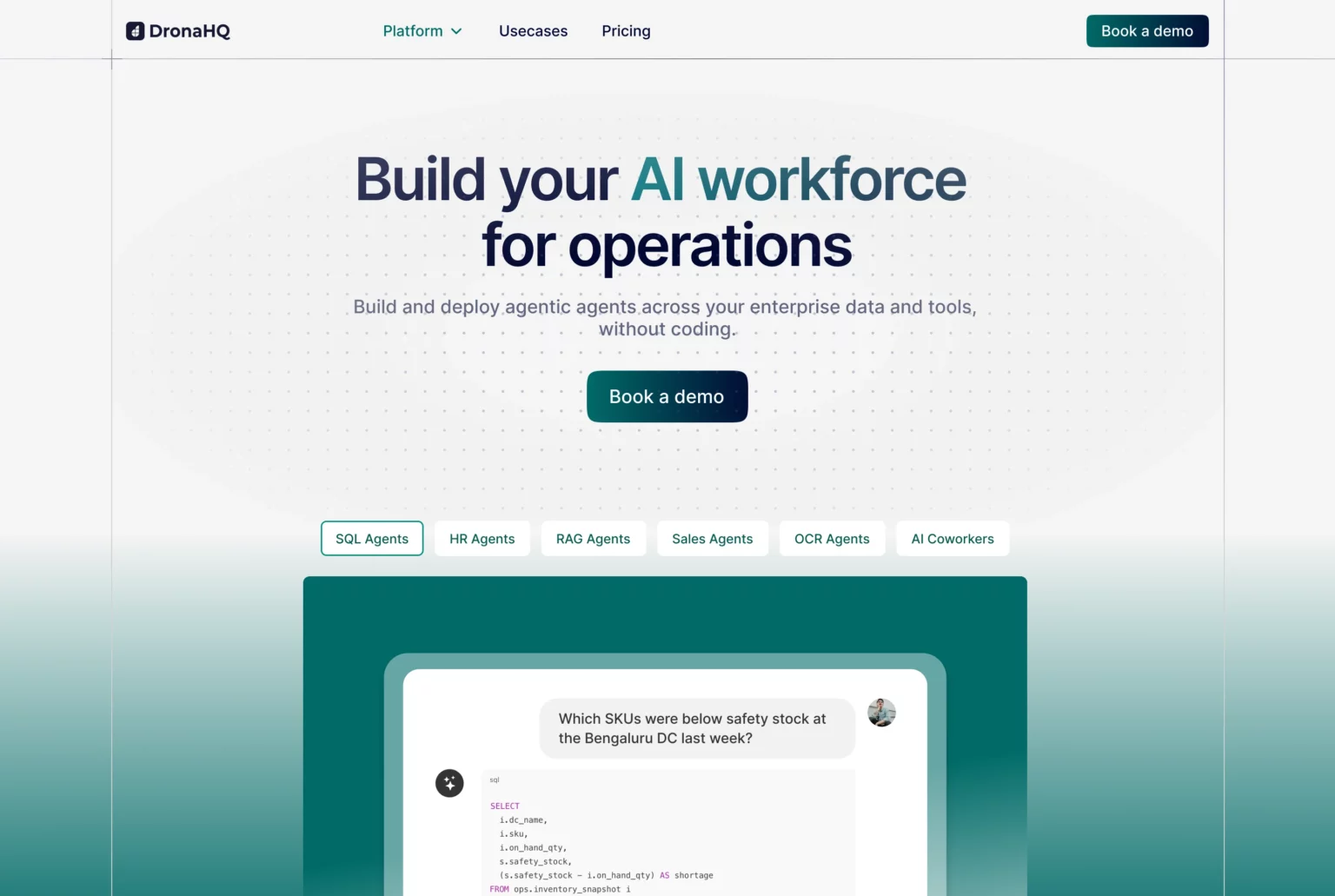
DronaHQ is an agentic platform for building chat, WhatsApp, and voice agents that connect directly into enterprise workflows, data, and UI, rather than stopping at conversational responses. It’s built for teams that need the bot to actually complete a task (book, reschedule, escalate, update a record) not just answer a question about it.
Why teams pick it over Yellow.ai
- One execution engine across chatbots, WhatsApp agents, and voice, instead of separate configuration for each channel.
- 4,000+ OAuth tool integrations without manual API key management, so an agent can act on real systems from day one.
- Audit trails and observability built in, useful for teams whose compliance function wants visibility into why an agent did what it did.
- Combines agent logic with UI, human-in-the-loop checkpoints, and workflow steps in one place, so a support agent isn’t a standalone bot bolted onto a helpdesk.
- Usage-based, pay-as-you-go pricing instead of custom enterprise quotes that only appear after a sales call.
Where it’s a weaker fit
- If all you need is a lightweight FAQ bot for a single channel, the platform’s broader scope is more than the use case requires.
- Teams evaluating on templated speed-to-launch alone, without needing execution depth, may find Yellow.ai’s prebuilt industry templates faster to start with.
Best for: teams that have already run a chatbot pilot and hit the point where “answering” isn’t enough, and the bot needs to actually do something inside company systems.
2. Kore.ai
Kore.ai rebuilt its platform as Artemis in May 2026: an AI-native agent platform with its own agent language, a governance layer, FedRAMP Moderate certification, and sovereign or on-prem deployment options. It was named a Gartner Magic Quadrant Leader again in August 2026, and it’s built for large enterprises running conversational automation across departments, not just a single support channel.
Why teams pick it over Yellow.ai
- Stronger governance and audit posture, which matters for finance, healthcare, and government buyers.
- Multi-agent orchestration for coordinating several agents on one task instead of a single linear bot flow.
- Broad connector library into contact center and CRM systems.
Where it’s a weaker fit
- Pricing isn’t public. Multiple sources put enterprise contracts around $300,000 a year, which puts it out of range for mid-market teams.
- Implementation cycles are longer, and the platform needs a dedicated team to get real value out of it.
Best for: enterprises in regulated industries that need agent orchestration with strong compliance guarantees and are prepared for a longer implementation.
3. Cognigy (NiCE)
Cognigy is now part of NiCE, following a roughly $955 million acquisition that closed in September 2025. It’s sold both standalone and inside NiCE’s CXone Mpower suite, so choosing Cognigy also means choosing a relationship with NiCE. The platform is built for agentic automation across voice, chat, and contact centers, with connectors into Genesys, Avaya, AWS, and 8×8.
Why teams pick it over Yellow.ai
- Deeper telephony and contact-center integrations for teams running real call center infrastructure, not just web and WhatsApp chat.
- Stronger multilingual NLU for global deployments.
- Built-in AI ops and runtime observability.
Where it’s a weaker fit
- No public pricing, and enterprise packages often start around $115,000 to $300,000 annually.
- The platform requires dedicated engineering for orchestration and ongoing optimization.
Best for: enterprises with existing contact center infrastructure that need voice and chat automation tightly integrated into that stack.
4. IBM watsonx Orchestrate
Watsonx Orchestrate, which absorbed watsonx Assistant, is IBM’s platform for building and governing AI agents across systems and workflows. It’s positioned around IBM’s broader governance and compliance posture, and it supports hybrid or on-prem deployment.
Why teams pick it over Yellow.ai
- Hybrid cloud flexibility for teams with data residency requirements.
- Governance controls (audit logging, RBAC, data residency) built for regulated operations.
- Long-standing enterprise support relationships for teams already inside the IBM ecosystem.
Where it’s a weaker fit
- Pricing starts around $530 a month for Essentials, but real cost depends on monthly active users and can climb quickly.
- Implementation overhead is higher than lighter, self-serve platforms.
Best for: enterprises with strong compliance requirements and existing IBM infrastructure investments.
5. Intercom (Fin)
Fin is Intercom’s AI support agent, embedded directly inside its helpdesk and messaging platform. It isn’t a general conversational orchestration engine like Yellow.ai. It’s purpose-built to resolve support tickets inside an existing Intercom inbox.
Why teams pick it over Yellow.ai
- Fast to activate if you already run support through Intercom, since there’s no separate bot infrastructure to stand up.
- Pricing is tied to AI-resolved conversations ($0.99 per resolution) rather than platform seats or token usage, which makes ROI easier to model.
- Human handoff happens in the same thread, so escalation doesn’t lose context.
Where it’s a weaker fit
- Built for chat and text support. It isn’t a real-time voice or telephony platform.
- Limited control over routing strategy or multi-model orchestration.
- Tightly coupled to the Intercom helpdesk, which limits portability if you use a different support stack.
Best for: SaaS support teams that already run their helpdesk on Intercom and want AI deflection without building separate bot infrastructure.
6. Gupshup
Gupshup is a conversational commerce and messaging platform with deep expertise in the WhatsApp Business API, particularly strong across India, Southeast Asia, and Latin America. It’s a common direct comparison for Yellow.ai buyers because both platforms compete heavily on WhatsApp-first CX in the same markets.
Why teams pick it over Yellow.ai
- Strong native WhatsApp commerce features (catalog, cart, payments) for teams selling directly through chat.
- Established messaging infrastructure and carrier relationships across emerging markets.
- Simpler pricing model for teams whose primary channel is WhatsApp rather than omnichannel CX.
Where it’s a weaker fit
- Less suited to complex, multi-department workflow automation beyond messaging and commerce.
- Voice and broader enterprise workflow capabilities are less mature than dedicated agentic platforms.
Best for: commerce-led businesses whose primary automation need is WhatsApp sales and support, not broader enterprise workflow automation.
7. Salesforce Agentforce
Agentforce embeds conversational AI agents directly inside Salesforce’s CRM, grounding responses in Customer 360 data rather than operating as a standalone system.
Why teams pick it over Yellow.ai
- Agents are grounded in live CRM data, which improves relevance without separate data syncing.
- Unmetered AI output per seat, rather than per-message billing.
- CRM-first orchestration means agents extend existing Salesforce workflows instead of duplicating logic elsewhere.
Where it’s a weaker fit
- Pricing is seat-based ($125 per user/month, plus required Service Cloud licenses), which scales with headcount, not usage.
- Deep lock-in to the Salesforce ecosystem limits portability if the CRM changes.
Best for: enterprises whose service and sales data already live in Salesforce and want conversational AI as an extension of that system, not a separate platform.
What this shift means for enterprises
The common thread across these alternatives isn’t that Yellow.ai is weak. It’s that the market has moved from “can you build a bot” to “can the bot act inside real systems, with cost and governance you can predict.” Platforms that only orchestrate conversation are increasingly compared against ones that also execute, and that comparison usually surfaces gaps that don’t show up in a pilot.
The next shift worth watching is agentic workflows that span multiple systems in one interaction, rather than a single bot answering from one knowledge base. Teams evaluating alternatives now are effectively buying for that future, not just for the current support queue.
Frequently asked questions
What is the best Yellow.ai alternative for execution, not just conversation?
Platforms like DronaHQ that combine chat, WhatsApp, and voice agents with workflow execution and UI tend to fit better once a bot needs to complete tasks, not just answer questions.
How does pricing typically compare to Yellow.ai?
Yellow.ai’s published pricing tops out at $5,000/month, with most enterprise deals running through custom quotes that add usage fees for MTUs and WhatsApp conversations. Alternatives split between usage-based models (predictable at scale) and seat- or contract-based enterprise pricing (harder to forecast early, but sometimes cheaper at very high volume).
Which alternative offers the most governance and control?
Kore.ai, IBM watsonx Orchestrate, and DronaHQ each expose stronger audit trails, RBAC, and observability than Yellow.ai’s templated builder, though the depth and pricing model differ significantly between them.
Is Yellow.ai still a reasonable starting point?
For fast, templated deployment across many channels, yes. The gap tends to appear later, when the bot needs deeper system access, predictable costs at scale, or governance beyond what the builder exposes.
Closing thought
Picking a Yellow.ai alternative isn’t really about finding a better chatbot builder. It’s about deciding how much of your customer or employee workflow you want the agent to actually own, and what you need to trust it with that. Start there, and the shortlist gets a lot shorter on its own.