
n8n vs Workato vs DronaHQ: how to actually think about this comparison
n8n, Workato, and DronaHQ all show up when someone searches for workflow automation software. But only two of them are built to do the same job.
n8n and Workato move data and trigger actions between systems. That’s integration and workflow automation, and they compete directly. DronaHQ builds and runs AI agents that work inside those systems, retrieving context and taking governed actions, not just passing data from one app to another.
TLDR: if you’re wiring Salesforce to Slack to NetSuite, compare n8n and Workato. If you’re building an agent that needs to look something up, decide what to do with it, and act on it inside real business systems, that’s a different job, and that’s where DronaHQ sits.
Here’s a concrete version of the difference. A support team wants a workflow that creates a Zendesk ticket whenever a form is submitted, and pings the right Slack channel. That’s n8n or Workato territory: trigger, transform, route. Now say the same team wants something that reads an incoming ticket, checks the customer’s account history, decides if it’s a billing issue or a bug, and either replies or escalates. That’s an agent making a judgment call across systems, which is a different design problem than a trigger-action chain.
Why this comparison keeps coming up now
Every automation vendor has spent the last year bolting “AI agent” capability onto their product. n8n added AI nodes. Workato built Agent Studio and an MCP gateway. That’s blurred the line between “automation platform with some AI features” and “AI agent platform with some automation features,” and it’s why these three names keep landing in the same search results and the same evaluation spreadsheets.
If you’re doing that evaluation right now, it helps to separate what each tool was originally built for before comparing what they’ve added on top.
What is n8n
n8n is an open-source, node-based workflow automation tool. You build automations visually, dragging in triggers and action nodes, and drop into JavaScript or Python when the visual layer runs out of road. 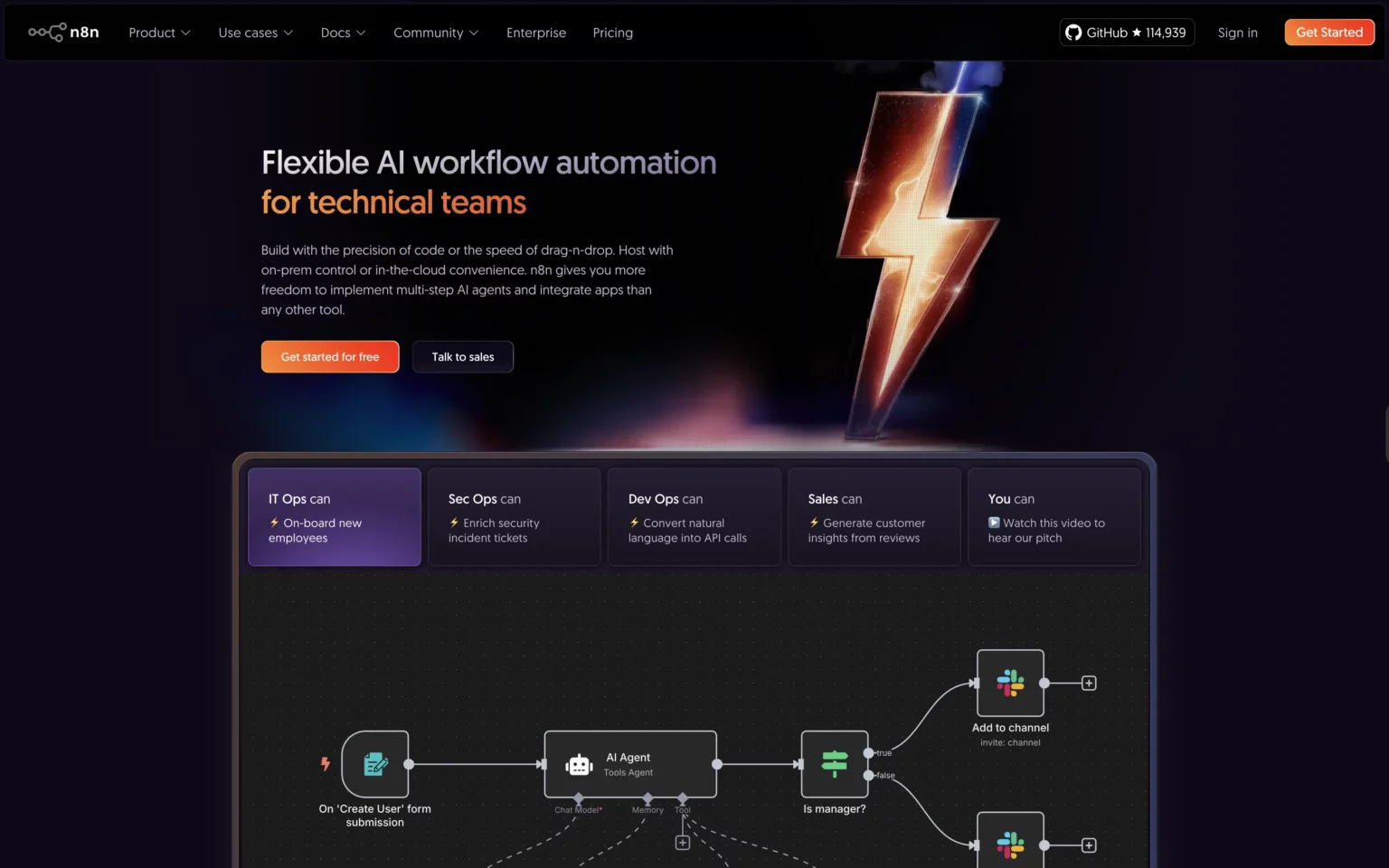
Key things about n8n:
- Self-hostable, with a fair-code license rather than a fully permissive open-source one
- Node-based canvas with 400+ integrations, HTTP request nodes, and database connectors
- Built-in AI nodes for calling LLMs and chaining basic agent behavior via LangChain
- Strong developer ergonomics: version control, custom code, expression syntax
n8n is popular with technical teams because you can inspect and modify the platform itself. The tradeoff is that it assumes technical competence. A marketing ops person used to Zapier’s trigger-action simplicity will find n8n’s canvas and data structures a real learning curve.
What is Workato
Workato is an enterprise iPaaS: integration platform as a service, built for IT and ops teams that need to connect dozens of SaaS systems without engineering on every workflow.
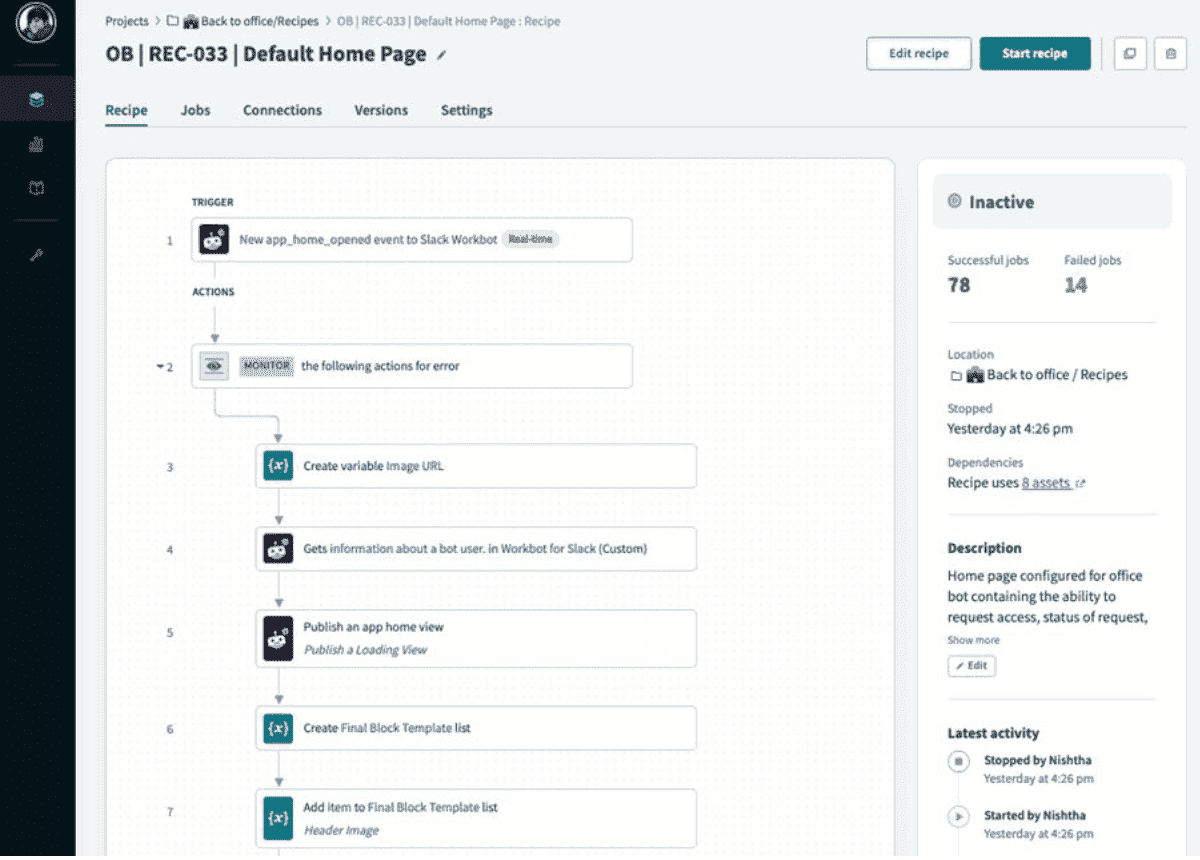
Key things about Workato:
- 1,200+ pre-built connectors, no-code recipe builder for business users
- Compliance certifications that matter to regulated industries: SOC 2 Type II, ISO 27001, HIPAA
- Agent Studio and an MCP gateway for teams extending recipes into agentic workflows
- Managed infrastructure, so there’s no self-hosting or patching to think about
Workato’s pitch is governance at scale. Centralized IT can set guardrails once, and business teams build within them instead of every department running its own integration stack. That governance is also why it’s priced and positioned for organizations with a real IT function, not a five-person startup.
What is DronaHQ
DronaHQ is a platform for building and running AI agents that work inside real business systems, not just calling a model and returning text.
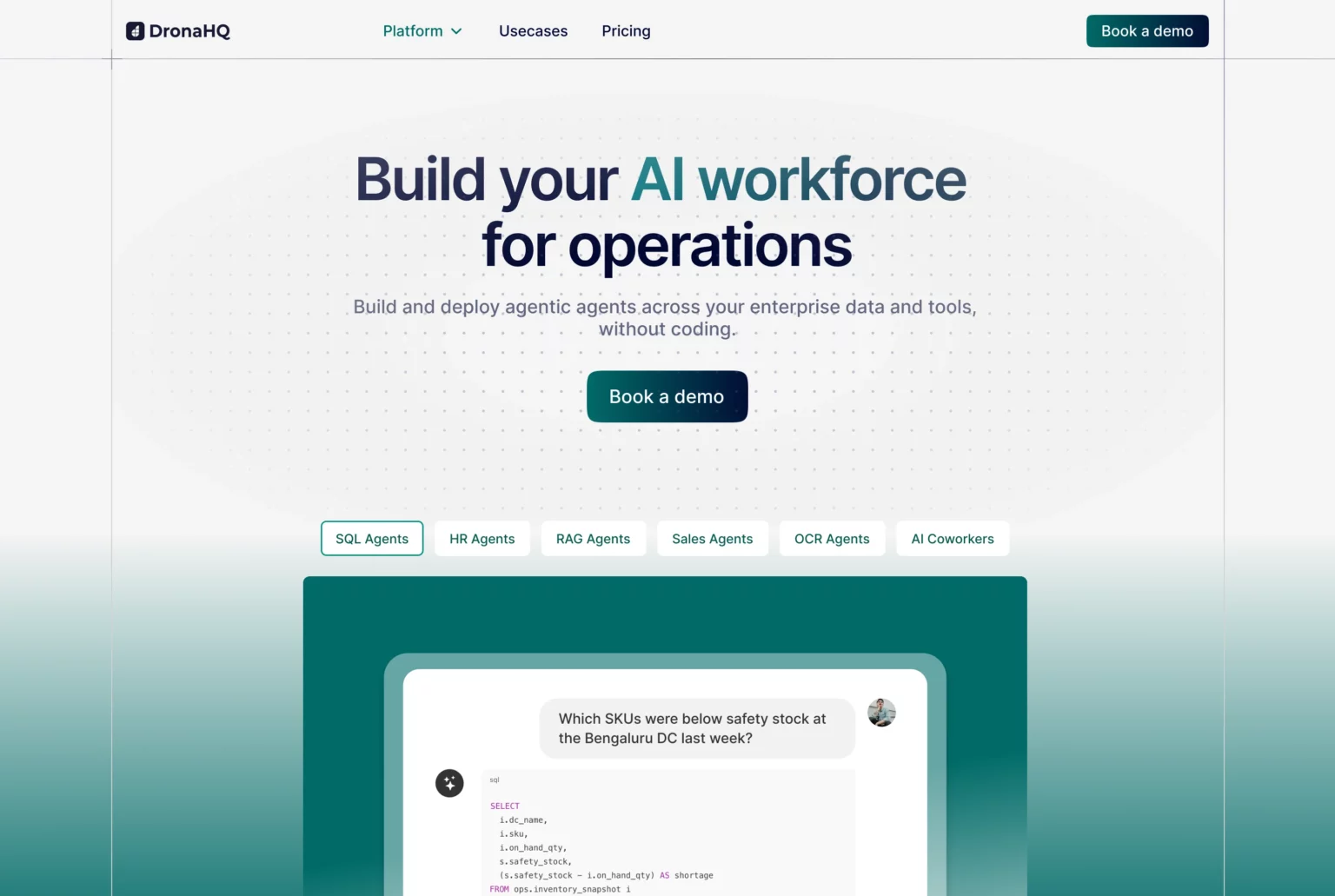
Key things about DronaHQ:
- Agent builder connected to a centralized connectors hub for APIs, databases, and third-party services
- Agents that retrieve information, update records, and trigger actions under defined permissions, not just draft a reply
- Support for chat, voice, and data agents from the same underlying orchestration layer
- Role-based access, audit visibility, and deployment options that mirror what IT already expects from internal tools
The distinction that matters: n8n and Workato move data along a path you define. An agent has to decide what to do next based on what it finds, inside a scope you’ve fenced off for it. Building that reliably (retrieval, permissioning, fallback when the agent is wrong) is a different set of problems than building a reliable trigger-action chain.
Where the category lines actually blur
There’s real overlap, and pretending otherwise would be dishonest.
- All three can call an LLM as a step in a larger process
- All three can be described as “orchestration” if you squint
- Teams sometimes use n8n or Workato as the plumbing underneath an agent, and an agent platform as the decision layer on top
Where they don’t overlap: n8n and Workato don’t give an agent judgment. You can wire an LLM node into a workflow, but the workflow still runs the same path every time unless you’ve hand-built branching logic for every case you anticipated. An agent platform is built around the idea that the path isn’t fully known in advance.
n8n vs Workato vs DronaHQ: comparison table
| n8n | Workato | DronaHQ | |
| Core job | Workflow automation | Enterprise iPaaS | AI agent platform |
| Deployment | Self-hosted or cloud | Managed cloud | Cloud or self-hosted |
| Best for | Technical teams, custom logic | IT-governed automation across departments | Agents that act inside business systems |
| Pricing model | Free self-hosted, usage-based cloud | Enterprise, usage-based | Enterprise. usage-based |
| AI depth | AI nodes, basic agent chaining | Agent Studio, MCP gateway | Native agent builder, chat/voice/data agents |
| Governance | Basic RBAC on paid tiers | Deep: SOC 2, ISO 27001, HIPAA, audit logs | Role-based access, audit visibility |
| Learning curve | Steep for non-developers | Low for business users, IT sets it up | Depends on agent complexity, not workflow syntax |
Numbers and certifications shift often enough that it’s worth checking each vendor’s current pricing and compliance pages before you commit.
Choosing based on your team, not the marketing page
A few honest starting points:
- If you’re a small technical team wiring APIs together and want full control, start with n8n.
- If you’re IT and need to standardize integrations across sales, HR, and finance with compliance sign-off, Workato is built for that conversation.
- If the thing you’re trying to build has to make a decision, not just move data, you’re evaluating agent platforms, and DronaHQ is one of the tools built specifically for that job.
- If you’re not sure which one you need, that’s usually a sign the project is still an integration problem, not an agent problem yet. Agents are worth reaching for once the workflow genuinely can’t be fully pre-defined.
Where each one tends to break
Every tool in this space fails in predictable ways once you push past the demo.
n8n: workflows get hard to maintain as they scale, and debugging a large flow takes real familiarity with the platform. There’s no built-in UI for internal dashboards, so anything user-facing needs another tool.
Workato: the cost curve is steep, and usage-based pricing at enterprise scale can get unpredictable. It’s also overkill if you don’t actually need cross-department governance yet.
DronaHQ, and agent platforms generally: they need clearer system design up front. An agent with vague permissions or no fallback path is a liability, not a shortcut. Agent platforms are also a worse fit for simple, fully-predictable task automation, where a plain workflow tool is faster to ship.
What this means going forward
The three-way comparison itself is a symptom of where automation is heading. Workflow tools are absorbing AI steps. Agent platforms are absorbing integration and governance features that used to be iPaaS-only territory. In a year or two, “workflow automation” and “AI agent platform” may not be separate shopping categories at all.
For now, the useful question isn’t “which of these three is best.” It’s “am I moving data along a known path, or am I asking something to decide what to do.” That answer points you to the right category before you start comparing feature lists inside it.
Want to understand the difference and figure out whether you need an AI agent builder or an iPaaS? Read this blog.
If you’re already leaning toward agents that need to act inside real systems, not just respond in a chat window, that’s worth a closer look on its own terms rather than as a line item next to a workflow tool.
Related Articles