
Why enterprise AI agents stall in pilot, and what it takes to ship them
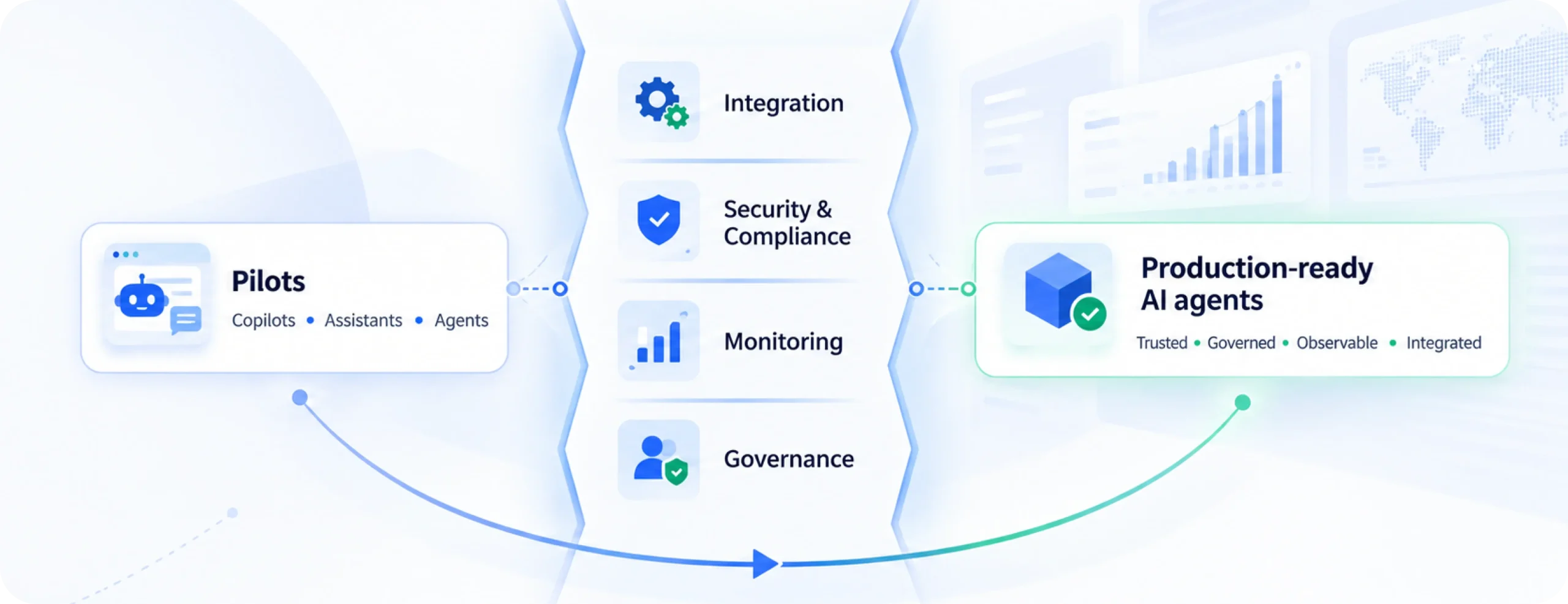
Enterprise AI agents stall in pilot because production requires work pilots usually skip: integration with existing systems, security and compliance review, monitoring, and governance. Deloitte’s 2026 survey found only 25% of organizations have moved 40% or more of their AI pilots into production, and only 21% of companies planning to deploy agents report a mature governance model.
That gap is mostly not about the model. This post covers why pilots stall, what the evidence says about the ones that shipped, and a checklist for getting an agent ready for production.
Why do AI agent pilots stall before production?
A pilot shows that an agent can handle the case it was built for. Production asks whether it keeps working on everything else, safely, with someone accountable. Four gaps show up repeatedly.
No defined success metric. Gartner expects over 40% of agentic AI projects to be canceled by the end of 2027, citing escalating costs, unclear business value or inadequate risk controls. If nobody defined what success looks like, nobody can defend the budget to scale.
Weak integration. An agent that cannot read from and write to the systems where work happens stays a side tool. Deloitte’s findings, as summarized by Unite.AI, describe production as requiring integration with existing systems, security and compliance reviews, monitoring and long-term maintenance.
Governance that lags deployment. In the same summary, 73% of organizations name data privacy and security as their top AI risk, while only 21% report a mature governance model for autonomous agents.
The wrong tool for the job. Gartner calls out “agentwashing”: labeling AI assistants as agents. It also says most agentic projects today are early experiments that are often misapplied. Before scaling, check that the workflow needs an agent at all.
What the numbers do and don’t say
The figures above measure different things, so avoid combining them.
McKinsey’s 2026 survey (1,719 respondents, fielded May 4 to June 8, 2026) found 40% of respondents from large organizations report scaling AI agents, against 22% from smaller ones. These are respondent reports, not audited deployments.
Gartner’s 40% figure is a forecast: 40% of enterprise applications integrated with task-specific agents by the end of 2026, up from under 5% in 2025. It describes applications, not customer adoption.
Deloitte’s 25% covers AI pilots in general, not only agents.
The common thread is that scaling is hard and uneven. McKinsey also found that only about 6% of respondents qualify as AI high performers, a share unchanged from 2025.
What the pilots that shipped did differently
No public dataset tracks individual pilots from start to production. What exists are survey results and engineering guidance, and four patterns recur.
They redesigned the workflow. In McKinsey’s survey, nearly three-quarters of high performers said they fundamentally redesigned workflows because of AI. About a quarter of other respondents said the same. High performers are the respondents who attribute at least 5% of EBIT to AI.
They defined how impact would be measured. High performers were twice as likely to report defined processes for measuring the impact of AI initiatives. Gartner lists unclear business value among the main reasons it expects projects to be canceled.
They tested against real failures. Anthropic’s engineering team recommends starting with 20 to 50 tasks taken from failures you have seen, grading what the agent produced rather than the exact path it took, and pairing automated evals with production monitoring.
They treated risk controls as part of the build. McKinsey found high performers much more likely to work on preventing unauthorized or unintended agent actions. Gartner names inadequate risk controls as a cancellation driver.
These McKinsey figures describe AI use broadly, not agent pilots specifically.
Pilot setup vs production requirements
Area | Typical pilot setup | What production requires |
Success measure | Works on the case it was designed for | A defined metric tied to business value |
Testing | Manual testing and intuition | Evals built from real failures, plus a regression suite |
Monitoring | Someone watches the runs | Production monitoring and long-term maintenance |
Integration | Limited or sample data access | Integration with existing systems |
Security and compliance | Informal | Security and compliance review |
Governance | Informal | A mature governance model for agents |
Risk controls | Broad or unscoped actions | Controls against unauthorized or unintended actions |
Cost | Not tracked | Operating cost kept within budget |
Governance is easier to act on when it is split into three questions.
What can the agent do? Define what it can read, propose, change and send, per system. Anything it can change should have an owner who approves that scope.
How will you know it is working? Anthropic describes production monitoring as the way to catch real-world failures that pre-launch tests miss. Pair it with evals you rerun on every change to the agent or model.
Can someone reconstruct what happened? Keep the full record of each run: outputs, tool calls, reasoning and intermediate results, plus the final state of the system the agent touched. That is the same transcript-and-outcome split Anthropic uses in its evals.
Human review and exception handling
Human review works when it is designed, not bolted on.
Decide in advance which actions need approval and which do not. Reversible, low-stakes actions can run unattended. Irreversible ones should not.
Send exceptions to a named person, with the context needed to decide: what the agent was asked, what it found, and what it proposes.
Treat “agent could not complete this” as a valid outcome. Count escalations separately from failures.
This part is design guidance rather than survey data. Test it against your own workflow.
Connecting agents to enterprise data and systems
An agent needs access to the systems of record it acts on, scoped to the task. Two practical points.
First, check the result in the system, not in the agent’s reply. Anthropic’s example: a booking agent may say the flight is booked, but the outcome is whether a reservation exists in the database.
Second, plan for data to move both ways. An agent that can read but not write turns every result into manual work, which erodes the case for scaling.
A production-readiness checklist
Define the success metric and the business value it maps to.
Confirm the workflow needs an agent, not an assistant or a fixed automation.
Redesign the workflow around the agent instead of inserting it into the old one.
Build 20 to 50 eval tasks from real failures, and rerun them on every change.
Scope permissions per system: read, propose, change, send.
Set approval rules and a named owner for exceptions.
Turn on production monitoring and keep a full record of each run.
Track operating cost per completed task.
Read the full testing checklist for AI Agent in production.
Where an application and orchestration layer fits
Most of the gaps above sit outside the model. They concern how an agent reaches business systems, who approves what it does, and where a person steps in.
That is the layer an application and orchestration platform covers. DronaHQ is one example. It connects chat, voice and data agents to existing systems and workflows, so an agent’s output lands in a process someone already owns.
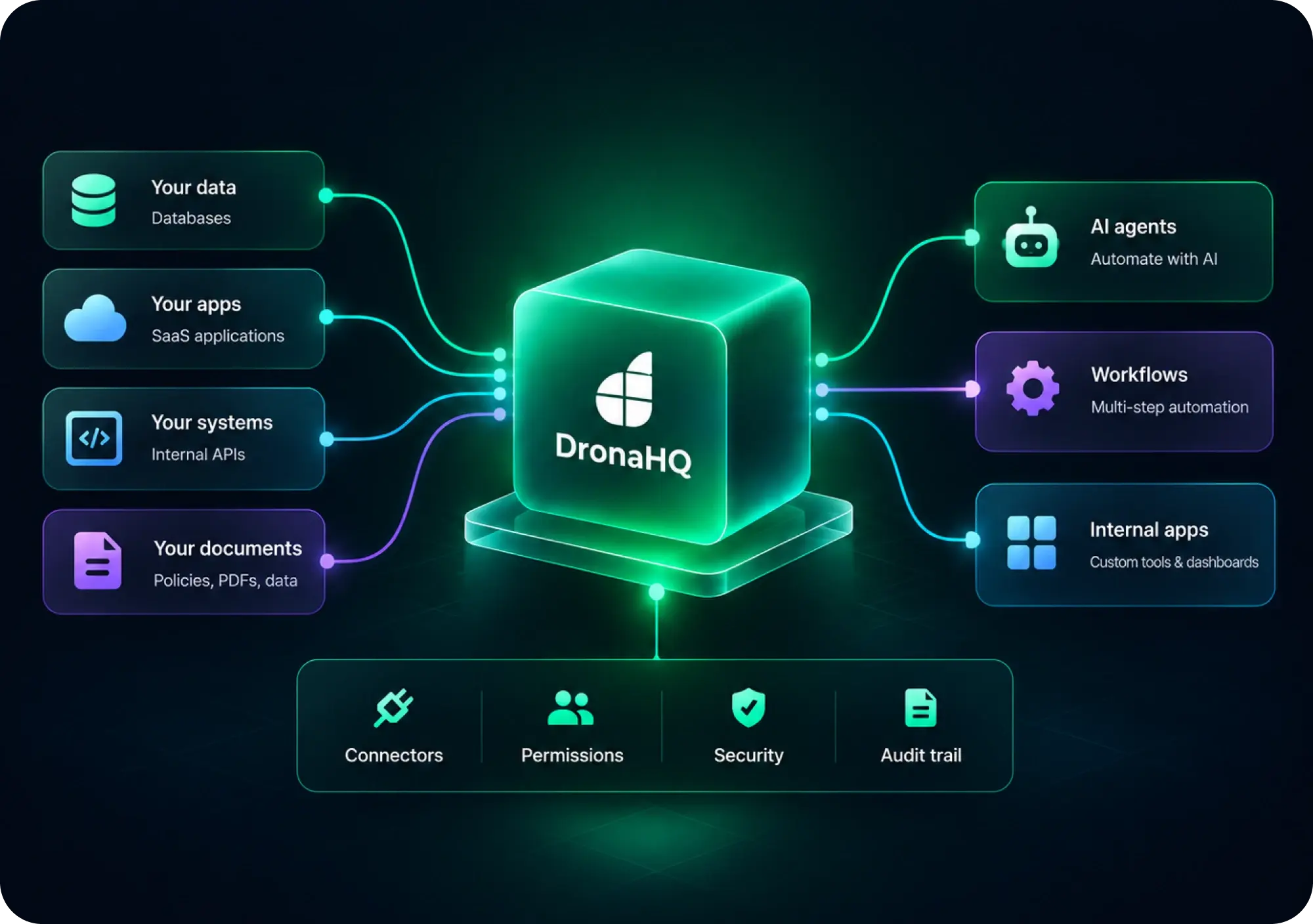
Whatever platform you evaluate, check four things:
Can it connect agents to the systems of record they act on?
Can it route exceptions to a named person, with the context needed to decide?
Does it record what the agent did, so someone can review it?
Can it limit what each agent can read and change?
Related Articles