
Enterprise guide to agentic voice AI: use cases, metrics, and a practical ROI framework
Enterprise interest in voice AI has moved quickly over the past two years, from early pilots to wider production use across customer service, banking, healthcare, and retail. Alongside that growth, the terminology has shifted too. Vendors, analysts, and enterprise teams increasingly use the term “agentic voice AI” to describe a newer category of systems that goes beyond routing calls.
This guide answers the questions enterprise teams are asking as they evaluate this category: what agentic voice AI actually is, why adoption is accelerating now, what these systems can do, and how to think about measuring return on investment.
What is agentic voice AI? Key differences from traditional voice AI
Agentic voice AI refers to voice systems built on large language models that can reason through a conversation, take actions inside backend systems, and complete a task within a single call, rather than simply routing the caller to a person or a recorded response.
Traditional voice AI and IVR systems were built primarily for call routing. A caller states their reason for calling, the system identifies intent using rule-based logic or a basic classifier, and the call is directed to a queue or department. The actual resolution work, such as updating an account or processing a request, has historically required a human agent.
Agentic voice AI combines speech recognition, natural language understanding, planning, and autonomous action to perform tasks across multiple steps or systems with less manual prompting. Rather than only handling the conversation, these systems can authenticate a caller, retrieve account information, apply business logic, and execute a transaction inside the call itself.
The distinction comes down to autonomy. Agentic systems interpret intent, reason through a conversation, and adapt to changing input, while rule-based systems follow fixed scripts and predefined logic. This is a meaningful shift in what the voice channel is expected to do, but it is also a more complex system to build, govern, and measure, which is why evaluation criteria matter as much as the technology itself.
Why enterprise voice AI is taking off in 2026
Enterprise interest in voice AI is accelerating for a combination of reasons: the underlying technology has matured, customer expectations around automated interactions have shifted, and infrastructure for handling enterprise data and compliance requirements has become more standardised.
The technology has matured. Speech recognition models now perform reliably across background noise, accents, and natural interruptions in ways that were not commercially consistent a few years ago. Large language models can reason through multi-step workflows and decide on actions, not just responses. Latency, historically one of the biggest barriers to natural-feeling voice interactions, has also improved meaningfully across vendors.
Adoption is broad-based. Industry surveys report that the large majority of organisations are already using some form of voice AI, with continued spending growth expected over the next year. This reflects voice AI moving from experimentation into mainstream enterprise technology evaluation, alongside other forms of generative and agentic AI.
Analyst forecasts support continued investment. Gartner predicts that by 2029, agentic AI will autonomously resolve 80% of common customer service issues without human intervention, with an associated 30% reduction in operational costs. This is a forward-looking projection rather than a current state of the market, and it is worth treating it as such when setting internal expectations for what a given deployment can realistically achieve today.
Compliance and governance infrastructure has matured alongside the technology. Regulated industries such as banking and healthcare have historically been cautious about voice AI adoption due to data residency, audit trail, and PII handling requirements. Enterprise platforms increasingly ship with these controls as standard capabilities rather than custom engineering work, which has lowered one of the practical barriers to deployment in regulated sectors.
Taken together, these shifts explain why voice AI has moved from a narrow automation tool into a broader enterprise technology category under active evaluation across industries.
Five core capabilities of agentic voice AI
Agentic voice AI systems are generally evaluated across five capabilities. These provide a useful framework for enterprise teams comparing platforms, regardless of vendor.
Listening. Real-time speech processing that handles natural interruptions, picks up conversational context across the full interaction rather than just the most recent utterance, and works reliably across accents and background noise.
Reasoning. Large language models grounded in enterprise-specific knowledge, including policies, customer history, and approved content, rather than generic responses. This grounding is typically achieved through retrieval-augmented generation (RAG) over a company’s own knowledge base.
Acting. Executing verified actions inside backend systems such as CRM, billing, or scheduling platforms, confirmed through an API call rather than simply stated to the caller.
Verifying. Confirming that an action was actually completed before communicating the outcome to the customer. This step matters because earlier-generation systems could tell a customer something was resolved without the underlying system reflecting that change.
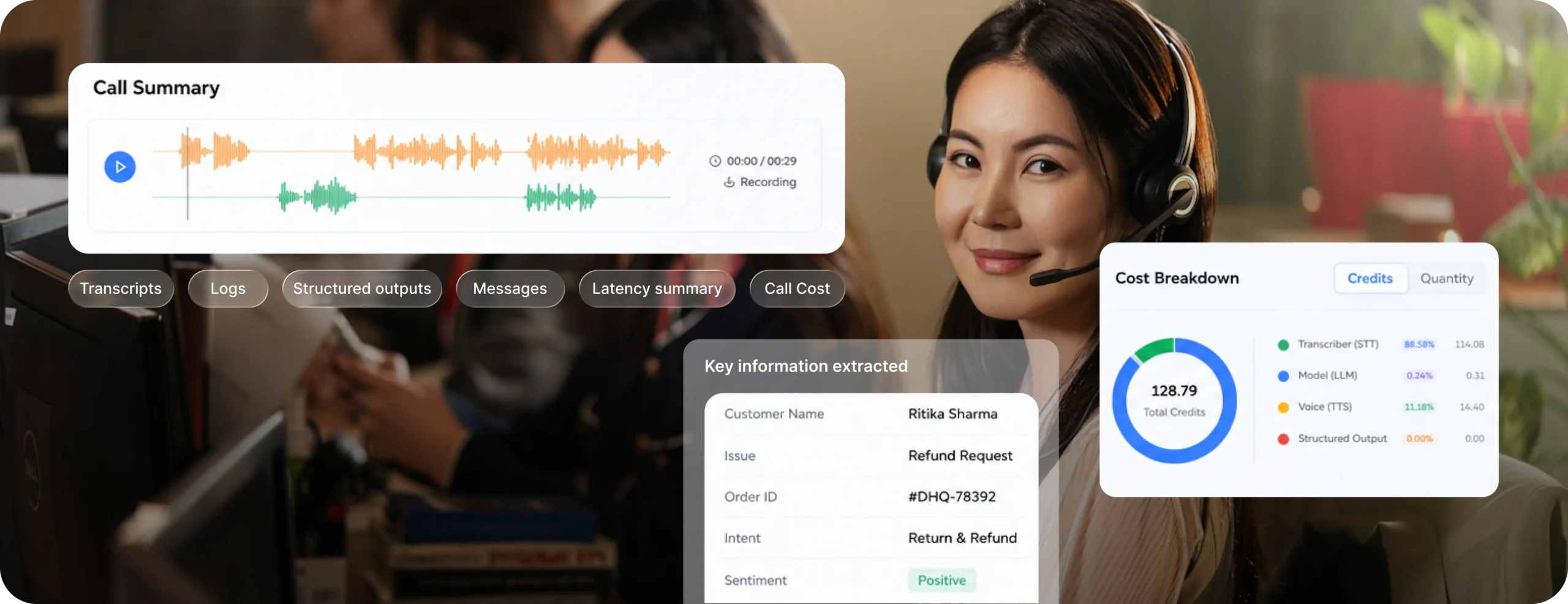
Learning. Every conversation and action is captured in a structured audit log, creating a complete record that serves two purposes. First, it supports compliance and governance, giving enterprise teams a searchable, time-stamped trail of what the AI said, what it did inside backend systems, and when. Second, that same log is the foundation for ongoing improvement: teams can review failure patterns, identify where the AI misclassified intent or failed to complete a step, and feed those insights back into the model or dialog design. A system without comprehensive logging cannot improve reliably and cannot satisfy audit requirements in regulated industries.
A platform that performs well on some of these dimensions but not others is likely to show strong results in pilot testing while struggling at production scale, which is why evaluating all five together is more useful than assessing any single capability in isolation.
How to measure the ROI of enterprise voice AI
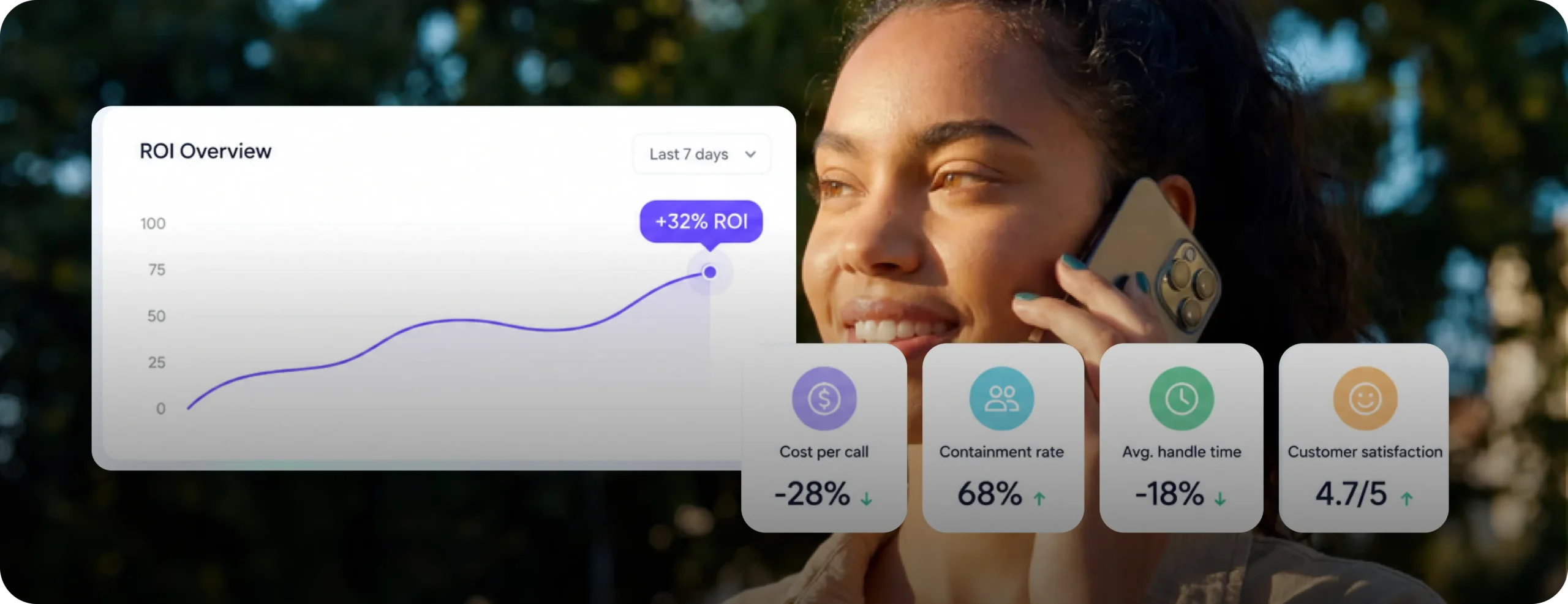
Voice AI ROI is best understood across a small set of categories: operational efficiency, customer experience, agent productivity, and financial outcomes. No single metric captures the full picture, and the metrics that matter will vary somewhat by use case and industry.
Deflection rate
The percentage of total inbound volume fully resolved by the voice AI without any human intervention. Target: above 60% for Tier-1 support. This is the broadest operational indicator of automation coverage and is useful for reporting to business leaders and finance.
Containment rate
The percentage of calls handled by the AI without transferring to a human agent. Enterprise conversational systems generally aim for containment rates in the 70-90% range depending on the use case, while simpler FAQ-style deployments average lower, around 40-60%. Containment is a useful operational metric, but it works best when read alongside resolution-focused metrics like FCR and CSAT rather than as a standalone success indicator.
First call resolution (FCR)
The percentage of calls where the customer’s issue was resolved without needing a follow-up contact. Industry benchmarks for FCR generally sit in the 70-85% range, with high-performing deployments reaching 85% or above. Agentic voice deployments have reported FCR improvements of 5-15 percentage points when the AI ensures every required process step is completed within the first call, which directly reduces the callbacks and transfers that add operational cost.
Average handle time (AHT)
The average duration of a call from initiation to resolution. Production deployments have reported AHT reductions in the range of 20-50%, typically achieved through faster information collection, more accurate routing, and real-time guidance provided to human agents handling complex escalations.
Customer satisfaction (CSAT) and NPS
Post-interaction customer ratings remain one of the clearest indicators of whether automation is actually working for the customer, not just for operational metrics. CSAT should generally be tracked separately for fully-resolved AI interactions versus escalated ones, since blending the two tends to understate performance on calls the AI handled well.
Agent productivity
Beyond direct automation, voice AI affects how human agents work. AI-assisted tools have been associated with reductions in new-hire ramp time of 50-85% in some deployments, as agents are supported with real-time guidance rather than relying entirely on training documentation. This shifts agent time toward more complex, judgment-based interactions where human involvement adds the most value.
Cost per call and financial impact
A Forrester Consulting Total Economic Impact study coFmmissioned by PolyAI found that a composite enterprise organisation achieved a three-year ROI of 391%, with $14.2 million in value generated against $2.9 million in costs, and payback achieved in under six months. It is worth noting this figure reflects a specific vendor-commissioned study with a composite organisation model rather than a universal benchmark, and actual results will vary by deployment scope, call volume, and use case mix.
A practical ROI framework typically follows these steps: establish a baseline cost per call before deployment, identify which call types are realistic candidates for full resolution by AI (not every call driver is), project savings based on containment and resolution rates for those call types specifically, and adjust the calculation for any repeat-call cost if FCR is below the human baseline.
Which industries are evaluating voice AI most actively?
Adoption has concentrated in industries with high call volumes, repeatable transactional workflows, and structured information that lends itself to automation.
Banking, financial services, and insurance. High call volumes combined with well-documented resolution logic make this a common starting point. Typical use cases include balance inquiries, card activation, loan status checks, and policy FAQs, often alongside compliance value from consistent call recording and audit trails.
Healthcare. Use cases span both patient-facing interactions, such as appointment scheduling and prescription refill requests, and clinical workflows like ambient documentation support.
Retail and e-commerce. Common applications include order status, delivery tracking, and returns handling, alongside outbound use cases like promotional or re-engagement campaigns.
Telecommunications. High call volumes combined with predictable diagnostic and billing-related call types make this a natural fit for structured automation, particularly for tier-one technical support triage.
Across these industries, voice AI is generally most effective on high-volume, rules-based interactions, while complex or emotionally sensitive interactions continue to benefit from human judgment. This division of labour, rather than full replacement of either AI or human agents, reflects how most production deployments are currently structured.
Key criteria for evaluating enterprise voice AI platforms
A few evaluation dimensions are consistently useful regardless of vendor or use case.
Integration depth. Whether the platform offers pre-built connectors to core CRM, billing, and back-office systems, or whether every integration requires custom engineering work. This has a direct impact on total cost of ownership and time to deployment.
Knowledge grounding. Whether responses are grounded in a company’s own approved content through retrieval-augmented generation, rather than relying on general-purpose model knowledge that may be inaccurate or outdated for a specific business context.
Analytics and observability. Whether the platform provides visibility into containment, AHT, intent distribution, and failure patterns, ideally with the ability to review individual conversation transcripts. Without this visibility, it becomes difficult to diagnose why a metric is moving in a given direction.
Governance and compliance. Whether the platform includes PII handling controls, audit trails, and documented alignment with relevant frameworks such as SOC 2, HIPAA, or GDPR as standard capabilities rather than custom additions.
A useful practice when evaluating vendors is asking for benchmarks from deployments that resemble your own in scale, industry, and use case complexity, rather than relying on platform-wide averages that may not reflect your specific context.
A few principles for measuring voice AI performance
Establish a baseline before deployment. Recording cost per call, AHT, FCR, and CSAT before launch makes it possible to attribute improvement to the deployment with confidence, rather than estimating retroactively.
Track metrics by call type rather than as a single blended average. A blended containment or FCR rate can obscure meaningful variation between simple, structured call types and more complex ones.
Read operational and experience metrics together. Containment rate, FCR, and CSAT each tell part of the story. Reviewing them together, rather than reporting containment in isolation, gives a more complete and accurate picture of performance.
Treat analyst projections as directional, not as current-state benchmarks. Forward-looking figures, such as Gartner’s 2029 resolution projection, are useful for long-term planning but should be distinguished clearly from what current deployments are achieving today.
What comes next
Enterprise voice AI is still in a phase of active maturation. As large language models continue to improve at multi-step reasoning and tool use, and as enterprise integration and compliance infrastructure becomes further standardised, the range of tasks these systems can reliably complete is likely to expand. Multimodal systems that combine voice with other channels in a single customer journey, and more granular task-completion metrics that go beyond call-level resolution, are reasonable directions for the measurement frameworks used in this space to evolve toward over the next few years.
For enterprise teams currently evaluating this category, starting with well-scoped, high-volume, repeatable use cases, and building a measurement foundation alongside the deployment rather than after it, remains a sound approach regardless of which specific platform or vendor is selected.
FAQs
What is agentic voice? Agentic voice refers to voice systems that complete end-to-end customer tasks, including multi-step actions inside backend systems, without requiring a human agent handoff. It differs from traditional IVR or routing-based voice AI by being able to authenticate, retrieve data, execute transactions, and verify outcomes within a single interaction.
How is agentic voice different from traditional IVR? Traditional IVR routes calls based on menu inputs or basic intent detection but transfers the actual resolution work to a human agent. Agentic voice is designed to complete that resolution work directly, using LLM-based reasoning and API-based actions.
What is a good first call resolution rate for voice AI? Industry benchmarks put FCR in the 70-85% range, with high-performing systems reaching 85% or higher, based on a 48-72 hour verification window.
What ROI should enterprises expect from voice AI? Reported ranges vary by source and deployment maturity, but typical figures cited in industry research fall between 200% and 500% ROI within 3-6 months for well-implemented systems, with some independent studies citing up to 331% three-year ROI.
Which industries are adopting voice AI fastest? Banking and financial services, healthcare, retail and e-commerce, and telecommunications are commonly cited as the leading verticals, largely due to high call volumes and structured, repeatable workflows.
Related Articles